


Fitcart Editorial Team Ritu Makhija.
Estimated reading time: 7–8 minutes.
Why your legs may be one of the most important parts of your health — and why 30 daily squats could be a simple place to start.
We often think about the heart as the body’s great pump.
It beats continuously, sending oxygen-rich blood around the body and helping deliver nutrients while carrying away metabolic waste.
But there is another remarkable system working alongside it — particularly in the lower body.
Your leg muscles help move blood back towards the heart, especially when you are standing or moving around.
This is why the phrase “your legs are your second heart” has become popular in health and fitness circles.
It isn’t literally a second heart. Your leg muscles don’t pump blood as the heart does.
But the comparison highlights something important:
Strong, active legs are closely connected to circulation, mobility, metabolic health and healthy ageing.
And one of the simplest exercises for keeping those muscles active is the humble squat.
Could doing 30 squats a day make a difference?
It can be a useful habit — but the real benefit comes from consistent movement and progressive strength training, rather than a magical number of repetitions.
Why Your Legs Matter So Much
Your legs contain some of the body’s largest muscle groups.
The quadriceps, hamstrings, glutes and calf muscles work together every time you walk, climb stairs, stand up, sit down, run or change direction.
They also provide an important mechanical contribution to blood circulation.
The calf-muscle pump
When you walk or contract your calf muscles, the muscles compress veins in the lower legs.
Because veins contain valves that help prevent blood from flowing backwards, repeated muscle contractions help propel venous blood upwards towards the heart.
This mechanism is often called the skeletal-muscle pump.
It becomes particularly important when you are standing for long periods.
In simple terms:
Move your legs → contract your muscles → help venous blood return towards the heart.
This is one reason prolonged sitting is considered unhealthy and why simply getting up and moving regularly is so important.
Squats: A Small Exercise With a Big Muscle Footprint
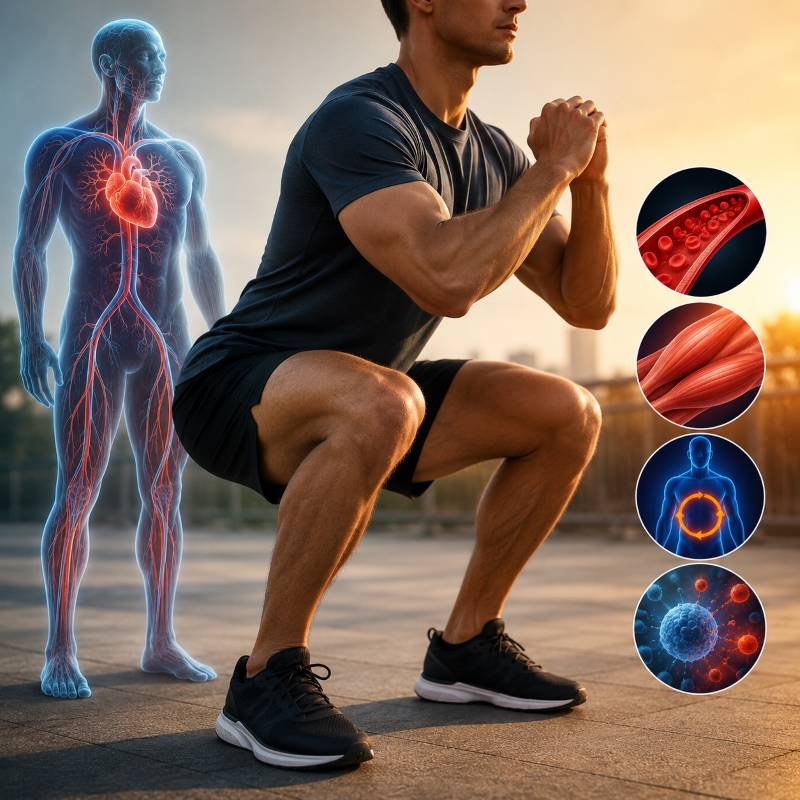
A squat looks simple. You bend your knees and hips, lower your body, and stand back up. But that movement recruits several major muscle groups.
A properly performed bodyweight squat can train:
- Quadriceps
- Glutes
- Hamstrings
- Calves
- Core and trunk stabilisers
It also challenges balance, coordination and lower-body control.
That makes squats particularly useful as a basic functional movement.
Think about everyday life.
Getting out of a chair? Squat pattern.
Getting off the floor? Squat pattern.
Climbing stairs? Your legs need to produce force.
Lifting something from the ground? Your hips and legs are involved.
Maintaining independence as you age? Strong legs become increasingly important.
What Could 30 Squats a Day Do?
30 squats a day isn’t a scientifically established magic dose.
There is no special physiological switch that turns on when you reach repetition number 30. But 30 bodyweight squats can be a practical daily movement target for many healthy adults because they are:
- Equipment-free
- Quick
- Easy to perform almost anywhere
- Scalable
- Useful for maintaining movement consistency
The bigger benefit may be behavioural.
Thirty squats take only a few minutes.
That means they can become an easy reminder to move your body every day.
And consistency is one of the most important principles in fitness.
Your Legs and Metabolic Health
Large muscles are also important from a metabolic perspective.
Skeletal muscle is one of the body’s major tissues responsible for glucose disposal.
When muscles contract during exercise, glucose uptake can increase through pathways that do not rely exclusively on insulin.
Regular resistance exercise can therefore contribute to improved glucose regulation and insulin sensitivity.
This is one reason strength training is increasingly recognised as an important component of metabolic health.
Squats alone won’t transform your metabolism.
But progressively strengthening large muscle groups can become part of a much larger strategy involving:
Resistance training + walking + cardiovascular exercise + adequate protein + good nutrition + quality sleep.
Could Squats Help With Inflammation?
This is where the conversation needs some nuance.
Inflammation isn’t automatically bad.
Acute inflammation is an important part of the body’s normal response to injury and exercise.
The concern is persistent, low-grade systemic inflammation, which is associated with a range of chronic health conditions.
Regular physical activity has been associated with a healthier inflammatory profile.
Exercise can influence several biological pathways involved in inflammation, metabolic health and immune function.
Resistance training, in particular, can contribute to improved body composition, muscle health and metabolic function — all factors that can influence overall health.
But we should not say:
“30 squats reduce inflammation.”
A more scientifically accurate statement is:
Regular physical activity and resistance training can support metabolic health and may contribute to healthier regulation of inflammatory processes.
Thirty squats are one small piece of that picture.
The Muscle–Inflammation Connection
Skeletal muscle isn’t simply tissue that allows us to move.
It is also metabolically active tissue that communicates with other organs through signalling molecules produced during muscle contraction.
These exercise-related signals, sometimes referred to as myokines, are an active area of research.
Regular exercise can influence metabolic, immune and inflammatory pathways.
This is another reason maintaining muscle mass becomes increasingly important as we get older.
The objective isn’t simply to look stronger.
It is to remain physically capable.
Strong Legs Could Mean Better Healthy Ageing
One of the most important reasons to train your legs has nothing to do with aesthetics.
It is independence. Strong lower-body muscles help you:
- Rise from a chair
- Climb stairs
- Walk confidently
- Carry shopping
- Maintain balance
- Get up from the floor
- Participate in sport
- Reduce physical limitations associated with ageing
Muscle mass and strength naturally tend to decline with age if they aren’t actively maintained.
Resistance training is one of the most effective tools we have for combating this decline.
And you don’t necessarily need an expensive gym.
Your own bodyweight provides resistance.
How to Do Your 30 Squats
If you’re new to squats, don’t immediately aim for 30 consecutive repetitions.
Start with a number you can perform with good technique.
Basic bodyweight squat
- Stand with your feet approximately shoulder-width apart.
- Keep your chest comfortably lifted and your spine neutral.
- Brace your abdominal muscles gently.
- Push your hips back and bend your knees.
- Lower yourself only as far as you can comfortably control.
- Keep your feet grounded.
- Drive through your feet to return to standing.
- Repeat with controlled movement.
A simple progression
Instead of immediately doing:
30 squats × 1
you could try:
10 squats × 3 sets
with short rests between sets.
As your strength improves, you can gradually increase repetitions or introduce more challenging variations.
Don’t Chase Repetitions — Chase Quality
Thirty poor-quality squats are not better than ten controlled repetitions.
Your knees, hips, and lower back should feel comfortable throughout the movement.
Avoid bouncing at the bottom or rushing through repetitions.
Control the downward phase.
Maintain stable feet. And breathe naturally.
If you experience pain rather than normal muscular effort, stop and seek appropriate professional guidance.
Want More Than 30 Squats? Progress Gradually
Once bodyweight squats become easy, the body needs a new challenge.
You could progress by adding:
- More repetitions
- More sets
- Slower tempo
- Pause squats
- Split squats
- Step-ups
- Lunges
- Resistance bands
- Dumbbells
- Barbells, under appropriate supervision
This is the principle of progressive overload.
Muscles adapt when they are challenged progressively.
Doing the same 30 repetitions forever may eventually provide less stimulus than it did when you started.
Don’t Forget the Calves
If we’re going to call the legs a “second heart”, the calves deserve special attention.
Walking is an excellent way to repeatedly activate the calf-muscle pump.
You can also include simple calf raises:
Stand tall → rise onto your toes → pause → lower slowly.
Calf raises can be performed almost anywhere and can help maintain lower-leg strength.
For overall circulation and health, however, regular walking and whole-body movement are much more important than any single exercise.
The Fitcart 5-Minute Leg Health Habit
Want to turn the idea into a simple daily routine? Try this:
1 minute — Walk
Get moving and raise your body temperature.
1 minute — Bodyweight squats
Perform controlled repetitions appropriate for your fitness level.
1 minute — Calf raises
Slow, controlled repetitions.
1 minute — Sit-to-stand
Use a chair if necessary and practise controlled movement.
1 minute — Walk again
Finish by moving rather than immediately sitting down.
It isn’t a complete workout. But it is a movement habit.
And movement habits accumulate.
The Bigger Picture: Your Heart Loves Movement
The greatest mistake would be to interpret the “second heart” concept as meaning that squats alone are enough. They’re not.
For cardiovascular and metabolic health, combine resistance exercise with regular aerobic activity.
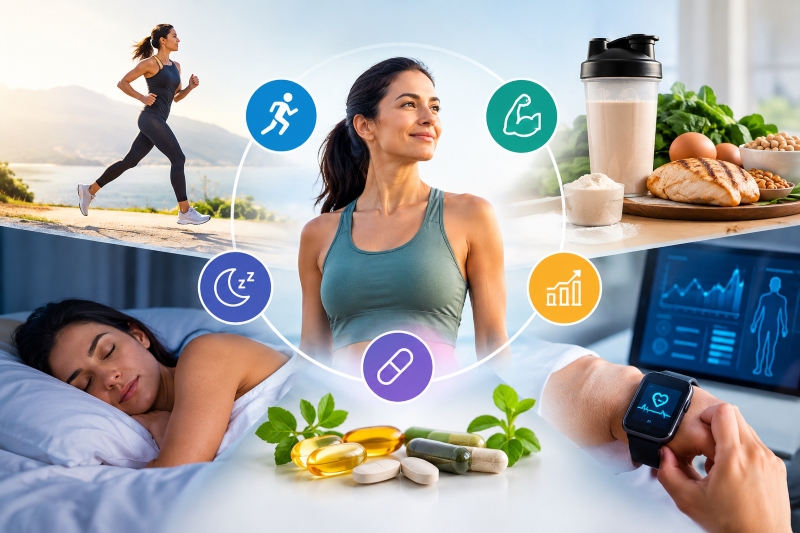
A well-rounded week might include:
- Walking or other aerobic activity
- Strength training 2–3 times per week
- Regular movement throughout the day
- Mobility and balance work
- Adequate protein and nutrient-rich food
- Good hydration
- Quality sleep
This combination is far more powerful than chasing one exercise or one supplement.
Nutrition: Feed the Muscles You’re Building
Exercise creates the stimulus. Nutrition provides the raw materials for adaptation.
Adequate protein is particularly important for maintaining and building muscle.
Good dietary sources include:
- Eggs
- Fish
- Chicken
- Lean meat
- Milk and yoghurt
- Paneer
- Soy
- Lentils
- Beans
- Nuts and seeds
A diet rich in vegetables, fruits, whole grains, legumes and healthy fats also provides fibre, vitamins, minerals and plant compounds that support overall health.
Where supplements may fit
For people who struggle to obtain enough protein through food, a quality protein powder can be a convenient option.
Other supplements such as creatine monohydrate have substantial evidence supporting their role in strength and high-intensity exercise when used appropriately.
Magnesium, omega-3 and other nutritional supplements may be useful when dietary intake or individual requirements justify them.
But supplements should support the foundation — they don’t replace movement, food or recovery.
So, Are Your Legs Really Your Second Heart?
Not literally. Your heart is still the organ responsible for pumping blood throughout your circulatory system.
But your legs — particularly your calf muscles — provide an important skeletal-muscle pump that assists venous blood return.
And your larger leg muscles play a major role in:
- Movement
- Strength
- Glucose metabolism
- Physical independence
- Exercise capacity
- Healthy ageing
That makes the phrase “second heart” a useful reminder of just how important our legs are.
The Fitcart Bottom Line
You don’t need an elaborate exercise routine to start taking better care of your legs.
Start with movement.
Walk.
Climb stairs.
Stand up regularly.
Strengthen your legs.
And if 30 controlled bodyweight squats fit your current fitness level, they can be a simple daily habit. But don’t become obsessed with the number.
Thirty good squats are better than thirty rushed squats — and a consistent strength-training programme is better than relying on 30 squats alone.
Your legs aren’t just there to carry you around.
They are some of the most metabolically active and functionally important muscles in your body.
Train them. Fuel them. Move them. Keep them strong.
Your future self may thank you for it.
Health & Information Disclaimer
This article is intended for general educational and informational purposes only. It is not medical advice and should not be used to diagnose, treat, cure or prevent any disease, injury or medical condition.
The phrase “legs are your second heart” is a metaphor describing the role of skeletal-muscle contractions, particularly the calf-muscle pump, in supporting venous blood return. The legs are not a second heart and do not perform the same function as the cardiac muscle.
The potential health benefits of squats and physical activity vary between individuals. Thirty squats per day is not a medically established dose or requirement and should not be interpreted as a guaranteed method for reducing inflammation, improving circulation, losing weight or preventing disease.
Anyone with existing cardiovascular disease, significant joint problems, recent surgery or injury, unexplained leg swelling or pain, or other medical concerns should seek advice from a qualified healthcare professional before starting or changing an exercise programme.
Stop exercising and seek appropriate medical attention if you experience unusual chest pain, severe breathlessness, fainting, significant dizziness or unexplained severe pain.
Fitcart Supplement Disclaimer
Supplements are intended to complement a balanced diet and healthy lifestyle and are not substitutes for nutritious food, exercise, adequate sleep or medical treatment.
Protein, creatine, magnesium, omega-3 and other supplements may be useful for some individuals but are not necessary or appropriate for everyone.
Always follow the manufacturer’s recommended serving instructions and consult a qualified healthcare professional before using supplements if you have a medical condition, take medication, are pregnant or breastfeeding, or have specific nutritional concerns.
For athletes subject to anti-doping regulations, choose supplements carefully and, where possible, select products that have undergone appropriate independent batch testing and banned-substance certification.
Fitcart recommends choosing supplements that are batch tested and verified for content and quality, and checking where raw materials are produced and where the finished product is manufactured and packaged.
Follow us on X: https://x.com/fitcartofficial and Instagram: https://www.instagram.com/fitcartofficial/ for the latest updates, health insights, and exclusive content.
Follow Smart Nutrition India X: https://x.com/SmartNutrition1 and Instagram: https://www.instagram.com/smartnutritionindia/ for trusted sports nutrition, supplement education, wellness tips, and the latest news from the world of health and performance.
Fitcart believes in True Play and Clean Sport
#trustedbrandsbetterhealth