


Reading time: 8–10 minutes.
Author: Ritu Makhija.
CEO, Fitcart.com.
Co-Founder, Smart Nutrition India.
Head of Editorial Team, Fitcart Blog.
Introduction: Could Simply Walking with Weights Be One of the Most Effective Functional Exercises?
What if one of the most effective additions to your fitness routine involved nothing more complicated than picking up two weights and walking?
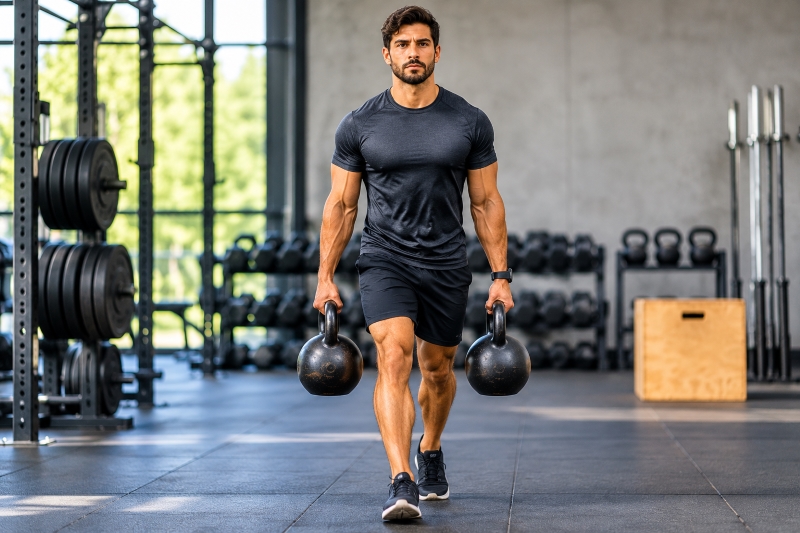
The Farmer’s Walk, also known as the Farmer’s Carry, is a deceptively simple strength-training exercise that is gaining attention among fitness enthusiasts, athletes, coaches, and strength-conditioning professionals.
The concept is straightforward: pick up a weight in each hand, stand tall, engage your core and walk while maintaining control and posture.
But beneath this simple movement lies a surprisingly demanding physical challenge.
Unlike exercises that isolate a particular muscle group, loaded carries require several parts of the body to work together. Your hands must maintain their grip, your shoulders and upper back must stabilise the load, your core must resist unwanted movement, and your legs must support and propel your body forward.
The result is an exercise that combines strength, muscular endurance, coordination, balance and locomotion.
Could this be one of the most time-efficient exercises to include in a strength-training programme?
Let’s explore what the science says, which muscles are involved, how to perform it correctly, and how nutrition and supplementation can support your results.
1. What Is the Farmer’s Walk?
The Farmer’s Walk is a loaded carry exercise traditionally inspired by the physical demands of farmers carrying heavy objects over distances.
In modern fitness, it is performed using:
- Dumbbells.
- Kettlebells.
- Trap bars.
- Specialised farmer’s carry handles.
The exercise involves lifting weights from the floor or a suitable rack, holding them at your sides and walking a controlled distance without losing posture.
It may look easy, but the challenge increases as the load, distance or duration increases.
The exercise requires your body to manage external resistance while moving naturally.
This makes it particularly interesting for functional fitness, athletic conditioning and general strength development.
2. What Muscles Does the Farmer’s Walk Activate?
One of the most interesting features of loaded carries is that they challenge several muscle groups simultaneously.
A. Grip and Forearm Muscles
Your hands and forearms must maintain a continuous grip on the weights throughout the exercise.
This challenges grip strength and muscular endurance.
Grip strength is important not only for lifting weights but also for everyday activities such as carrying shopping bags, opening jars, holding objects and maintaining independence as we age.
B. Core and Abdominal Muscles
Your abdominal muscles and obliques help stabilise the trunk while you walk.
The core works to resist excessive movement, including unwanted rotation and side bending.
This makes the Farmer’s Walk a useful dynamic core-stability exercise.
C. Back and Spinal Stabilising Muscles
The erector spinae, multifidus and other trunk muscles help maintain an upright position against the external load.
The upper back and trapezius muscles also contribute to shoulder-girdle stability.
D. Shoulders and Upper Body
The deltoids and surrounding shoulder stabilisers help maintain arm position and control the weights.
The upper body must remain stable while the lower body continues moving.
E. Glutes and Leg Muscles
Your lower body is responsible for supporting your weight and moving you forward.
Muscles involved include:
- Gluteus maximus and gluteus medius.
- Quadriceps.
- Hamstrings.
- Calves.
- Other muscles involved in ankle and hip stability.
The combination of muscular activity across the upper body, trunk and lower body makes this a genuinely integrated movement.
3. What Does the Research Actually Show?
A particularly interesting scientific paper published in the International Journal of Exercise Science in 2024 investigated muscle activation during loaded carry exercises.
The study, titled The Quantification of Muscle Activation During the Loaded Carry Movement Pattern, compared different forms of loaded carries and holds with the plank.
Researchers examined the activity of four trunk muscle groups:
- Rectus abdominis.
- External obliques.
- Longissimus.
- Multifidus.
Using electromyography (EMG), researchers measured electrical activity associated with muscle activation.
The study found that the Farmer’s Carry produced greater activation in the measured trunk muscles than the corresponding Farmer’s Hold.
This is an important finding because it suggests that walking while carrying weights creates additional muscular demands compared with simply holding weights in a stationary position.
The researchers also found that unilateral suitcase carries produced distinctive patterns of trunk muscle activation.
However, there are important limitations.
The study involved only 18 healthy, college-aged participants and examined selected trunk muscles rather than every muscle in the body. It did not establish that the Farmer’s Walk activates more muscles than every other exercise or that it produces superior long-term muscle growth.
Nevertheless, it provides useful evidence supporting the role of loaded carries in strength and conditioning programmes.
The takeaway: The Farmer’s Walk is an effective way to challenge trunk stabilisation while combining grip strength, upper-body stability and walking.
4. Why Loaded Carries Are So Valuable for Functional Fitness
Functional fitness is about developing strength and physical abilities that transfer into everyday movement and activities.
Think about the physical demands of:
- Carrying heavy shopping bags.
- Lifting and moving luggage.
- Carrying children.
- Moving household objects.
- Walking while carrying equipment.
- Maintaining balance while handling external loads.
These activities involve more than isolated muscle strength. They require coordination between the hands, arms, shoulders, core and legs.
Loaded carries train some of these same movement demands.
The benefits of incorporating loaded carries
1. Grip strength
Improves the ability to hold and control external loads.
2. Core stability
Challenges the abdominal and spinal stabilising muscles while the body moves.
3. Postural control
Encourages the development of strength and coordination required to maintain an upright position under load.
4. Muscular endurance
Requires muscles to sustain tension over a period of time.
5. Functional strength
Develops the ability to move while carrying external resistance.
6. Coordination and balance
Requires controlled movement and stabilisation with every step.
7. Athletic conditioning
Can be incorporated into sports conditioning programmes to challenge strength and work capacity.
Importantly, these benefits depend on appropriate loading, training consistency and correct technique.
5. How to Perform the Farmer’s Walk Correctly
You do not need complicated equipment to get started.
A pair of dumbbells or kettlebells is sufficient.
Step-by-step technique
Step 1: Choose your weights
Start with a manageable weight that allows you to maintain good posture throughout the exercise.
Step 2: Lift safely
Stand between the weights, bend through your hips and knees, keep your spine controlled and lift the weights using your legs and hips.
Step 3: Stand tall
Keep your chest comfortably lifted, shoulders stable and arms extended naturally at your sides.
Step 4: Engage your core
Brace your abdominal muscles gently as though preparing for a light impact.
Avoid holding your breath.
Step 5: Start walking
Take controlled steps while maintaining an upright position.
Avoid leaning forward, shrugging excessively or allowing the weights to swing.
Step 6: Complete your distance
Walk a predetermined distance or for a controlled duration.
Step 7: Put the weights down safely
Bend through your hips and knees and lower the weights under control.
How much should you do?
For beginners:
- 2–3 sets.
- 15–20 metres per set, or a manageable 15–30 seconds.
- Light to moderate weights.
- Adequate rest between sets.
As strength improves, gradually increase the load, distance or duration.
Quality of movement should always take priority over lifting heavier weights.
6. Four Variations of Loaded Carries to Challenge Different Muscles
The Farmer’s Walk is only one version of loaded carry training.
Different variations create different stability and loading demands.
1. Farmer’s Carry
Focus: Grip strength, trunk stability, upper back and general functional strength.
2. Suitcase Carry
Hold one weight in one hand and walk without allowing your body to lean towards the weighted side.
Focus: Core stability, obliques, and resistance to lateral bending.
3. Overhead Carry
Hold a suitable weight overhead while walking with controlled shoulder and trunk positioning.
Focus: Shoulder stability, core control, and coordination.
This is a more demanding variation and requires adequate shoulder mobility and control.
4. Front Rack Carry
Hold kettlebells or dumbbells in the front rack position while walking.
Focus: Upper-body stability, trunk control, and muscular endurance.
These variations add variety to a training programme, but they aren’t interchangeable in terms of loading and difficulty.
7. Can the Farmer’s Walk Help Build Muscle?
Yes, loaded carries can contribute to strength development and muscular conditioning.
However, it is important to understand the distinction between muscle activation and muscle growth.
Muscle activation refers to the electrical activity associated with muscle recruitment during an exercise.
Muscle hypertrophy, or muscle growth, is a longer-term adaptation influenced by progressive resistance training, sufficient training volume, recovery, and nutrition.
A high level of muscle activation during one exercise does not automatically mean that it will produce the greatest muscle growth.
For optimal muscle development, loaded carries should complement rather than replace exercises such as:
- Squats.
- Deadlifts.
- Lunges.
- Chest presses.
- Rows.
- Pull-downs.
- Shoulder presses.
The most effective programmes use a variety of movements to challenge different muscle groups through appropriate ranges of motion.
The 2026 American College of Sports Medicine position stand reinforces the importance of regular resistance training, individualised programming and training all major muscle groups at least twice weekly.
The central message is that consistency and progressive effort matter more than chasing one supposedly perfect exercise.
8. Why Grip Strength and Muscle Preservation Matter as We Age
Grip strength is an interesting measure of physical function.
Research has associated lower grip strength with poorer health outcomes and increased risk of functional limitations in older populations.
However, grip strength is not a standalone diagnostic test or a guarantee of longevity.
As we age, maintaining muscle strength, mobility and physical independence becomes increasingly important.
For women approaching and going through menopause, this is particularly relevant.
Changes in oestrogen levels, ageing and reduced physical activity can contribute to declining muscle and bone health.
A well-designed resistance-training programme can help maintain muscle mass, strength and physical function.
Loaded carries are particularly useful as one component of this programme because they combine gripping, stabilisation and locomotion.
For adults over 40, 50 and beyond, the objective should not simply be to lift heavier weights. It should be to remain strong, mobile, balanced and physically capable throughout life.
9. Nutrition: What Should You Eat to Support Strength and Muscle Recovery?
Exercise provides the stimulus for adaptation, but nutrition supplies the building blocks.
Without sufficient protein, energy and recovery, it becomes harder to achieve the desired training adaptations.
Protein: The Foundation of Muscle Recovery
Protein provides amino acids required for muscle repair and growth.
Useful sources include:
- Eggs.
- Fish.
- Chicken.
- Lean meat.
- Greek yoghurt.
- Milk and cottage cheese.
- Soy and tofu.
- Lentils and beans.
- Whey and plant protein powders.
For many physically active adults, approximately 1.4–2.0 grams of protein per kilogram of body weight daily can be a useful evidence-based range, adjusted for individual requirements and health status.
Distributing protein across meals can also help support muscle protein synthesis.
Carbohydrates: Fuel Your Training
Carbohydrates provide an important source of energy, particularly during higher-volume training.
Include:
- Oats.
- Brown rice.
- Whole grains.
- Potatoes.
- Sweet potatoes.
- Fruits.
- Legumes.
There is no need to eliminate carbohydrates to develop strength or maintain a healthy body composition.
Healthy Fats
Include omega-3-rich foods and other sources of unsaturated fats.
Good options include:
- Fatty fish.
- Walnuts.
- Chia seeds.
- Flaxseeds.
- Almonds.
- Olive oil.
A balanced diet supports overall health and provides the nutrients required for training and recovery.
10. Supplements That Can Support Strength and Performance
At Fitcart, we believe supplementation should be based on scientific evidence, individual nutritional needs and product quality.
Here are some ingredients worth considering.
1. Creatine Monohydrate
Creatine is one of the most extensively researched ingredients in sports nutrition.
It supports the phosphocreatine energy system, which helps regenerate ATP during short-duration, high-intensity exercise.
Research supports creatine supplementation, alongside resistance training, for improving strength and lean mass in many exercising populations.
It can be particularly relevant for people incorporating strength training and functional exercises into their routines.
A commonly studied maintenance intake is 3–5 grams daily.
Creatine is not a substitute for training and does not independently build muscle without an appropriate exercise stimulus.
2. Whey Protein
Whey provides all nine essential amino acids and is a convenient source of high-quality protein.
It can be useful following resistance training or whenever additional dietary protein is needed.
Whey concentrate and whey isolate differ in their protein concentration and lactose content.
People with milk protein allergies should avoid whey products.
3. Plant Protein
For those following vegetarian or vegan diets, plant protein powders can help meet daily protein requirements.
Soy, pea and blended plant proteins can provide useful amounts of essential amino acids.
Look at the actual protein content per serving and the overall amino acid profile.
4. Omega-3
EPA and DHA contribute to normal cardiovascular function.
Omega-3 supplementation may be useful for people who do not regularly consume oily fish, although it should not be presented as a guaranteed muscle-building supplement.
5. Electrolytes
For individuals exercising in hot environments or undertaking prolonged, sweaty training sessions, electrolyte replacement may be useful.
Sodium and other electrolytes help maintain fluid balance and normal muscle and nerve function.
Not everyone requires an electrolyte supplement for a short workout.
11. The Importance of Choosing Clean, Batch-Tested Sports Nutrition
Performance and health go hand in hand with supplement quality.
A product may have attractive marketing and an impressive ingredient list, but consumers should also consider manufacturing standards, ingredient transparency and testing.
At Fitcart, our focus is on connecting Indian consumers with trusted international health, fitness and sports nutrition brands.
When choosing supplements, consider:
- Clearly declared ingredients and dosages.
- Transparent product labelling.
- Manufacturing quality and traceability.
- Batch-specific testing where available.
- Independent third-party certification.
- Product authenticity and verification.
For competitive athletes, programmes such as Informed Sport, NSF Certified for Sport, HASTA and BSCG provide additional testing assurance for products within their respective certification scopes.
Always verify the specific product and batch against the certifier’s database.
Fitcart’s Check My Supplement platform helps consumers check supplement authenticity using available product information.
Visit: https://www.fitcart.com/check-my-supplement
Science and Evidence-Based Formulas. Clean and Transparent Ingredients. Athlete-Tested and Trusted by the World’s Best.
12. A Simple Weekly Functional Strength Training Plan
Here is an example of how to incorporate loaded carries into a balanced fitness programme.
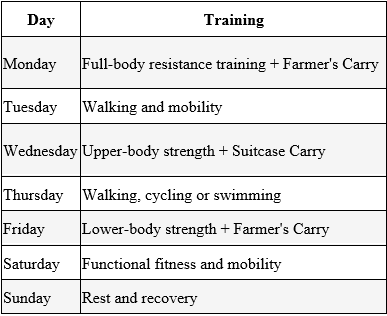
For beginners, start with two strength-training sessions per week and introduce carries using light weights.
Progress according to your ability, recovery and training experience.
The Fitcart Takeaway: Train Your Body to Be Strong for Life
The Farmer’s Walk is a simple but effective functional exercise that challenges the body to work as an integrated system.
It combines grip strength, core stability, upper-body control, lower-body movement and muscular endurance.
While it is not a replacement for a complete resistance-training programme, it is a valuable addition to one.
Whether your goal is athletic performance, better functional fitness, muscle preservation, improved strength or healthy ageing, the principle remains the same:
Build strength. Move consistently. Eat well. Recover properly.
At Fitcart, we believe fitness is not just about how much weight you can lift or how you look. It is about developing the strength, mobility and resilience to perform better in sport and everyday life.
Fitcart – Fuel Your Health. Build Your Strength. Perform Better.
Health, Fitness and Supplement Disclaimer
This article is intended for general educational and informational purposes only. It does not constitute medical advice, diagnosis or treatment.
Exercise suitability varies according to age, fitness level, injury history and individual health conditions. Loaded carries can place considerable demands on grip, shoulders, spine and lower-body joints. Begin with manageable loads and prioritise correct technique. Seek guidance from a qualified fitness professional where necessary.
People with existing musculoskeletal injuries, cardiovascular conditions, balance problems or other relevant medical concerns should consult an appropriate healthcare professional before beginning a new exercise programme.
Nutritional and supplement requirements vary between individuals. Supplements are not substitutes for a balanced diet, appropriate exercise or medical care. Consult a qualified healthcare professional before supplementation, particularly if you have a medical condition or take medication.
Third-party supplement testing can reduce, but cannot eliminate, contamination risks. Competitive athletes should verify product and batch certification and remain responsible for compliance with applicable anti-doping rules.
Follow us on X: https://x.com/fitcartofficial and Instagram: https://www.instagram.com/fitcartofficial/ for the latest updates, health insights, and exclusive content.
Follow Smart Nutrition India X: https://x.com/SmartNutrition1 and Instagram: https://www.instagram.com/smartnutritionindia/ for trusted sports nutrition, supplement education, wellness tips, and the latest news from the world of health and performance.
Fitcart believes in True Play and Clean Sport
#trustedbrandsbetterhealth