



Fitcart Editorial Team Ritu Makhija.
Estimated reading time: 8–10 minutes.
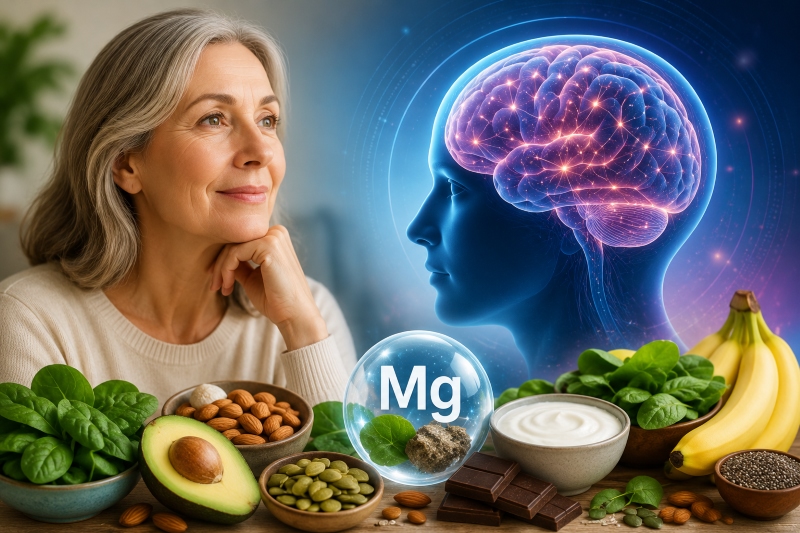
New research highlights a fascinating connection between magnesium intake, brain volume, inflammation and healthy ageing.
When we think about magnesium, we often associate it with muscles, sleep, stress or recovery. But this essential mineral may have another important role to play — brain health.
Research is increasingly examining whether adequate magnesium intake is associated with healthier brain structure and cognitive ageing.
One particularly interesting study involving more than 6,000 adults found that higher dietary magnesium intake was associated with larger brain volumes, including grey matter and hippocampal volume. The associations were particularly notable in women.
A later study from the same research group found that higher dietary magnesium intake was also associated with lower levels of several inflammatory markers and larger grey-matter and white-matter volumes. The researchers suggested that lower inflammation may partly explain the relationship between magnesium intake and brain structure.
So, could magnesium be one of the nutritional pieces that helps support healthy brain ageing? The science is promising — but there is an important distinction between an association and proof of cause and effect. Let’s look at what we know.
Why Magnesium Matters to the Brain
Magnesium is an essential mineral involved in hundreds of biochemical processes throughout the body. The brain is no exception.
Magnesium participates in processes involved in:
- Nerve signalling
- Energy production
- Muscle and nerve function
- Cell metabolism
- Maintaining normal neurological function
- Regulation of excitatory signalling
- Blood vessel function
- Metabolic health
The brain requires enormous amounts of energy to function continuously.
It therefore depends on efficient cellular energy production, adequate blood supply and carefully regulated communication between nerve cells.
Magnesium contributes to several of these fundamental biological processes.
This is one reason researchers are interested in whether adequate magnesium status could be relevant to long-term brain health.
The Study That Put Magnesium and Brain Volume in the Spotlight
A 2023 study published in the European Journal of Nutrition examined data from 6,001 UK Biobank participants aged 40–73.
Researchers assessed dietary magnesium intake and used brain imaging data to examine brain volumes and white-matter lesions.
Higher baseline dietary magnesium intake was associated with larger:
- Overall grey-matter volume
- Left hippocampal volume
- Right hippocampal volume
The hippocampus is particularly important because it plays a central role in learning and memory.
But the most interesting aspect of the research was the difference observed between men and women.
Why Women May Be Particularly Interesting
The study found notable sex differences in the relationship between magnesium intake and brain structure.
Among women, participants whose magnesium intake followed a higher-but-decreasing trajectory had larger grey-matter and right hippocampal volumes compared with the stable-normal group.
Conversely, the low-increasing magnesium trajectory was associated with smaller brain volumes and larger white-matter lesion volumes.
The researchers also reported that the apparent neuroprotective association of higher magnesium intake was greater in post-menopausal women than pre-menopausal women.
This is particularly interesting because women’s brain health changes across the lifespan are influenced by several factors, including ageing and hormonal changes around menopause.
However, the findings should not be interpreted as proof that magnesium prevents brain ageing after menopause.
They are an important association that warrants further research.
What Does “Larger Brain Volume” Actually Mean?
Brain volume is not a simple measure of intelligence.
A larger brain volume does not automatically mean someone has better memory, higher intelligence, or a lower risk of dementia.
As we age, some degree of brain-volume reduction is normal.
Researchers therefore study brain volume as one marker of brain structure and ageing, alongside cognition, white-matter changes, vascular health and other measures.
The magnesium research is interesting because higher intake was associated with larger volumes in several brain regions.
But that doesn’t mean magnesium is a guaranteed way to “grow your brain.”
Instead, it suggests that maintaining adequate magnesium intake may be part of a broader nutritional pattern associated with healthier brain structure.
The Hippocampus: A Particularly Important Brain Region
The hippocampus is a small structure deep within the brain. Despite its size, it plays a major role in:
- Memory formation
- Learning
- Spatial navigation
- Information processing
The hippocampus is also one of the brain regions researchers frequently examine when investigating ageing and neurodegenerative conditions.
The association between magnesium intake and hippocampal volume is therefore particularly interesting.
In the UK Biobank study, higher dietary magnesium was associated with larger left and right hippocampal volumes. Again, this is an association — not proof that magnesium supplementation will increase hippocampal size.
Magnesium, Inflammation and the Brain
Another fascinating piece of the puzzle is inflammation. The brain doesn’t operate independently from the rest of the body.
Metabolic health, cardiovascular health, immune signalling and inflammatory processes can all interact with brain health.
A 2024 study examined dietary magnesium intake alongside inflammatory markers and brain measurements.
Higher magnesium intake was associated with lower levels of:
- High-sensitivity C-reactive protein (hs-CRP)
- White blood cell count
- Glycoprotein acetylation (GlycA)
It was also associated with larger grey-matter and white-matter volumes and larger right hippocampal volume.
Interestingly, the researchers found evidence that lower hs-CRP partially mediated the association between higher magnesium intake and larger grey-matter volume.
Magnesium → healthier inflammatory profile → potentially healthier brain structure.
But this remains a research hypothesis rather than a proven chain of cause and effect.
Magnesium and Cognitive Health: What Else Does the Research Show?
The evidence isn’t limited to brain imaging.
A 2024 systematic review and meta-analysis examined research on magnesium and cognitive health in adults. It included three randomised controlled trials and 12 cohort studies.
The authors concluded that evidence from the limited number of randomised trials was insufficient to determine whether magnesium supplementation improves cognitive outcomes.
The observational studies showed some associations between magnesium and cognitive health, but results were not completely consistent.
This distinction is extremely important.
Association does not equal causation.
People who consume more magnesium may also have healthier overall diets, exercise more, consume more vegetables and whole grains, have better cardiovascular health or differ in other lifestyle factors.
Researchers attempt to adjust for many of these variables, but observational studies cannot eliminate every possible confounding factor.
What About Older Women?
Another study published in Nutritional Neuroscience examined dietary magnesium intake and cognitive impairment in adults aged 55 and older in northern China.
The researchers included 612 participants, including 352 women.
Higher dietary magnesium intake was associated with lower odds of certain forms of mild cognitive impairment, particularly among women.
Again, the authors concluded that adequate magnesium intake may have a protective effect in older women.
The wording matters.
It is not:
“Magnesium prevents dementia.”
It is:
“Adequate magnesium intake is associated with better cognitive outcomes in this population.”
That is a much more scientifically responsible interpretation.
Why Might Magnesium Matter More During Midlife and Beyond?
Midlife is an important period for long-term health.
For women, the menopausal transition brings substantial biological changes, including changes in hormonal patterns.
Brain health during and after menopause is therefore receiving increasing research attention.
Studies examining menopause and brain structure have reported differences in regions including the frontal and temporal cortices and hippocampus.
This does not mean magnesium specifically prevents menopause-related brain changes.
Rather, it reinforces the importance of nutritional adequacy, exercise, sleep, cardiovascular health and metabolic health during this stage of life.
Magnesium is one part of that picture.
Food First: Where Do You Get Magnesium?
Magnesium is naturally present in many nutrient-dense foods. Excellent sources include:
Nuts and seeds
- Almonds
- Cashews
- Pumpkin seeds
- Chia seeds
- Sesame seeds
Whole grains
- Oats
- Whole-wheat products
- Brown rice
- Quinoa
Legumes
- Lentils
- Chickpeas
- Beans
Vegetables
- Spinach
- Other leafy greens
- Avocado
Other sources
- Dark chocolate with a high cocoa content
- Certain fish
- Dairy and other foods in smaller amounts
A diet containing a variety of whole foods can make a significant contribution to magnesium intake.
Why Magnesium Status Can Be Complicated
Getting enough magnesium isn’t simply about how much you consume.
Absorption and magnesium status can be influenced by a number of factors.
Dietary pattern, gastrointestinal health, kidney function, medications, and overall nutritional status can all matter.
This is why simply taking increasingly large doses of magnesium isn’t necessarily the answer.
More is not always better.
The goal is adequacy, not excessive intake.
Magnesium Supplements: Does the Form Matter?
Magnesium supplements come in several forms. Common examples include:
- Magnesium glycinate
- Magnesium citrate
- Magnesium malate
- Magnesium oxide
Different forms provide different amounts of elemental magnesium and can differ in absorption and gastrointestinal tolerance.
For Fitcart customers, an important point is:
Don’t compare supplements simply by the size of the magnesium compound on the front of the label.
Look for the actual amount of elemental magnesium provided per serving.
Also consider:
- Ingredient transparency
- Manufacturing standards
- Batch testing
- Quality verification
- Third-party testing where appropriate
- Clear serving information
Magnesium, Stress and Sleep: The Bigger Picture
Magnesium has already attracted significant interest for stress, relaxation and sleep.
This makes the brain-health conversation even more interesting.
Poor sleep, chronic stress, inactivity and poor metabolic health can all influence long-term wellbeing.
A healthy lifestyle therefore needs to address the whole system.
Think:
- Magnesium-rich nutrition
- Regular exercise
- Strength training
- Good sleep
- Stress management
- Cardiovascular health
- Healthy metabolic function
rather than looking for one “brain supplement.”
Exercise Is Brain Nutrition Too
If you’re serious about healthy brain ageing, don’t stop at supplements.
Physical activity is one of the most powerful lifestyle tools available.
Walking, aerobic exercise and resistance training support cardiovascular health and metabolic function and are associated with benefits for brain health and cognition.
Strength training also helps preserve muscle mass as we age.
That matters because healthy ageing isn’t just about keeping your brain functioning well.
It’s about maintaining the ability to move, think, work, socialise and remain independent.
Don’t Forget Omega-3, Protein and Overall Nutrition
Magnesium is one nutrient. The brain requires many nutrients to function normally.
A brain-supportive dietary pattern can include:
Protein for maintaining body tissues and supporting normal physiological function.
Omega-3 fatty acids from foods such as oily fish.
Fibre from vegetables, fruits, whole grains and legumes.
Polyphenols and other plant compounds from colourful fruits and vegetables.
Micronutrients from a diverse diet.
And, importantly:
Adequate calories and hydration.
Healthy brain ageing is unlikely to be determined by a single nutrient.
The Fitcart Approach: Think “Brain Longevity,” Not “Brain Hacks”
The supplement industry can sometimes make healthy ageing sound like a simple equation:
Take one ingredient → get one result.
Human biology isn’t that simple.
The magnesium research is exciting precisely because it points towards a broader concept:
Nutritional adequacy may be part of maintaining brain structure and function as we age.
For Fitcart customers, that means thinking beyond a single capsule. Build a strong foundation:
- Eat well.
- Move regularly.
- Strength train.
- Sleep properly.
- Manage stress.
- Maintain cardiovascular health.
- Get adequate nutrients.
- Use supplements intelligently when appropriate.
That is a much more sustainable approach to brain longevity.
The Bottom Line
Higher magnesium intake has been associated with larger brain volumes and healthier brain markers, and some research suggests the relationship may be particularly relevant in women.
The UK Biobank research found associations between higher dietary magnesium intake and larger grey-matter and hippocampal volumes, with notable sex differences.
Further research found associations between higher magnesium intake, lower inflammatory markers and larger brain volumes.
Research in older adults has also suggested a possible relationship between adequate magnesium intake and lower risk of certain forms of cognitive impairment, particularly among women.
But the evidence does not yet establish that taking magnesium supplements will slow brain ageing or prevent dementia.
What we can say with greater confidence is that magnesium is an essential nutrient and that maintaining adequate intake is an important part of a healthy diet.
And when combined with exercise, quality sleep, good nutrition, cardiovascular health and stress management, adequate magnesium intake may form part of a much bigger strategy for healthy ageing — from the body to the brain.
Fitcart’s Magnesium Checklist
If you’re considering a magnesium supplement, look for:
✓ Clearly stated elemental magnesium
✓ Transparent ingredient quantities
✓ Appropriate form of magnesium
✓ Quality manufacturing
✓ Batch testing
✓ Verification of ingredient identity and content
✓ Clear serving instructions
✓ Appropriate contaminant testing
And remember:
A good supplement should complement a good diet — not compensate for a poor one.
Supplement Disclaimer
Magnesium supplements are intended to complement a balanced diet and healthy lifestyle and are not intended to diagnose, treat, cure or prevent dementia, cognitive decline, neurological disease or any other medical condition.
The research discussed in this article includes observational studies. An association between higher magnesium intake and brain volume does not establish that magnesium supplementation causes larger brain volume, slower brain ageing or improved cognition.
Individual magnesium requirements vary. Excessive magnesium supplementation can cause gastrointestinal side effects and, particularly in people with impaired kidney function, may pose significant health risks.
People with kidney disease or other medical conditions, or those taking regular or prescription medicines, should consult a qualified healthcare professional before taking magnesium supplements.
Do not exceed the manufacturer’s recommended serving unless advised by a healthcare professional.
Fitcart recommends choosing supplements that are batch tested and verified for content and quality, and checking where raw materials are produced and where the finished product is manufactured and packaged.
Disclaimer
This article is provided for general educational and informational purposes only. It is not medical, neurological, nutritional or diagnostic advice and should not be used as a substitute for consultation with a qualified healthcare professional.
The scientific evidence surrounding magnesium, brain volume, cognitive function, inflammation and healthy ageing continues to develop. Results from population studies should not be interpreted as proof that magnesium supplementation can prevent brain ageing, dementia or cognitive decline.
Healthy brain ageing is influenced by many factors, including genetics, cardiovascular health, blood pressure, physical activity, sleep, diet, metabolic health, social and cognitive engagement and other lifestyle factors.
If you have concerns about memory, cognition or neurological health, consult an appropriately qualified healthcare professional rather than relying on supplementation alone.
Follow us on X: https://x.com/fitcartofficial and Instagram: https://www.instagram.com/fitcartofficial/ for the latest updates, health insights, and exclusive content.
Follow Smart Nutrition India X: https://x.com/SmartNutrition1 and Instagram: https://www.instagram.com/smartnutritionindia/ for trusted sports nutrition, supplement education, wellness tips, and the latest news from the world of health and performance.
Fitcart believes in True Play and Clean Sport
#trustedbrandsbetterhealth