



Fitcart Editorial Team Ritu Makhija.
Reading time: 8–10 minutes.
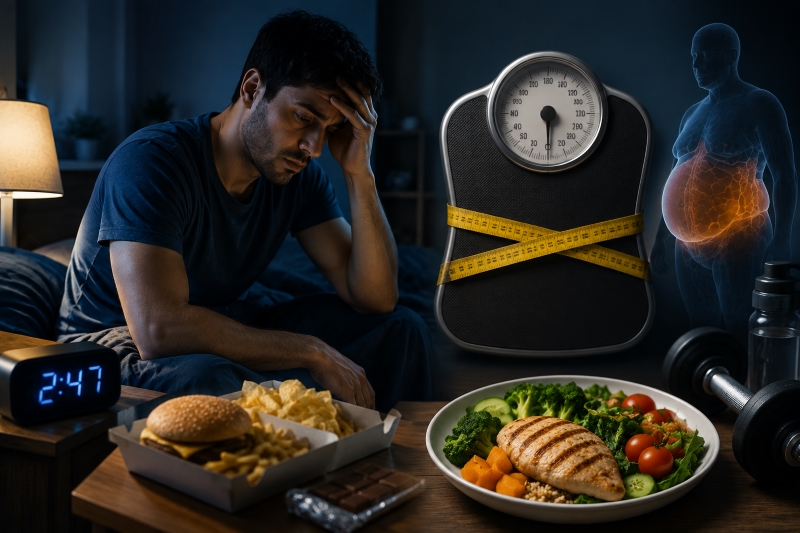
You can eat perfectly and still make weight loss harder by sleeping badly.
Imagine you are doing everything right.
You have cleaned up your diet.
You are eating enough protein.
You have reduced processed food.
You exercise regularly.
You are watching your portions.
But there is one thing you are neglecting: Sleep.
You go to bed late, wake up early, and spend your days running on coffee and willpower.
Then the scales stop moving.
Your waist refuses to cooperate.
Hunger becomes harder to control.
Your energy drops.
And suddenly that supposedly “perfect diet” doesn’t seem to be working.
Is sleep really that important? Yes.
And the relationship between sleep and body weight is far more complicated than simply calories in versus calories out.
Your body doesn’t stop working when you go to sleep
Sleep is not wasted time.
It is an active biological process during which the body carries out important work involving the brain, hormones, metabolism, immune function, tissue repair and recovery.
When sleep is consistently restricted, several of these processes can be disrupted.
Research has increasingly connected insufficient sleep with obesity risk and metabolic dysfunction.
That doesn’t mean one bad night’s sleep will make you gain body fat.
It means that chronic sleep deprivation can create a biological environment that makes healthy weight management more difficult.
Does lack of sleep make your body turn food into fat?
This popular claim contains an important piece of truth—but needs some scientific nuance.
Your body does not suddenly decide that every calorie you eat after a poor night’s sleep must become fat.
Energy balance still matters.
But sleep restriction can change how the body handles energy and nutrients.
In controlled research, sleep loss has been associated with changes in insulin sensitivity, appetite regulation, energy expenditure and body-composition outcomes.
One particularly interesting controlled study found that when people followed a calorie-restricted diet, those who were allowed adequate sleep lost more fat, while those whose sleep was restricted lost a greater proportion of their weight as fat-free mass.
In other words, sleep can affect the composition of the weight you lose—not simply the number on the scale.
That is an important distinction.
Your diet isn’t operating in isolation
We often talk about nutrition as though the food on your plate is the entire story.
It isn’t.
Your metabolism is influenced by:
Food + activity + sleep + stress + hormones + muscle mass + genetics + environment.
Two people can eat broadly similar diets and experience different outcomes because their sleep, activity, stress and physiology aren’t identical.
This is why sleep should be considered part of a weight-management programme—not an optional extra.
Sleep deprivation can make you hungrier
One of the most obvious effects of poor sleep is what happens to appetite.
After insufficient sleep, many people report greater hunger and increased desire for calorie-dense foods.
That creates a practical problem.
You may have planned a nutritious day with carefully controlled portions.
But after a terrible night, you find yourself craving something sweet in the afternoon.
Then you snack.
Then you want something salty at night.
Then the willpower disappears.
The problem isn’t necessarily that your diet wasn’t “perfect.”
Your biological drive to eat may have changed.
The brain starts looking for quick energy
Think about what happens when you’re exhausted.
A bowl of vegetables doesn’t sound particularly exciting.
A sugary snack suddenly looks irresistible.
A pastry with coffee seems like the perfect solution.
This isn’t simply a failure of discipline.
Sleep deprivation can affect the brain’s reward systems and food preferences, making highly palatable foods more attractive.
And when tiredness is combined with stress, long working hours and easy access to ultra-processed food, maintaining a calorie deficit becomes considerably harder.
What about insulin?
This is where the sleep-metabolism relationship becomes particularly interesting.
Insulin helps regulate blood glucose and influences how nutrients are stored and used.
Experimental sleep restriction has been associated with reduced insulin sensitivity in some studies.
That means the body may not handle glucose as efficiently when you’re consistently sleep deprived.
Poor sleep does not automatically cause diabetes or make every carbohydrate turn into body fat.
But chronically inadequate sleep can be one factor contributing to poorer metabolic health.
And for anyone trying to improve body composition, that matters.
Sleep and muscle: the forgotten connection
If your goal is fat loss, you don’t simply want the scale to go down.
You want to preserve as much lean muscle as possible while reducing excess body fat.
Muscle is crucial for strength, movement, glucose disposal and long-term physical function.
Sleep is an important component of recovery from resistance training and physical activity.
If you’re training hard but consistently sleeping poorly, you’re potentially compromising part of the recovery process.
The ideal fat-loss programme isn’t:
Eat less + exercise more + sleep less.
It is:
Eat intelligently + train appropriately + recover properly + sleep adequately.
Lack of sleep can also make you move less
Here’s another piece of the puzzle.
When you’re exhausted, you may unconsciously reduce your daily activity.
You take fewer steps.
You sit longer.
You don’t feel like going for that evening walk.
You skip the gym.
You take the lift instead of the stairs.
None of these decisions seems significant individually.
But across a week, they can reduce your total daily energy expenditure.
So sleep may affect weight not only through hormones and metabolism, but also through behaviour and spontaneous movement.
The stress connection
Sleep deprivation and stress often travel together.
Poor sleep can increase feelings of stress and irritability.
Stress can make it harder to sleep.
And the cycle continues.
Stress also interacts with eating behaviour.
When people are tired and stressed, they may be more likely to reach for highly palatable foods or eat emotionally.
This is why simply telling someone to “eat less” can be an incomplete strategy.
Sometimes the better starting question is:
“How well are you sleeping?”
Can Sleep Support Supplements Help?
This is where Fitcart takes a quality-first, evidence-based approach.
A sleep-support supplement can sometimes complement a good bedtime routine, but it should not be viewed as a replacement for adequate sleep, sensible nutrition, exercise or medical care.
And importantly, not every product sold as a sleep supplement is necessarily equivalent in quality or accuracy.
For consumers choosing a supplement, Fitcart recommends looking for products that are batch-tested and independently verified, with transparent ingredient quantities, manufacturing information and appropriate quality certifications where available.
Magnesium
Magnesium is frequently included in sleep-support formulas.
It plays important roles in normal nerve and muscle function, but evidence specifically supporting magnesium supplements for insomnia is still limited and mixed.
A review cited by the U.S. National Center for Complementary and Integrative Health found some potential benefit for sleep-onset latency in older adults, but the available studies were small and of low quality. Another review found conflicting evidence for magnesium and sleep outcomes.
That doesn’t mean magnesium is useless.
It means the quality of the evidence doesn’t justify presenting magnesium as a guaranteed sleep treatment.
Food sources of magnesium include nuts, seeds, legumes, whole grains and leafy green vegetables.
If using a magnesium supplement, check the actual amount of elemental magnesium and avoid excessive supplemental intake unless advised by a healthcare professional.
L-Theanine
L-theanine is an amino acid naturally found in tea and is often marketed for relaxation and sleep support.
There is some research suggesting potential benefits, but evidence remains less established than many marketing claims suggest. Reviews of sleep supplements have described the evidence for L-theanine as limited and variable.
For Fitcart readers, the key message is simple:
Look for transparent formulations and batch-tested products rather than buying purely on the basis of a “sleep” label.
Melatonin
Melatonin is different from many herbal sleep ingredients because it is a hormone naturally produced by the body that helps regulate the sleep-wake cycle.
Melatonin supplementation may be useful in certain situations, particularly jet lag and some circadian rhythm or sleep-timing problems. However, evidence does not support treating it as a universal solution for chronic insomnia.
Melatonin can also interact with medicines and may cause side effects such as daytime sleepiness or headaches.
Anyone taking medication, pregnant or breastfeeding, or managing a medical condition should discuss melatonin use with an appropriate healthcare professional.
What should you look for in a sleep supplement?
Instead of asking:
“What is the strongest sleep supplement?”
ask:
“Is this a high-quality, appropriately tested product that contains what the label says?”
Look for:
- Clearly disclosed ingredient quantities
- Transparent manufacturing information
- Batch testing or independent verification
- Appropriate quality certifications
- No unnecessary proprietary blends that hide ingredient quantities
- Clear directions and safety warnings
- A reputable manufacturer
- Information about where ingredients are sourced and where the finished product is manufactured and packaged
For athletes, additional sport-specific certification may be particularly important when choosing supplements because contamination and prohibited-substance risks need to be considered.
Don’t supplement your way out of sleep deprivation
This may be the most important message in the entire article.
If you are regularly sleeping four or five hours and taking a sleep supplement in an attempt to compensate, you’re treating the symptom rather than the lifestyle problem.
A supplement may have a role.
But the foundation remains:
Regular sleep schedule. Dark, comfortable bedroom. Daytime movement. Natural light exposure. Appropriate exercise. Good nutrition. Stress management. Limited late-day caffeine.
And if persistent sleep problems continue, seek professional help.
For chronic insomnia, behavioural approaches such as cognitive behavioural therapy for insomnia (CBT-I) are much more established than relying on supplements alone.
What happens when you finally start sleeping better?
You don’t need to achieve perfect sleep overnight.
Small improvements can help.
Try creating a consistent sleep and wake time.
Reduce bright screens close to bedtime.
Keep the bedroom cool, dark and comfortable.
Avoid excessive caffeine late in the day.
Get natural daylight earlier in the day.
Exercise regularly.
Give yourself time to wind down.
And don’t treat bedtime as the enemy of productivity.
Sleep is part of productivity.
It is also part of fitness.
And it is part of body-composition management.
The Fitcart 7-night sleep reset
Want to see whether sleep affects your eating and recovery?
Try this for seven nights.
1. Keep the same wake-up time
Even on weekends, try to keep your schedule reasonably consistent.
2. Aim for adequate sleep
Most adults need around 7–9 hours of sleep opportunity per night, although individual needs vary.
3. Stop treating caffeine as a substitute for sleep
Coffee can make you feel more alert.
It cannot replace biological recovery.
4. Walk during the day
Regular daytime movement can support sleep and overall health.
5. Train—but recover
Exercise is beneficial, but more is not always better.
6. Create a wind-down routine
Dim the lights.
Put the phone away.
Read.
Stretch.
Take a warm shower.
Try a few minutes of slow breathing.
7. Eat for recovery
Prioritise adequate protein, fibre-rich foods, vegetables, fruit, healthy fats and minimally processed foods.
Supplements can have a role in specific situations, but they should sit underneath—not above—the fundamentals of good sleep.
The perfect diet isn’t enough
Perhaps the biggest lesson is that nutrition doesn’t operate in a vacuum.
You can eat beautifully designed meals.
You can count every gram of protein.
You can choose healthy fats.
You can carefully control portions.
But if you’re chronically exhausted, your body and brain may respond differently to that diet.
Poor sleep can increase hunger, change food preferences, affect insulin sensitivity, reduce activity and interfere with recovery.
So don’t just ask:
“What should I eat to lose fat?”
Also ask:
“How well am I sleeping?”
Because sometimes the missing ingredient in a successful fat-loss programme isn’t another food restriction.
It is another hour of sleep.
Fitcart Takeaway
Sleep isn’t a luxury added after diet and exercise. It is one of the foundations supporting both.
If you’re trying to lose body fat, preserve muscle and improve metabolic health, think beyond the plate.
Eat well. Train well. Walk regularly. Manage stress. Sleep enough. Recover.
Your body needs all six.
And when it comes to weight management, the goal isn’t to find one magical food that makes fat disappear.
It’s to create an environment in which your body can regulate appetite, energy, recovery and metabolism as effectively as possible.
Sometimes, the smartest thing you can do for your diet is to turn off the lights.
Fitcart Health & Supplement Disclaimer
This article is for general health, fitness, nutrition and educational purposes only and is not intended to diagnose, treat, cure or prevent any disease or medical condition. Sleep, nutrition, exercise, stress and body weight are influenced by many individual factors.
Lack of sleep does not mean that all food is automatically converted into body fat, and adequate sleep does not override the importance of overall energy intake, diet quality and physical activity. The relationship between sleep restriction, metabolism, appetite, insulin sensitivity and body composition is complex and continues to be researched.
Sleep-support supplements should not be considered a substitute for adequate sleep or professional treatment. Evidence for ingredients such as magnesium, L-theanine and melatonin varies, and some supplements may interact with medicines or be unsuitable for certain individuals.
If you experience persistent sleep difficulties, excessive daytime sleepiness, loud snoring, interrupted breathing during sleep or other sleep-related symptoms, consult a qualified healthcare professional.
Before starting a new diet, exercise or supplement programme, seek appropriate professional advice where necessary.
Fitcart recommends choosing supplements that are appropriately batch-tested and independently verified for their stated contents, quality and safety, and checking where the raw materials are produced and where the finished products are manufactured and packaged.
Follow us on X: https://x.com/fitcartofficial and Instagram: https://www.instagram.com/fitcartofficial/ for the latest updates, health insights, and exclusive content.
Follow Smart Nutrition India X: https://x.com/SmartNutrition1 and Instagram: https://www.instagram.com/smartnutritionindia/ for trusted sports nutrition, supplement education, wellness tips, and the latest news from the world of health and performance.
Fitcart believes in True Play and Clean Sport
#trustedbrandsbetterhealth