


Fitcart Editorial Team Ritu Makhija.
Estimated time: 6–7 minutes.
If you are looking for a natural pre-workout strategy to support endurance, there may be something surprisingly simple sitting in the vegetable aisle: beetroot.
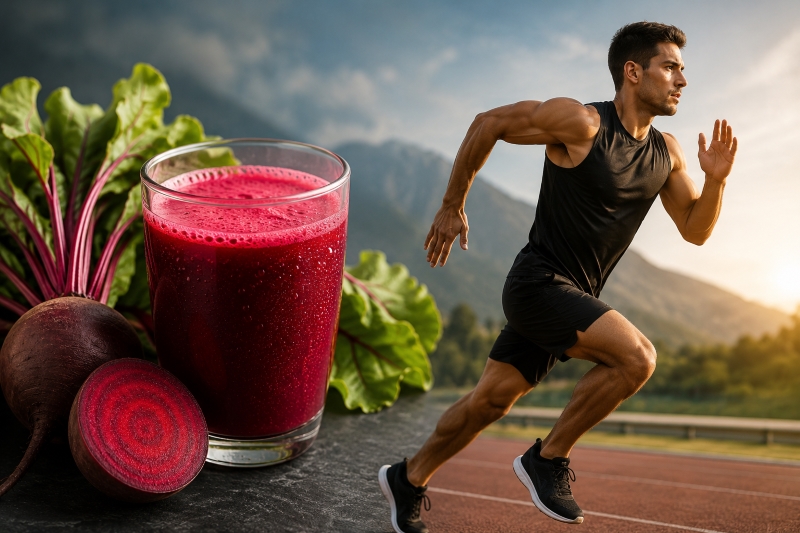
Beetroot juice has attracted considerable attention in sports nutrition because it is naturally rich in dietary nitrate, a compound that can be converted in the body into nitric oxide. Research suggests that nitrate supplementation may improve exercise efficiency and certain measures of endurance and high-intensity performance.
And timing may matter.
For athletes and active people, consuming nitrate-rich beetroot juice approximately 2–3 hours before exercise is one of the most commonly studied strategies. Research has found that acute nitrate supplementation taken at least 150 minutes before exercise can produce performance benefits in some circumstances.
Why Beetroot?
Beetroot is one of the richest natural dietary sources of nitrate.
When nitrate is consumed, part of it is converted to nitrite and subsequently to nitric oxide. Nitric oxide plays an important role in regulating blood vessels and blood flow and is involved in processes related to muscle function and oxygen utilisation.
The theory behind beetroot juice as a sports-nutrition tool is therefore quite interesting: better nitric-oxide availability may help working muscles perform more efficiently.
Research reviews have suggested that nitrate supplementation can improve exercise performance, particularly during certain forms of endurance and high-intensity exercise.
Why take beetroot juice around 2 hours before training?
The timing isn’t simply a fitness trend.
Research indicates that nitrate supplementation is most effective when consumed sufficiently ahead of exercise, with 2–3 hours before exercise being a commonly investigated window. One systematic review reported acute doses around 6–12.4 mmol of nitrate taken 2–3 hours before activity, while another meta-analysis found that acute nitrate doses were most effective when provided at least 150 minutes before exercise.
This gives athletes a practical pre-exercise window:
Beetroot juice → approximately 2–3 hours → training or competition
However, there is an important distinction: not every bottle of beetroot juice contains the same amount of nitrate. Therefore, simply drinking an unspecified amount of beetroot juice does not guarantee the same effect seen in clinical studies.
What could beetroot juice do for endurance?
1. It may improve exercise efficiency
One of the most interesting effects of nitrate supplementation is its potential to improve the efficiency with which muscles use energy during exercise.
Some research has reported improvements in exercise tolerance and time to exhaustion following nitrate supplementation.
For an endurance athlete, even a relatively small improvement in efficiency could potentially become meaningful during a long training session or competition.
2. It may support aerobic performance
A 2026 systematic review and meta-analysis involving 38 studies and 703 participants found that beetroot juice supplementation was associated with a small improvement in VO₂max/VO₂peak compared with placebo. The effect was more apparent in recreationally active participants, while evidence in highly trained athletes was less convincing.
This is an important reminder that beetroot juice should be viewed as a potential performance-support tool, not a magic endurance enhancer.
3. It may help with high-intensity efforts
Beetroot-derived nitrate isn’t only relevant to runners and cyclists.
Research has investigated nitrate supplementation in repeated-sprint and high-intensity exercise. A systematic review found that beetroot juice may improve measures such as repeated-sprint fatigue resistance, although results vary between studies.
Another systematic review and meta-analysis found small positive effects of dietary nitrate supplementation on certain high-intensity exercise outcomes, including mean power output and Yo-Yo intermittent recovery performance.
That could make nitrate-rich beetroot products interesting for sports involving repeated bursts of effort—such as hockey, football, cricket, basketball and racquet sports.
How much beetroot juice should you take?
This is where athletes need to pay attention.
Studies generally focus on the nitrate content, rather than simply the volume of beetroot juice.
Research has investigated acute doses ranging from approximately 5–14.9 mmol of nitrate, with some reviews suggesting that around 6–12 mmol taken 2–3 hours before exercise may be an effective range.
Another systematic review reported that a minimum acute dose of approximately 400 mg nitrate from beetroot juice, taken around 2–2.5 hours before exercise, produced the best results in the studies it assessed for certain muscle-performance outcomes.
Therefore, athletes should look at the standardised nitrate content on a product label, rather than assuming that a larger glass of ordinary beetroot juice automatically means better performance.
Beetroot juice vs. a Beetroot shot
For sports nutrition, concentrated beetroot shots can be convenient because they can provide a more consistent nitrate dose in a relatively small volume.
That can be particularly useful before competition when an athlete does not want to consume a large amount of liquid or fibre.
However, the important factor remains the actual nitrate dose and product quality, not whether the product is marketed as a “shot” or “juice.”
Don’t forget the mouth bacteria
There is another fascinating part of the nitrate story.
The conversion of dietary nitrate into nitrite begins partly through bacteria in the mouth. Research indicates that practices that substantially interfere with oral bacteria can reduce the performance response to nitrate supplementation.
This has led researchers to investigate whether aggressive antibacterial mouthwash use around nitrate supplementation could interfere with the nitrate-to-nitrite pathway.
For athletes experimenting with beetroot juice, the broader lesson is simple: don’t assume that more supplements automatically equal better performance.
Timing, dose, product formulation and individual response all matter.
Can beetroot juice replace a pre-workout?
Beetroot juice and conventional pre-workout products work through different nutritional pathways.
Beetroot provides dietary nitrate, whereas many pre-workout formulas may contain ingredients such as caffeine, creatine, beta-alanine or other compounds.
Beetroot therefore should be considered a specific sports-nutrition strategy, rather than a universal replacement for a complete pre-workout formula.
And remember: the foundation of athletic performance remains training, adequate calories, carbohydrates, protein, hydration, sleep and recovery.
What about strength training?
Beetroot juice is often associated with endurance sports, but research has also examined muscular endurance.
A systematic review and meta-analysis of beetroot-based supplements found a positive effect on muscular endurance, with studies using nitrate doses broadly within the range of several hundred milligrams and often administering them 2–3 hours before exercise.
This suggests that beetroot may also have a role for people performing resistance training, particularly where the goal involves maintaining performance across repeated sets.
It doesn’t mean beetroot juice will suddenly make you stronger—but it may potentially help you perform more work before fatigue under certain conditions.
Who might benefit most?
Beetroot juice may be particularly interesting for:
- Endurance runners
- Cyclists
- Swimmers
- Triathletes
- Rowers
- Hockey players
- Football players
- Cricket players
- Racquet-sport athletes
- Athletes performing repeated high-intensity efforts
- Recreationally active people looking for evidence-based nutrition strategies
However, the response is individual.
Interestingly, recent evidence suggests that highly trained athletes may experience smaller benefits than recreationally active individuals for some aerobic outcomes.
A simple Fitcart pre-exercise strategy
For someone wanting to experiment with beetroot as part of their sports-nutrition routine, a practical approach could be:
3–4 hours before exercise:
Have your normal balanced pre-training meal, particularly if the session is long or demanding.
2–3 hours before exercise:
Consume a nitrate-standardised beetroot juice or beetroot shot according to the product’s serving instructions.
Closer to training:
Maintain normal hydration and use carbohydrates as appropriate for the duration and intensity of the session.
During longer sessions:
Don’t rely on beetroot alone. Carbohydrate and fluid replacement can be far more important for maintaining performance during prolonged exercise.
Is Beetroot juice a natural performance enhancer?
Potentially—but “natural” doesn’t automatically mean “guaranteed.”
The research around dietary nitrate is substantial, and multiple systematic reviews have found benefits for particular measures of exercise performance. However, the size of the benefit varies according to the individual, training status, exercise type, dose and supplementation strategy.
A 2026 meta-analysis found improvements across several aerobic and anaerobic performance measures, including VO₂max, high-intensity interval sprint performance and mean power output, although the researchers noted that factors such as athlete status, sport type, dose and timing may influence the response.
So the better way to think about beetroot juice is not as a miracle drink, but as a potentially useful evidence-backed addition to a well-designed sports nutrition programme.
The Fitcart takeaway
Beetroot juice may be one of the simplest ways to explore dietary nitrate as part of a pre-exercise nutrition strategy.
Taking a nitrate-rich beetroot product approximately 2–3 hours before exercise is supported by research investigating acute nitrate supplementation and may help improve exercise efficiency, endurance, time to exhaustion or certain high-intensity performance measures. But the details matter.
Look for a product that clearly states its nitrate content, follow the manufacturer’s serving guidance, test it during training rather than for the first time on competition day, and remember that beetroot juice works best as part of a bigger performance strategy.
Training builds the engine. Nutrition supplies the fuel. Recovery keeps the engine running. Beetroot may help you use that fuel a little more efficiently.
Sports Nutrition Disclaimer
This article is for general educational and informational purposes only and is not intended to diagnose, treat, cure, or prevent any disease or medical condition. Sports-nutrition research can produce different results between individuals, and beetroot juice or dietary nitrate will not improve performance in every athlete.
Individuals with medical conditions, those taking medication, pregnant or breastfeeding women, and anyone with concerns about dietary nitrate or blood pressure should consult a qualified healthcare professional before using concentrated beetroot or nitrate supplements.
Do not use supplements as a substitute for a balanced diet, appropriate training, hydration, sleep and recovery.
Fitcart recommends choosing sports-nutrition supplements that are appropriately batch-tested and verified for their contents and manufactured and packaged according to recognised quality standards. Check the product label, nitrate content, manufacturing information and relevant third-party certifications before purchase.
Follow us on X: https://x.com/fitcartofficial and Instagram: https://www.instagram.com/fitcartofficial/ for the latest updates, health insights, and exclusive content.
Follow Smart Nutrition India X: https://x.com/SmartNutrition1 and Instagram: https://www.instagram.com/smartnutritionindia/ for trusted sports nutrition, supplement education, wellness tips, and the latest news from the world of health and performance.
Fitcart believes in True Play and Clean Sport
#trustedbrandsbetterhealth