


Biological age, ageing clocks and the new science of measuring how we age.
Fitcart Editorial Team Ritu Makhija.
Reading time: 8–9 minutes.
We all know our chronological age. It is the number of birthdays we have had.
But what if two people who are both 50 years old are not ageing at the same biological rate?
One may have excellent cardiovascular fitness, good metabolic health, healthy muscle mass, good sleep, and relatively low levels of chronic inflammation. Another person of the same chronological age may have poorer metabolic health, lower fitness, reduced muscle mass and other markers associated with accelerated ageing.
This is where the rapidly developing field of biological age and ageing clocks comes in.
Scientists are increasingly looking beyond the calendar to understand the biological processes associated with ageing. New technologies can analyse DNA methylation, proteins, metabolites, and other molecular measurements to estimate biological ageing.
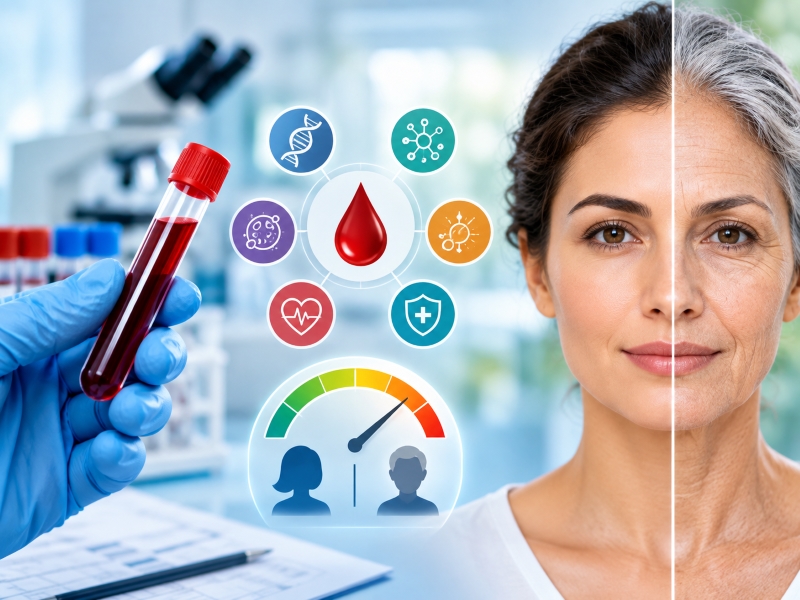
The exciting question is: Can a blood test tell us how fast we are ageing?
The answer is increasingly “perhaps — but with important qualifications.”
Chronological age versus biological age
Chronological age is straightforward.
If you were born in 1976, you are 50 years old in 2026.
Biological age is much more complicated.
It attempts to estimate an individual’s biological state using measurable characteristics of cells, tissues, and physiological systems.
Researchers have developed a variety of mathematical models that combine biomarkers into an estimated biological age or an indication of the pace of ageing.
Importantly, there is currently no single universally accepted test that can definitively tell someone their “true” biological age.
Researchers are still determining which biomarkers best capture the ageing process, how different clocks should be interpreted and how well they work across different populations.
What exactly is an ageing clock?
An ageing clock is essentially a mathematical model.
Researchers analyse biological measurements from large groups of people and look for patterns associated with chronological age, health outcomes, disease risk or mortality.
The resulting algorithm can then be applied to biological samples from another person.
Some of the best-known clocks use DNA methylation.
DNA methylation involves chemical modifications to DNA that can influence how genes are regulated. Particular methylation patterns change with age, and scientists have developed algorithms that use patterns at specific sites in the genome to estimate age-related biological characteristics.
These are known as epigenetic clocks.
The original generation of clocks was largely designed to estimate chronological age. More recent approaches have attempted to capture aspects of biological ageing, healthspan, mortality risk or the rate at which ageing is occurring.
Your blood may contain clues about ageing
DNA methylation isn’t the only approach.
Researchers are also investigating proteomic ageing clocks, which use patterns of proteins found in blood.
Proteins are involved in virtually every biological system, including inflammation, metabolism, immune function, tissue repair and cellular communication.
A 2026 review in Nature Aging highlighted the rapid development of proteomic ageing clocks, while also pointing out that different platforms, populations and modelling strategies can produce substantially different results.
Other approaches investigate:
- Metabolites
- Inflammatory markers
- Blood chemistry
- Gene-expression patterns
- Immune-system characteristics
- Telomere-related measurements
- Physiological and functional measures
- Combinations of multiple biological systems
The future may therefore involve multi-dimensional ageing profiles rather than one simple “age number.”
Why researchers are interested in ageing clocks
Imagine trying to determine whether an intervention actually slows ageing.
Waiting 30 or 40 years to see whether people live longer is obviously impractical for most research studies. An ageing biomarker could potentially provide an earlier signal.
For example, researchers might investigate whether a particular intervention changes biological ageing markers over several months or years.
This is one reason ageing clocks are attracting so much attention in longevity research.
A major 2026 Nature Medicine review described biological clocks as potentially useful for risk assessment, prevention, early detection, and evaluating whether lifestyle or other interventions influence ageing biology.
But there is a crucial distinction.
A biomarker changing is not automatically the same thing as a person living longer.
The big question: does a younger biological age mean you’ll live longer?
This is where Fitcart believes consumers need to be careful.
Suppose someone takes a biological-age test and receives a result saying:
“Your biological age is 46.”
But their chronological age is 52.
That sounds impressive.
But it does not mean they have suddenly gained six years of life expectancy.
Similarly, if another test reports a biological age several years older than chronological age, it does not mean that person is destined to develop disease or die earlier.
Ageing clocks are predictive and research tools, not crystal balls.
Many studies have found relationships between particular biological-age measures and health outcomes, morbidity or mortality. However, researchers are still establishing how these biomarkers should be used as reliable surrogate measures for interventions designed to extend human healthspan or lifespan.
Not all ageing clocks measure the same thing
There isn’t one universal biological clock.
Different clocks can be trained using different data and designed for different purposes.
One might be particularly good at estimating chronological age.
Another may be designed around mortality risk. Another may attempt to estimate physiological ageing.
Another may focus on the rate at which ageing appears to be occurring.
Recent research has shown that even widely used epigenetic clocks can capture different molecular signals and biological pathways. A 2026 study comparing five major clocks found substantial differences in the biological processes associated with them.
So asking: “What’s my biological age?”
may actually be less useful than asking:
“Which biological-age measurement was used, what was it validated for, and what does the result actually tell me?”
Pace of ageing may be more interesting than a single number
One of the most fascinating developments is the move from asking:
“How old am I biologically?”
towards:
“How quickly am I ageing?”
A single measurement is essentially a snapshot.
But ageing is dynamic.
Repeated measurements could potentially provide more information about whether particular biological markers are changing over time.
This is one reason researchers are developing measures designed to estimate the pace of ageing, rather than simply producing an age-equivalent number.
Recent research continues to investigate whether these measures can provide meaningful information about future health and longevity.
So what can actually influence healthy ageing?
Consumers can become fascinated by sophisticated tests and forget something much simpler:
The foundations of healthy ageing still matter enormously.
Nutrition, physical activity, muscle health, cardiovascular fitness, sleep, stress management, metabolic health and social/environmental factors all form part of the bigger picture.
Build and preserve muscle
Muscle mass and strength become increasingly important as we age.
Resistance training, adequate protein intake and sufficient overall energy and nutrient intake can help support muscle maintenance.
For active adults, this means looking beyond a single supplement and considering the complete recovery picture:
Training + protein + energy intake + micronutrients + sleep + recovery.
Eat for long-term health
A longevity-oriented diet does not need to be exotic.
A diverse dietary pattern rich in vegetables, fruits, legumes, whole grains, nuts, seeds and other minimally processed foods can provide fibre, vitamins, minerals and bioactive compounds.
Adequate protein becomes increasingly important as maintaining lean mass becomes a greater priority.
Healthy fats, including sources of unsaturated fats and omega-3 fatty acids, can also form part of a balanced dietary pattern.
Keep moving
Exercise is one of the most powerful tools available for maintaining health as we age.
A combination of:
- Resistance training
- Aerobic exercise
- Walking
- Balance and mobility work
- Regular daily movement
can provide a much more meaningful health strategy than simply trying to make a biological-age number look younger.
Don’t underestimate sleep
Sleep is an important part of recovery, metabolic regulation, cognitive health and overall wellbeing.
A person interested in longevity should therefore consider sleep quality and consistency alongside nutrition and exercise.
A sophisticated biological-age test cannot compensate for consistently poor lifestyle foundations.
Where do supplements fit?
This is where a precision supplementation approach becomes particularly relevant.
The emergence of biological-age testing may eventually help researchers understand which interventions influence particular ageing pathways.
But today, it would be premature to suggest that everyone needs an “anti-ageing supplement stack.”
Instead, supplementation should be considered according to the individual’s:
Diet → age → training → lifestyle → goals → nutritional requirements → relevant blood tests or clinical findings.
For example, supplementation may be appropriate when someone has an identified nutritional gap or when a qualified professional recommends a particular intervention.
The objective should not be to take the largest possible number of supplements.
It should be to identify what is actually needed and why.
What about “anti-ageing” supplements?
This is an area where consumers should be particularly careful.
Products marketed around longevity, cellular ageing, NAD+, antioxidants, mitochondrial health or other ageing pathways may have interesting scientific rationales.
But mechanistic plausibility does not automatically equal proven improvements in human lifespan.
The same principle applies to biological-age testing.
If a supplement changes a biomarker, that does not automatically prove that it extends lifespan.
This distinction between changing a biomarker and improving meaningful long-term health outcomes is central to interpreting the emerging longevity field.
Could biological-age testing become part of preventive health?
Potentially. Researchers envision a future in which multiple biological measurements could help identify individuals who may benefit from earlier preventive intervention.
Instead of simply saying: “You are 55.”
A future health assessment might provide a much richer picture:
- Cardiovascular health
- Metabolic health
- Immune function
- Muscle and physical function
- Cognitive health
- Inflammatory status
- Biological ageing markers
- Nutritional status
- Lifestyle factors
This would move healthcare further towards personalised and preventive medicine.
But that future is still developing.
The scientific community continues to debate which ageing biomarkers are sufficiently validated for clinical decision-making and how they should be interpreted.
The Fitcart perspective: don’t chase the number
There is an understandable temptation to turn biological age into a competition.
“I’m 50, but my biological age is 42.”
It sounds great.
But healthy ageing is not a race to obtain the lowest possible number.
A better goal is to build and maintain healthspan — the years of life spent in good physical, metabolic, cognitive and functional health.
That means focusing on the fundamentals:
Eat well.
Move regularly.
Build and maintain muscle.
Protect cardiovascular fitness.
Sleep properly.
Manage stress.
Maintain a healthy body composition.
Avoid smoking.
Moderate alcohol intake.
Maintain strong social connections.
Use supplements intelligently rather than indiscriminately.
These behaviours remain relevant regardless of what an ageing clock says.
The future may be less about “age” and more about biological resilience
Perhaps the most exciting possibility is that ageing science will eventually move beyond one number.
Instead of asking: “How old are you?” or even: “What is your biological age?”
we may increasingly ask:
“How resilient are your biological systems, and how are they changing over time?”
That could be a much more sophisticated approach to healthy ageing.
Biological clocks are helping scientists investigate that possibility.
But they are still tools under development.
A blood test may eventually tell us much more about how our bodies are ageing. For now, however, it should be interpreted as one piece of information within a much larger health picture — not a definitive prediction of lifespan.
And perhaps that is the most important message for anyone interested in longevity:
You don’t need to wait for the perfect ageing clock to start ageing well.
Fitcart Editorial Disclaimer
This article is for general educational and informational purposes only and is not intended to diagnose, treat, cure, or prevent any disease or to predict an individual’s lifespan. Biological-age and ageing-clock technologies are an evolving area of research, and different tests may measure different aspects of ageing. A biological-age result should not be interpreted as a definitive measure of life expectancy or proof that an intervention will extend lifespan. Health outcomes are influenced by nutrition, physical activity, sleep, stress, genetics, environment, medical history and many other factors.
Anyone considering blood testing, longevity interventions or supplementation should discuss their individual circumstances with an appropriately qualified healthcare professional.
Where supplements are used, consumers should consider transparent ingredients, appropriate dosing, and reputable third-party and batch-tested products, particularly athletes who may need additional safeguards against prohibited-substance contamination.
Follow us on X: https://x.com/fitcartofficial and Instagram: https://www.instagram.com/fitcartofficial/ for the latest updates, health insights, and exclusive content.
Follow Smart Nutrition India X: https://x.com/SmartNutrition1 and Instagram: https://www.instagram.com/smartnutritionindia/ for trusted sports nutrition, supplement education, wellness tips, and the latest news from the world of health and performance.
Fitcart believes in True Play and Clean Sport
#trustedbrandsbetterhealth