


Fitcart Sports News Blog.
Authored by S. Kannan (Sports Analyst) and Fitcart Editorial Team Ritu Makhija.
Estimated Reading time: 8–10 minutes.
Fitness fundas, the Novak Djokovic way.
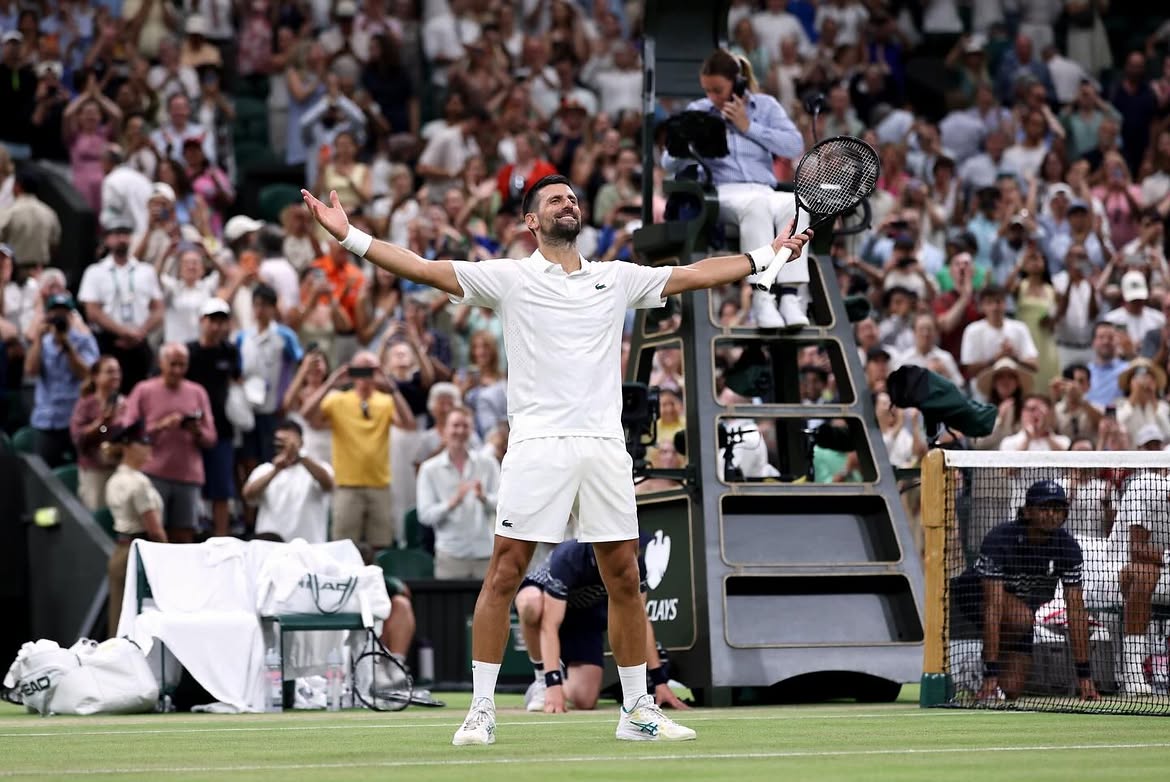
Novak Djokovic is the best example of how an elite athlete can manage conditions. As the 39-year-old Serbian heads into the US Open in Big Apple (New York), starting next week, what is surprising, former numero uno Roger Federer says Nole can be a favourite.
You gotta be kidding, an old man, past prime, as some say, will last the long fortnight at the tennis season’s last Grand Slam. New York during the US Open is raucous, noisy and crazy match schedules means Novak Djokovic has to be ready to play at odds hours – literally.
This is, perhaps, one of the most-watched Grand Slams after Wimbledon, and the fan engagement is massive. If you have been to the US Open, fans love it and can scream, cheer and go bonkers over lager and tennis. Novak has sampled all this in his illustrious career. To have won 24 Grand Slam singles titles, topping it with an Olympic gold medal at the Paris 2024 Olympics held at the Roland Garros on brick-red clay, Novak stole the show.
For those who romance tennis, old stars and how they have made an impact on the sport, Novak is a legend. Adding more sheen to the lustre is a documentary released on Novak Djokovic last week. It’s a runaway hit, where intricate facets of Novak’s career have been touched upon, from poverty to penury and how he was targeted for not taking the Covid-19 vaccines during the dark days of the pandemic.
There is, no doubt, vaccines are life savers. As it were, tennis players come under a WHO protocol wherein they take annual flu shots and more, for hepatitis, yellow fever, which is now once in a lifetime, and more prevention tablets, if needed. After all, for the Western World humans, malaria is also a big concern. Novak refusing the Covid vaccine, being pilloried by Melbourne, which he has himself talked of as an agenda, when he was deported is a dark chapter.
For a man who has seen war in his life, and how Serbs versus Croats was dangerous, Novak is happy. An ultimate team man, he can today compete without fear, even though, despite all his diet change, phenomenal workout, where stretching is the key, has kept him going. That said, last week, in the USA, he had to drop out of a tournament owing to heat exhaustion. It’s strange, since Novak has enjoyed the Melbourne heat in January and delivered, year after year. Perhaps, higher humidity now in the US in certain regions makes it harder for Novak.
If there are comparisons to be made, Novak versus the young boys like Jannik Sinner and Carlos Alcaraz has been defined as a battle where Novak is ‘old’ and the Young Turks have an edge. That, really, is laughable in the 2026 tennis season.
Alcaraz, the successor to Rafael Nadal had a bumpy ride in 2026, where he missed the French Open and Wimbledon. He says the right wrist, which produces all the muscular tennis shots, has healed. Only time will tell if Alcaraz can again pound the tennis ball on the hard courts. He has to win seven matches to emerge champion.
How Alcaraz shapes up and will perform will be viewed as closely as what Novak does. The Serbian drops crazy hints, he is not going to be there long. Another day, he talks of wanting to be around till the LA 2028 Olympics. What to believe and what to ignore, it’s a dilemma.
If we look at how Novak has maintained himself, it is a treatise. He has used all available stuff in the world today to be strong. Such is his aura and presence, he has maintained a healthy weight all along, at 77kg. The focus has been on a lean, mean look, to put less pressure on his joints.
When you talk of Novak and fitness, do not think of hard gym routines or someone who is guzzling protein shakes. In 2010, he realised he had to change his diet pattern drastically owing to gut issues. By adopting a lighter diet where there are more plant-based proteins, Novak has emerged stronger. He has believed in own planning, turning to a Vegan diet. That is something not so common.
In terms of workouts, how strong Novak is can be gauged from his comebacks. Sample this, in 2024, at the French Open in Paris, the scheduling was so bad, he was playing till 2 am local time. Novak complained but the high priests at Roland Garros turned a blind eye. He had during the French Open, sustained a knee injury. A scan revealed knee meniscus tear. By opting to go for a quick surgical procedure and bouncing back in training so fast, Novak was showing to the world how strong he is.
It was crazy, a normal man after a knee procedure gets ruled out for six months. Here, Novak bounced back within a fortnight, was competing at Wimbledon, on slippery grass. It was an unbelievable story for sure. What followed was more drama, more intent, as Novak returned to Paris for the Olympics. The emotions which were on view were massive, once he won gold. Hugging his wife Jelena, who was his girlfriend first, seen kissing his kids, Novak showed to the world what family supports is.
It is well-chronicled, Jelena mentioning how Novak keeps stretching at home and his kids keep watching him do it. In turn, they are also now in that same mode. So, Novak has broken the stereotype, you don’t have to eat like a beast and train like a beast. His methods are radical and are working, even at 39. How this is possible, Novak only knows. As he says: “I know my body best.”
All arguments end here!
The Fitcart Fitness Lesson: Longevity Is Built, Not Bought
Novak Djokovic’s career offers a fascinating lesson for anyone interested in healthy ageing, athletic longevity and performance after 30.
While recreational exercisers obviously cannot replicate the demands of a Grand Slam tennis player, several principles from elite sport can be adapted to everyday fitness.
The biggest takeaway may be that fitness isn’t necessarily about training harder every day.
It is about training intelligently and recovering consistently.
Mobility can be a performance tool
One of the most recognisable aspects of Djokovic’s physical preparation is his emphasis on mobility and flexibility.
Tennis requires athletes to repeatedly:
- Accelerate and decelerate
- Rotate the trunk
- Reach overhead
- Lunge
- Change direction
- Stretch into extreme positions
- Stabilise the hips, knees and ankles
Mobility work can therefore be particularly valuable.
For the general population, a simple daily mobility routine involving the hips, ankles, thoracic spine and shoulders can complement walking and resistance training.
The objective isn’t to become extraordinarily flexible. It is to maintain comfortable, controlled movement through useful ranges of motion.
Strength training doesn’t have to mean bodybuilding
Another important lesson from elite sport is that strength has a purpose.
For a tennis player, strength must support movement, power, stability and injury resilience rather than simply increasing muscle size.
For everyday fitness, two or three weekly resistance-training sessions can provide an excellent foundation.
Squats, lunges, rows, presses, hinges, carries and core exercises can collectively train most major movement patterns.
As we age, maintaining muscle and strength becomes increasingly important for maintaining independence and physical function.
The Djokovic diet lesson: individualisation matters
Diet discussions surrounding Djokovic have generated enormous interest.
His dietary choices should not automatically be interpreted as a universal prescription.
One of the most important lessons is actually individualisation.
What works for one athlete may not work for another.
A good performance diet should provide adequate:
Protein + carbohydrates + healthy fats + micronutrients + fluids
For athletes consuming predominantly plant-based foods, particular attention may be required to nutrients such as protein, iron, vitamin B12, calcium, iodine and omega-3 fatty acids.
This is where a qualified sports dietitian can be extremely valuable.
Protein remains important
A plant-forward diet does not mean a low-protein diet.
Athletes can obtain protein from foods such as:
- Lentils
- Beans
- Chickpeas
- Soy and tofu
- Tempeh
- Peas
- Nuts and seeds
- Dairy, where consumed
- Eggs, where consumed
- Protein powders, when appropriate
The key is getting sufficient total protein and distributing it sensibly throughout the day.
Carbohydrates fuel high-intensity sport
Tennis is an intermittent high-intensity sport.
Players repeatedly sprint, stop, jump and strike the ball over several hours.
Carbohydrates therefore remain an important fuel source.
For recreational athletes, carbohydrates from foods such as oats, rice, potatoes, fruits, whole grains and legumes can support training.
The requirement will vary according to training volume and intensity.
There is no single ideal carbohydrate intake for everyone.
Hydration becomes even more important with age
Djokovic’s experience with heat and demanding competition also highlights the importance of hydration.
Dehydration can impair physical and cognitive performance, while exercising in hot and humid conditions can increase fluid and electrolyte losses.
For longer workouts or sessions involving heavy sweating, electrolytes may be useful.
However, not everyone needs an electrolyte drink for every workout.
Water is often perfectly adequate for shorter and less demanding sessions.
Recovery is part of the programme
Perhaps the most important Fitcart takeaway from elite athletes is the value of recovery.
Training creates the stimulus.
Recovery allows the body to adapt.
Recovery includes:
- Quality sleep
- Adequate nutrition
- Hydration
- Rest days
- Mobility work
- Managing training load
- Appropriate medical care after injury
This becomes particularly important as athletes get older.
The goal isn’t necessarily to train like a 20-year-old forever.
The goal is to remain strong, mobile and capable while adjusting training intelligently as the body changes.
Supplements: where do they fit?
The supplement industry offers a huge range of products marketed toward athletes and active adults.
Protein powder can make it easier to reach protein targets. Creatine monohydrate has substantial evidence for supporting high-intensity exercise performance and muscle strength. Electrolytes can be useful when sweat losses are significant.
Other supplements may have a role depending on an individual’s diet, deficiencies, health status or sporting requirements.
But supplements should remain exactly that—supplements to a strong nutritional foundation.
They are not replacements for sleep, exercise, adequate protein, a nutrient-rich diet or appropriate recovery.
For competitive athletes, supplement quality is particularly important because accidental contamination with prohibited substances can have serious consequences.
Choosing products that undergo appropriate independent batch testing and checking relevant sporting certification can provide an additional layer of protection.
Don’t copy the athlete—copy the principles
Perhaps the biggest mistake people make when looking at elite athletes is trying to reproduce the exact programme.
You don’t need to train like Novak Djokovic to benefit from his approach.
Instead, take the principles:
Move every day.
Build strength.
Maintain mobility.
Eat enough quality food.
Hydrate intelligently.
Prioritise sleep.
Respect recovery.
Listen to your body.
And perhaps most importantly, understand that longevity is not created by one extraordinary workout.
It is created by thousands of sensible decisions repeated over many years.
That may be the real Djokovic fitness fundas.
Fitcart Editorial & News Disclaimer
The original article is an independent editorial contribution by S. Kannan. The additional Fitcart material is provided for general education about fitness, sports nutrition, training, recovery and healthy ageing. It is not medical advice and should not be interpreted as an endorsement of any particular diet, supplement, treatment or training programme by Novak Djokovic.
Statements concerning athletes, tournaments, injuries, dietary practices and sporting events should be considered news/editorial content and may change as new information becomes available.
Supplement Disclaimer
Supplements are not a substitute for a balanced diet, appropriate exercise, adequate sleep or professional medical care. Individual nutritional requirements vary.
Before taking supplements—particularly if you are pregnant, have a medical condition, take medication or participate in drug-tested sport—consult a qualified healthcare professional or sports nutritionist.
Consumers should choose reputable products with transparent ingredient labels and appropriate quality controls. Where possible, look for independent batch testing and recognised sport-certification programmes, and verify where raw materials are manufactured and where finished products are produced and packaged.
Fitcart recommends using only responsibly manufactured, quality-tested sports nutrition products and making informed decisions based on individual needs.
Image credit to djokernole on Instagram.
Follow us on X: https://x.com/fitcartofficial and Instagram: https://www.instagram.com/fitcartofficial/ for the latest updates, health insights, and exclusive content.
Follow Smart Nutrition India X: https://x.com/SmartNutrition1 and Instagram: https://www.instagram.com/smartnutritionindia/ for trusted sports nutrition, supplement education, wellness tips, and the latest news from the world of health and performance.
Fitcart believes in True Play and Clean Sport
#trustedbrandsbetterhealth