


Fitcart Editorial Team Ritu Makhija.
Reading time: 8–10 minutes.
Artificial intelligence is rapidly moving from the world of technology into almost every part of health and wellness.
It can already recognise foods from photographs, analyse exercise and sleep data, identify patterns in health information and generate personalised recommendations.
The next step could be even more ambitious.
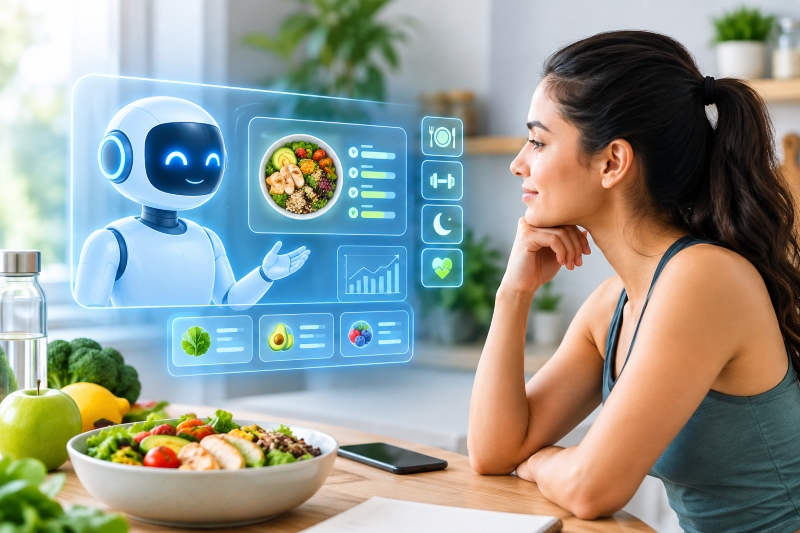
Imagine an AI nutrition system that does not simply ask what you ate today, but combines your food intake, continuous glucose monitoring (CGM), blood tests, gut microbiome, exercise, sleep, body composition, lifestyle and health history to help determine what type of nutrition may work best for you.
Instead of asking: “What is the best diet?”
AI-powered personalised nutrition may eventually ask:
“What appears to work best for your body, your lifestyle and your goals?”
This is the emerging world of AI-powered personalised nutrition and precision nutrition.
But there is an important Fitcart question:
Personalised nutrition needs better evidence, not just better algorithms.
Why personalised nutrition is becoming so important
Traditional nutrition advice is generally based on population-level evidence.
That makes sense. If research shows that increasing fibre, eating more vegetables, reducing excess added sugar and maintaining adequate protein can support health across populations, those are useful recommendations.
But humans do not respond identically to food.
Two people can eat the same meal and experience different post-meal glucose, triglyceride and metabolic responses.
The PREDICT research programme demonstrated substantial variation between individuals in responses to identical meals. Researchers also found that factors including the gut microbiome contributed to some of this variation, while machine-learning models showed potential for predicting individual responses.
This does not mean that everybody needs a completely different diet.
It does mean that there may be an opportunity to move beyond the idea that one nutritional strategy necessarily works equally well for everyone.
And this is where AI becomes interesting.
What could an AI nutrition coach actually analyse?
A future personalised nutrition platform could potentially combine multiple layers of information.
1. Food intake
AI can potentially analyse:
- What you eat
- Portion sizes
- Meal timing
- Macronutrients
- Fibre intake
- Micronutrients
- Added sugars
- Ultra-processed foods
- Dietary patterns
- Food variety
Food logging could become considerably easier if AI can identify foods from photographs or automatically analyse digital food records.
Instead of manually entering every ingredient, the system could potentially learn your normal eating patterns over time.
2. Continuous glucose monitoring
CGMs measure glucose continuously and can provide information about an individual’s glucose response to meals, activity, sleep and other factors.
For some people, this information could help identify patterns that would otherwise be difficult to see.
For example, an AI system might eventually recognise that a particular person consistently experiences a larger glucose response after a particular type of meal, while another meal produces a more stable response.
However, a CGM reading should not automatically be interpreted as proof that a food is “good” or “bad”.
Glucose is only one biological signal.
A healthy nutrition strategy also needs to consider overall dietary quality, protein, fibre, micronutrients, energy intake, physical activity, sleep and long-term health outcomes.
3. The gut microbiome
The gut microbiome is another potentially important layer.
Research has demonstrated complex relationships between diet, gut microorganisms and metabolic health. Large-scale studies have also shown that microbiome information can be associated with cardiometabolic markers.
Future AI systems could potentially use microbiome data alongside dietary and metabolic information to identify patterns that are difficult for humans to recognise.
But this is an area where caution is particularly important.
A microbiome test does not currently provide a simple instruction manual telling you exactly what to eat.
The microbiome is dynamic, complex and influenced by diet, lifestyle, medication, environment and many other factors.
So:
Microbiome data ≠ automatic personalised diet prescription.
4. Blood tests
Blood biomarkers could add another important dimension.
Depending on the individual and clinical context, relevant measurements might include markers relating to:
- Glucose regulation
- HbA1c
- Lipids
- Iron status
- Vitamin B12
- Vitamin D
- Liver function
- Kidney function
- Inflammation
- Thyroid function
- Other clinically relevant biomarkers
The important point is that AI could potentially integrate these measurements rather than looking at each result in isolation.
This could eventually make personalised nutrition more sophisticated.
But interpretation of abnormal blood results remains a clinical matter.
An algorithm should not replace a doctor, registered dietitian or other appropriately qualified healthcare professional.
5. Exercise and physical activity
Nutrition cannot really be separated from movement.
An endurance athlete, strength athlete, recreational runner and sedentary office worker may have very different nutritional requirements.
An AI system could potentially integrate:
- Training volume
- Training intensity
- Steps
- Heart-rate data
- Recovery
- Workout timing
- Exercise type
- Training load
The same person may also require different nutrition during different phases of training.
A high-volume training block could increase carbohydrate, protein, fluid and electrolyte requirements compared with a rest week.
This is where personalised nutrition could become particularly interesting for athletes.
6. Sleep
Sleep is another major piece of the puzzle.
Poor sleep can influence appetite, food choices, recovery, training performance and metabolic regulation.
Wearables can already provide information about sleep duration and patterns.
In the future, AI could potentially look at relationships between:
sleep → food choices → training → recovery → appetite → body composition
rather than treating each component as an isolated variable.
Again, however, correlation does not necessarily prove causation.
7. Body composition
Body weight alone tells only part of the story.
An increasingly sophisticated personalised nutrition system could potentially incorporate:
- Body weight
- Waist circumference
- Lean mass
- Fat mass
- Training status
- Changes over time
This could help distinguish between weight loss caused primarily by reductions in fat mass and unwanted loss of lean tissue.
For athletes and active adults, maintaining adequate muscle and recovery capacity can be particularly important.
The AI advantage: connecting the dots
The real potential of AI is not necessarily that it “knows more about nutrition” than a human expert.
Its advantage may be its ability to process large numbers of variables simultaneously.
Imagine the following dataset:
Food + CGM + microbiome + blood biomarkers + exercise + sleep + body composition + lifestyle + goals
A human may struggle to continuously analyse thousands of interactions.
Machine-learning systems are designed to identify patterns within complex datasets.
This is why researchers are increasingly interested in AI-driven precision nutrition.
A 2025 systematic review identified 11 studies involving AI-generated dietary recommendations, including approaches using machine learning and deep learning with inputs such as blood glucose, gut microbiome information and self-reported data. The researchers found promising improvements in some metabolic and health outcomes, but also highlighted the need for longer-term validation and better evidence.
A separate scoping review identified 198 publications examining AI for precision nutrition, with around 75% published since 2020—illustrating how rapidly the field is developing.
Personalised nutrition is already being tested
A 2024 randomised controlled trial published in Nature Medicine studied a personalised dietary programme incorporating food characteristics, individual post-meal glucose and triglyceride responses, microbiome data and health history.
The 18-week trial included 347 participants.
The personalised programme produced a significant improvement in triglycerides compared with the control group, along with improvements in several secondary outcomes including body weight, waist circumference, HbA1c, diet quality and microbiome measures. However, not every measured cardiometabolic outcome improved, and adherence appeared to matter.
That last point is extremely important.
The best personalised nutrition plan in the world is unlikely to be useful if someone cannot realistically follow it.
Personalisation must include the person—not just their biology.
Culture, budget, food availability, cooking ability, preferences, family circumstances, work schedule and enjoyment all matter.
The next generation: AI that learns from you
Today’s nutrition apps largely depend on information you enter.
Tomorrow’s systems may become more adaptive.
Instead of giving you a fixed meal plan, an AI nutrition coach could potentially operate as a feedback loop:
Eat → measure → analyse → adjust → repeat
For example:
You eat a meal.
Your activity and glucose response are recorded.
Your sleep and previous meals are considered.
The system identifies a pattern.
Your next recommendation changes slightly.
The system observes what happens.
The recommendation evolves.
Over weeks and months, the model could potentially become increasingly personalised.
This concept is particularly interesting because nutrition is not static.
Your nutritional requirements can change with:
- Age
- Training
- Weight
- Muscle mass
- Menstrual status
- Sleep
- Stress
- Travel
- Illness
- Medication
- Lifestyle
- Goals
A truly personalised nutrition system therefore needs to be dynamic, rather than simply producing a one-time diet plan.
But here is the Fitcart warning: AI can be confidently wrong
This is perhaps the most important section of the entire article.
AI is extremely good at producing answers.
That does not automatically make those answers correct.
Recent research into generative AI and precision nutrition has highlighted concerns including insufficient biological inputs, weak validation, synthetic data, hallucinations, privacy and the need for human experts to remain involved in higher-stakes applications.
An AI system could therefore produce a beautifully written nutrition plan that sounds highly personalised while being based on incomplete or poor-quality information.
That is a major distinction:
Personalised-looking ≠ biologically personalised.
More data does not automatically mean better nutrition
It is tempting to assume that the more data we collect, the better the recommendation becomes.
But this is not necessarily true.
A system containing:
- 1,000 wearable measurements
- 500 blood markers
- microbiome sequencing
- CGM data
- food photographs
- sleep data
- genetic information
does not automatically produce a better answer.
The quality of the underlying data matters.
So does the quality of the algorithm.
So does the population on which the algorithm was trained.
And, importantly, so does whether the recommendation has been tested in real humans over meaningful periods of time.
This is one of the biggest challenges facing AI-powered nutrition.
The Indian nutrition question
There is another important issue for Fitcart and the Indian market.
Many AI nutrition models are developed using populations from North America, Europe, or other specific demographic groups.
But Indian diets are different.
Consider the enormous diversity of:
- Regional cuisines
- Vegetarian diets
- Pulses and legumes
- Rice and wheat consumption
- Spices
- Fermented foods
- Dairy consumption
- Cooking oils
- Traditional snacks
- Religious and cultural food patterns
- Urban versus rural diets
An AI nutrition coach designed around Western food databases may not adequately understand the nutritional context of a traditional Indian meal.
The future of personalised nutrition therefore needs better culturally relevant datasets.
An Indian AI nutrition model should ideally understand Indian foods—not simply translate Western nutrition advice into Indian language.
AI should personalise nutrition—not replace nutrition science
This distinction is critical.
AI should not be used to reinvent basic nutritional principles simply because technology makes the recommendation look sophisticated.
There is still enormous value in fundamentals:
Adequate protein.
Adequate fibre.
A diverse diet.
Fruit and vegetables.
Whole and minimally processed foods.
Appropriate energy intake.
Healthy fats.
Quality carbohydrates.
Hydration.
Micronutrient adequacy.
Physical activity.
Good sleep.
And a sustainable eating pattern.
AI should ideally help determine how these principles can be applied to an individual, rather than convince people that basic nutrition no longer matters.
Where supplements could fit into AI-powered nutrition
This is where the future of precision supplementation becomes particularly interesting.
Instead of automatically recommending a huge supplement stack, a sophisticated system could theoretically ask:
What does this person actually need?
The decision could potentially consider:
Diet → age → training → lifestyle → goals → nutritional requirements → relevant blood tests or clinical findings
For an athlete, the system could additionally consider training load, recovery, competition schedule, and dietary intake.
For someone with a restricted diet, it might identify potential nutritional gaps.
For someone undertaking resistance training, protein intake and overall energy availability may be more important than adding numerous individual supplements.
For someone with a documented deficiency, supplementation may have a clearer rationale than taking a large collection of products “just in case”.
This is the direction FitCart believes personalised supplementation should move toward.
Less “take everything”.
More “take what is appropriate for you”.
AI could also improve supplement decision-making
The future could potentially involve an AI system analysing:
- Current diet
- Existing supplements
- Nutritional requirements
- Training
- Goals
- Relevant blood results
- Medication interactions
- Tolerability
- Ingredient transparency
- Product quality
This could make supplement decisions more rational.
But there is an important distinction between AI recommending a supplement and proving that the supplement will improve a health outcome.
The evidence for individual ingredients still matters.
Dosage still matters. Product quality still matters. Interactions still matter.
And the person taking the supplement matters.
AI should therefore be used as a tool for better decision-making, not as a substitute for evidence.
What should consumers look for in an AI nutrition platform?
Before trusting an AI nutrition coach, ask several questions.
What data is it actually using?
Is it simply asking what you like to eat?
Or is it genuinely integrating validated health and lifestyle information?
Has it been clinically tested?
A sophisticated-looking app is not the same thing as a clinically validated intervention.
Who developed it?
Nutrition scientists, registered dietitians, physicians, data scientists, and behavioural scientists may all have important roles.
Is there human oversight?
For medical or high-risk nutrition decisions, human expertise remains essential.
How does it handle uncertainty?
A good system should be able to say:
“We don’t know.”
That may be more scientifically responsible than generating a confident answer to every question.
What happens to your data?
Nutrition data can become highly personal when combined with blood tests, microbiome information, genetics, wearable data, and health history.
Privacy and data security therefore need to be taken seriously.
The future could be a nutrition feedback system
The most exciting possibility may not be an AI that simply creates a diet.
It could be an AI system that continuously learns how your body responds.
Imagine:
Food
↓
Glucose / metabolic response
↓
Activity
↓
Sleep
↓
Recovery
↓
Body composition
↓
Blood biomarkers
↓
Feedback
↓
Adjusted nutrition strategy
That would represent a major shift from traditional diet planning.
Instead of:
“Here is your diet for the next six months.”
the model could eventually become:
“Here is what the data currently suggests. Let’s test it, measure the response and adapt.”
That is much closer to the philosophy of precision health.
But the algorithm should never become the doctor
AI may become an extremely powerful nutritional tool.
It may help dietitians and clinicians analyse data.
It may help athletes understand training nutrition.
It may help consumers identify dietary patterns.
It may help researchers discover relationships that would otherwise be difficult to see.
But nutrition exists within the broader context of human health.
A person with diabetes, kidney disease, liver disease, gastrointestinal disease, an eating disorder, pregnancy, complex medication use or unexplained abnormal blood results should not rely solely on an AI-generated nutrition plan.
The more medically complex the situation, the more important qualified human oversight becomes.
The Fitcart perspective: personalised does not mean complicated
There is a danger that precision nutrition becomes another wellness trend where consumers believe they need:
CGM + microbiome test + 100 blood markers + genetic testing + wearable + 20 supplements + AI coach
just to eat breakfast.
That is not necessarily progress.
Personalised nutrition should ultimately make nutrition more understandable and more appropriate, not more confusing.
Sometimes the most personalised recommendation may still be remarkably simple:
Eat more vegetables.
Increase fibre.
Eat sufficient protein.
Improve sleep.
Walk more.
Strength train.
Reduce excess alcohol.
Eat fewer ultra-processed foods.
Correct a genuine nutritional deficiency.
And maintain these habits consistently.
Technology should help us determine which changes matter most, rather than create complexity for its own sake.
The future of AI nutrition may be incredibly powerful—but evidence comes first
AI has the potential to transform personalised nutrition.
It can process enormous datasets and potentially integrate information from food intake, CGMs, microbiome analysis, blood biomarkers, exercise, sleep and body composition.
Research is already demonstrating that personalised nutrition can produce meaningful improvements in some metabolic outcomes, while AI research is expanding rapidly.
But the field is still developing.
Recent reviews continue to highlight problems involving validation, generalisability, data interoperability, transparency, bias, privacy and human oversight.
And perhaps the most important lesson is this:
AI can personalise a recommendation. It cannot manufacture evidence.
The future of nutrition may therefore not be about replacing dietitians, doctors or nutrition scientists with machines.
It may be about giving those professionals—and consumers—better tools to understand individual variation.
For Fitcart, that means keeping the focus on evidence, transparency, quality, appropriate supplementation and measurable outcomes, rather than simply following whatever recommendation an algorithm produces.
The future may indeed be personalised.
But the smartest nutrition coach may ultimately be the one that knows when the evidence is strong, when it is uncertain, and when to ask a human expert.
FAQ’s
What is AI personalised nutrition?
AI personalised nutrition uses artificial intelligence and individual data to potentially create dietary recommendations tailored to a person’s biology, lifestyle, goals and nutritional needs.
Can AI create a personalised diet?
AI can generate personalised dietary recommendations, but the quality of those recommendations depends on the data, algorithm, evidence and validation behind the system. Current research shows promise but does not mean every AI-generated diet is clinically validated.
Can AI analyse blood tests for nutrition?
AI can potentially analyse and integrate multiple health biomarkers, but abnormal blood-test results should be interpreted by an appropriately qualified healthcare professional rather than relying solely on an AI system.
Can AI use CGM data to personalise nutrition?
Potentially. CGM data can provide information about individual glucose responses, which may be incorporated into personalised nutrition systems. However, glucose response is only one part of overall nutritional health.
Can AI use gut microbiome data?
Yes, microbiome information is increasingly being investigated as part of precision nutrition. However, microbiome testing is still an evolving field and should not be treated as a simple prescription for what an individual should eat.
Will AI replace nutritionists?
Probably not in the foreseeable future. AI may become a powerful tool for nutrition professionals, but human judgement, clinical context, behavioural understanding and accountability remain important.
Is AI nutrition advice accurate?
It can be useful, but accuracy varies significantly between systems. AI-generated advice should be evaluated according to the quality of its data, scientific evidence, validation and human oversight.
Can AI personalise supplements?
AI may eventually help identify potential nutritional gaps by combining dietary, lifestyle, training and relevant health data. However, supplement recommendations should still be based on evidence, appropriate dosing, product quality and individual circumstances.
Fitcart Supplement & Nutrition Disclaimer
This article is provided for educational and informational purposes only and is not intended to diagnose, treat, prevent, or cure any disease or to replace advice from a qualified healthcare professional, registered dietitian, or appropriately qualified nutrition and medical practitioner. AI-generated nutritional recommendations should not be treated as medical advice, particularly where an individual has a medical condition, takes medication, is pregnant, has abnormal laboratory results or has complex nutritional requirements.
Personalised nutrition and AI-assisted nutrition are rapidly developing fields. The availability of an algorithm, wearable, CGM, microbiome test, blood test or personalised recommendation does not necessarily establish that the resulting advice will improve long-term health outcomes.
Where supplements are considered, they should be evaluated in the context of the individual’s diet, training, lifestyle, nutritional requirements and relevant clinical information. Avoid unnecessary mega-dosing and products making unsupported health or longevity claims. Consumers should consider products with transparent ingredient information and, where appropriate—particularly for athletes—independent third-party testing and batch-tested products for prohibited or banned substances.
Individual nutritional requirements vary, and professional advice should be obtained where appropriate.
Fitcart.com — evidence-led nutrition, tested-clean sports nutrition and smarter supplementation.
Follow us on X: https://x.com/fitcartofficial and Instagram: https://www.instagram.com/fitcartofficial/ for the latest updates, health insights, and exclusive content.
Follow Smart Nutrition India X: https://x.com/SmartNutrition1 and Instagram: https://www.instagram.com/smartnutritionindia/ for trusted sports nutrition, supplement education, wellness tips, and the latest news from the world of health and performance.
Fitcart believes in True Play and Clean Sport
#trustedbrandsbetterhealth