


Fitcart Editorial Team Ritu Makhija.
Reading time: 7 minutes.
Modern life can be surprisingly demanding on the body.
Hours at a desk, driving, looking down at a phone, travelling, training, sitting in meetings, or simply carrying the stresses of the day can leave the neck, shoulders, upper back, lower back and hips feeling tight.
Stretching cannot solve every cause of back or neck discomfort, but gentle movement can be a valuable part of a healthy routine. Combined with controlled breathing, mobility work, regular walking, strength training, good sleep and adequate nutrition, it can help you move more comfortably and create a useful transition from a busy day into a more relaxed state.
At Fitcart, we believe that performance and wellbeing are built from the basics: movement, nutrition, recovery, sleep, and consistency.
Here are seven simple stretches and movement techniques that can be incorporated into a daily routine.
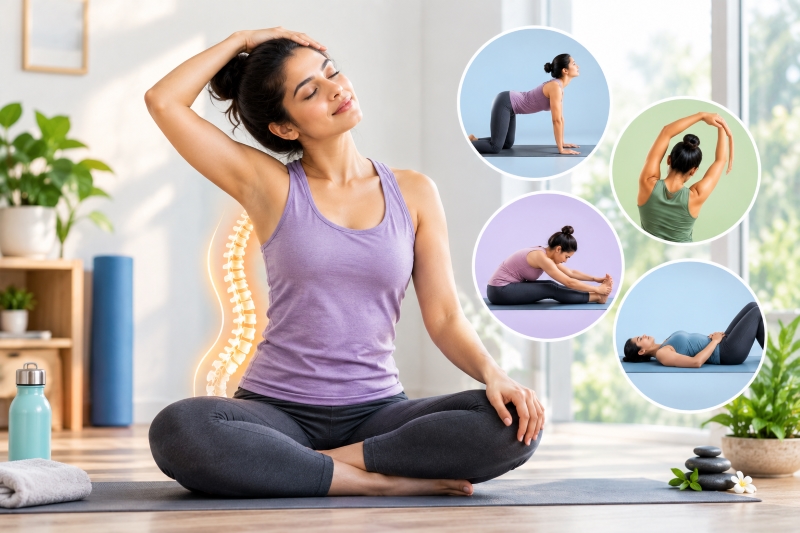
1. Cat-Cow: Gentle Spinal Mobility
Best for: Spine mobility, upper and lower back stiffness, gentle movement after sitting.
Cat-Cow is a simple way to move the spine through comfortable flexion and extension.
How to do it
- Start on your hands and knees.
- Place your hands approximately under your shoulders and knees under your hips.
- Slowly inhale and gently lift your chest while allowing the spine to extend.
- Exhale and gently round your spine, allowing your head to relax toward the floor.
- Move slowly rather than forcing the range of motion.
Try: 6–10 slow repetitions.
The key technique
Don’t try to create the biggest possible movement. Think about smooth, controlled movement through the spine.
2. Child’s Pose: A Relaxing Reset
Best for: Gentle back and hip stretching, relaxation and winding down.
Child’s Pose is often used as a restorative position because it allows the body to settle while gently lengthening the back and hips.
How to do it
- Kneel comfortably.
- Sit your hips back toward your heels.
- Extend your arms forward or rest them alongside your body.
- Allow your forehead to move toward the floor or a cushion.
- Breathe slowly and comfortably.
Hold for approximately 20–60 seconds, without forcing the stretch.
Add breathing
Try inhaling gently through the nose for approximately four seconds and exhaling slowly for approximately six seconds.
The emphasis should be on comfortable, unforced breathing rather than trying to take extremely deep breaths.
3. Knees-to-Chest: Gentle Lower-Back Relaxation
Best for: Gentle movement of the lower back and hips.
- Lie comfortably on your back with your knees bent.
- Slowly bring one or both knees toward your chest, holding them gently rather than pulling aggressively.
- Stay for 20–30 seconds, then release.
- You can also gently rock from side to side if that feels comfortable.
Important
This should feel like a gentle stretch—not pain, pressure or pulling.
4. Supine Spinal Twist
Best for: Gentle rotational mobility through the trunk and relaxation.
Lie on your back with your knees bent.
- Keep your shoulders relaxed against the floor.
- Allow both knees to move slowly toward one side.
- Keep the movement comfortable.
- Return to the centre.
- Repeat on the opposite side.
Hold for approximately 20–30 seconds per side.
The goal is not to force the knees toward the floor. Your comfortable range of motion is enough.
5. Hip Flexor Stretch
Best for: People who spend long periods sitting.
Prolonged sitting can leave the front of the hips feeling tight. Gentle hip-flexor mobility can therefore be useful as part of a broader movement routine.
How to do it
- Begin in a half-kneeling position.
- Place one foot forward.
- Keep your torso upright.
- Gently move your pelvis forward.
- Stop when you feel a mild stretch through the front of the hip.
Hold for 20–30 seconds per side.
Avoid arching your lower back excessively to create a deeper stretch.
6. Upper-Back and Shoulder Stretch
Best for: Desk workers, travellers and people who experience shoulder and upper-back tightness.
Sit or stand tall.
Bring one arm across your body and gently draw it toward your chest with the opposite arm.
Hold for 15–30 seconds, then change sides.
You can also perform slow shoulder rolls:
5–10 backwards → 5–10 forwards.
Keep the movements relaxed rather than exaggerated.
7. Legs Up the Wall
Best for: A gentle evening relaxation routine.
This is less about “stretching” and more about creating a quiet period for the body and mind.
Lie on your back and place your legs comfortably against a wall or elevated surface.
Allow your arms to rest by your sides.
Stay for 2–5 minutes, breathing comfortably.
If the position causes discomfort, come out of it.
Don’t Just Stretch—Breathe
One of the most useful additions to a stretching routine is controlled breathing.
When people are stressed, breathing can become faster and shallower. Deliberately slowing the breath can help create a calmer transition into relaxation.
Try this simple technique:
The 4–6 breathing method
Inhale: approximately 4 seconds
Exhale: approximately 6 seconds
Repeat for 2–5 minutes.
There is no need to hold your breath.
The objective is simply to make the exhalation slightly longer than the inhalation while remaining comfortable.
The 10-Minute Fitcart Spine & Stress Reset
You don’t need an hour-long yoga session to make mobility part of your day.
Try this simple routine:
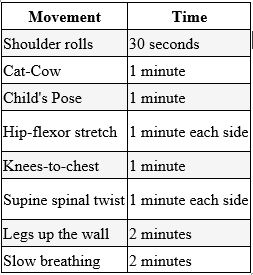
Total: approximately 10 minutes
You can perform this routine in the morning, after a long period of sitting, following travel or before bed.
A Simple Weekly Mobility Plan
Consistency matters more than doing an extremely long stretching session once a week.
Monday–Friday
5–10 minutes daily
Focus on:
- Spine mobility
- Hips
- Shoulders
- Gentle breathing
2–3 days per week
Add:
- Resistance training
- Core strengthening
- Glute strengthening
- Walking or another form of cardiovascular exercise
Weekend
Consider a longer 15–20 minute mobility or yoga session, followed by walking and relaxation.
The bigger goal is to avoid spending the entire day in one position.
Move regularly. Stretch when you feel stiff. Strengthen the muscles that support movement. Recover properly.
The “Movement Snack” Approach
You don’t have to wait until the evening to stretch. If you’ve been sitting for a long time, take a 2–3 minute movement break.
30 seconds shoulder rolls
30 seconds standing back extension or gentle mobility
30 seconds hip movement
30 seconds walking
30 seconds slow breathing
Repeat several times throughout the day.
For many people, the biggest improvement may come not from one perfect stretching session, but from breaking up long periods of uninterrupted sitting.
Stretching Rules: Less Force, More Consistency
A good stretching routine should leave you feeling looser and more comfortable—not injured.
Remember: Don’t bounce. Use slow, controlled movements.
Don’t force range of motion. A mild pulling sensation can be normal. Sharp, burning, or worsening pain is not something to push through.
Don’t hold your breath. Keep breathing naturally.
Don’t compete with yourself. Your flexibility today doesn’t need to match someone else’s.
Warm up when appropriate. If you are doing deeper mobility work or stretching before exercise, begin with gentle movement first.
Strength matters too. Flexibility and mobility are only part of the picture. A healthy back also benefits from adequate strength, physical activity, and good movement habits.
Stretching, Exercise, Nutrition & Recovery: The Bigger Picture
Back and muscle tension rarely exists in isolation. Your daily routine may include:
Movement → walking and mobility
Strength → resistance training
Nutrition → adequate protein, fibre, micronutrients and hydration
Recovery → sleep and rest
Stress management → breathing, relaxation and time away from screens
Lifestyle → reducing prolonged sitting and maintaining regular movement
Supplements may sometimes have a role where there is a genuine nutritional need or a specific performance objective, but they should not be viewed as a substitute for movement, nutrition, sleep or professional medical care.
For athletes and active individuals, supplement quality also matters. Where supplements are used, look for transparent ingredients, appropriate manufacturing standards and, where relevant, independent or batch testing and recognised sport-certification programmes.
When Stretching Is Not the Answer
Not every episode of back or neck discomfort should be treated with stretching.
Speak with a qualified healthcare professional if pain is:
- Severe or persistent
- Getting progressively worse
- Associated with significant weakness or numbness
- Radiating strongly into an arm or leg
- Associated with loss of balance or coordination
- Following a significant injury
- Associated with bladder or bowel changes
- Accompanied by other concerning symptoms
If you have an existing spinal condition, recent surgery, osteoporosis, significant injury or another medical condition, obtain appropriate professional guidance before beginning a new exercise or stretching programme.
The Fitcart Takeaway
You don’t need complicated equipment or an hour of yoga every day to look after your spine and muscles.
A few minutes of gentle mobility, combined with controlled breathing, regular walking, strength training, good nutrition and adequate recovery, can become a simple daily investment in physical wellbeing.
Stretch gently. Move regularly. Breathe slowly. Strengthen consistently. Recover well.
Your spine doesn’t need perfection—it needs regular movement and sensible care.
Health, Wellness & Supplement Disclaimer
The information provided in this article is intended for general educational and wellness purposes only. It is not intended to diagnose, treat, cure or prevent any disease, medical condition, injury or health problem, and it should not replace advice from a qualified doctor, physiotherapist, sports medicine professional, registered dietitian or other appropriate healthcare professional.
Stretching and exercise are not suitable for every individual or every condition. Stop any movement that causes pain, dizziness, numbness, unusual weakness or other concerning symptoms and seek appropriate professional advice.
Any discussion of nutrition or supplements is for general educational purposes and does not constitute medical advice or a recommendation to take a particular product or dosage. Supplements should be considered alongside overall diet, training, sleep, lifestyle, individual nutritional requirements and, where appropriate, blood tests and professional guidance.
For athletes, supplement quality and contamination risk are particularly important. A label or marketing claim alone does not guarantee that a supplement is free from prohibited or undeclared substances. Athletes should consider products with appropriate independent quality assurance and, where relevant, recognised sport-certification and batch-testing programmes. Always verify the specific product and batch/lot number where certification databases are available.
Individuals taking medication, pregnant or breastfeeding, managing a medical condition, or preparing for competition should obtain appropriate professional guidance before using supplements.
Fitcart supports informed, evidence-aware nutrition and the use of appropriately tested sports nutrition products.
Follow us on X: https://x.com/fitcartofficial and Instagram: https://www.instagram.com/fitcartofficial/ for the latest updates, health insights, and exclusive content.
Follow Smart Nutrition India X: https://x.com/SmartNutrition1 and Instagram: https://www.instagram.com/smartnutritionindia/ for trusted sports nutrition, supplement education, wellness tips, and the latest news from the world of health and performance.
Fitcart believes in True Play and Clean Sport
#trustedbrandsbetterhealth