



Fitcart Editorial Team Ritu Makhija.
The longevity industry has never been more exciting—or more confusing.
Every week brings a new discovery promising to slow ageing, reverse biological age, improve cellular health, or help us live longer.
Biological-age tests, longevity supplements, GLP-1 medications, wearable devices, senolytics, NAD+ boosters, fasting protocols, personalised nutrition, AI-powered health platforms, and experimental cellular-reprogramming technologies are all part of the conversation.
Some of this research is genuinely groundbreaking. Some is promising but still early.
And some claims have moved considerably faster than the science.
So, what should we actually believe in 2026?
The most useful way to understand the current longevity landscape is to separate what we know, what looks promising, and what remains largely experimental or overhyped.
First: Longevity Is Not the Same as Living Longer
One of the biggest problems with longevity marketing is that several different concepts are often treated as though they mean the same thing. They don’t.
Lifespan is how long you live.
Healthspan is the period of life spent in good health and functional independence.
Biological age is an attempt to describe aspects of physiological or molecular ageing that may differ from chronological age.
An intervention that improves cardiovascular health, muscle strength or metabolic health may be extremely valuable without having been proven to extend lifespan.
Likewise, a treatment that changes a biological-age biomarker has not automatically been proven to make someone healthier or live longer.
This distinction is particularly important because no gerotherapeutic has yet been approved specifically as an anti-ageing treatment, and researchers continue to debate which biomarkers can reliably demonstrate modification of human ageing.
The Longevity Evidence Map
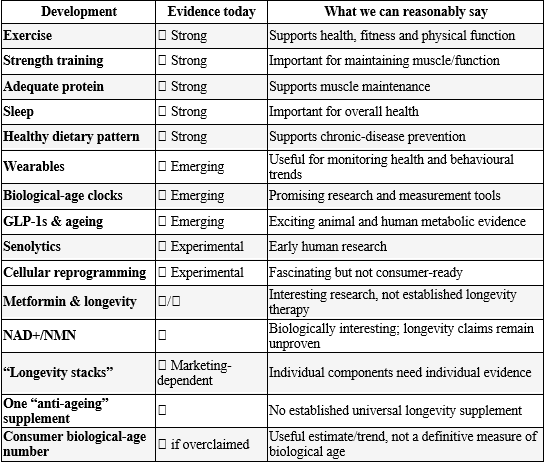
Let’s look at what sits behind the table.
🟢 What Is Strongly Evidence-Backed?
1. Exercise Remains One of the Best Longevity Strategies
For all the excitement around new longevity drugs and laboratory discoveries, exercise remains one of the most consistently supported components of healthy ageing.
Regular physical activity can support cardiovascular fitness, metabolic health, muscle function, mobility and physical independence.
Strength training is particularly important as we age because maintaining muscle and strength becomes increasingly relevant to mobility and everyday function.
Recent 2026 research continues to explore how physical activity affects ageing biology, including molecular changes in ageing tissues and age-associated inflammatory processes. Research in older adults has also found that physical fitness can preserve more youthful molecular characteristics in skeletal muscle.
But we should be careful with the terminology.
Exercise doesn’t need to be sold as an “age-reversal treatment.”
Its value is much more straightforward:
It helps maintain the physical systems that allow us to remain healthier and more independent as we age.
What the evidence supports
- Cardiovascular exercise
- Resistance training
- Regular daily movement
- Mobility and balance work
- Avoiding prolonged inactivity
What is hype?
Claims such as:
“This particular workout reverses your biological age by 10 years.”
That’s a much stronger claim than the evidence supports.
🟢 2. Protein and Muscle Preservation
Muscle is one of the most important components of functional ageing.
As people get older, maintaining muscle mass and strength becomes increasingly important for mobility, physical independence and resilience.
That makes adequate dietary protein an important part of healthy ageing nutrition.
Protein can come from:
- Fish
- Eggs
- Dairy
- Lean meat
- Soy
- Beans and lentils
- Other plant proteins
- Protein supplements when appropriate
The goal isn’t necessarily to consume enormous amounts of protein.
It is to ensure that nutritional intake supports muscle maintenance, particularly when combined with resistance training.
What is evidence-backed?
Adequate protein + resistance exercise + sufficient overall nutrition.
What is hype?
“The more protein you consume, the longer you will live.”
That has not been established.
🟢 3. Sleep Is Part of the Longevity Equation
Sleep is sometimes overlooked because it doesn’t come in a bottle.
But it remains one of the most important components of general health.
Researchers are increasingly studying relationships between sleep, physical activity, inflammation and biological ageing.
Recent NIH-supported research has examined how sleep and exercise may influence inflammatory processes associated with age-related clonal haematopoiesis.
The important point is that sleep doesn’t need a “longevity” label to be valuable.
Consistent, adequate sleep supports:
- Recovery
- Cognitive function
- Metabolic health
- Immune function
- Mood
- Exercise performance
What is hype?
A supplement that promises to “activate your longevity genes overnight.”
Sleep itself is much more important than a fashionable sleep stack.
🟢 4. A Healthy Dietary Pattern Still Matters
Longevity nutrition isn’t necessarily about one miracle food.
Researchers continue to investigate calorie restriction, fasting, dietary composition and nutrient-sensing pathways.
A 2026 review in Nature Aging examined decades of dietary-restriction research and discussed pathways involving autophagy, AMPK, mTORC1, NAD+, sirtuins and GLP-1 signalling. Importantly, the review also discusses potential negative consequences of excessive dietary restriction, including impaired wound healing and increased vulnerability to infection.
This is an important point.
More restriction isn’t automatically better.
The modern longevity approach needs to consider adequate nutrition, muscle preservation and individual circumstances.
🟡 What Is Promising but Not Yet Proven?
5. Biological-Age Clocks
This is one of the most fascinating developments in modern longevity research.
Scientists can now estimate biological ageing using measurements such as:
- DNA methylation
- Proteomics
- Metabolomics
- Blood biomarkers
- Clinical measurements
- Multi-omics data
Some newer clocks are becoming increasingly sophisticated.
In 2026, researchers published work examining how epigenetic ageing biomarkers respond to different categories of longevity interventions, including lifestyle interventions, medications and supplements.
But there is a critical distinction:
A biological-age clock is a measurement tool—not a crystal ball.
If a test tells you that your biological age is 52 when your chronological age is 58, it does not mean that you will live six years longer.
Likewise, a change in an ageing biomarker does not automatically prove that an intervention has extended healthspan or lifespan.
The future may be more interesting than the number
Instead of asking:
“What’s my biological age?”
we may eventually ask:
“Which biological systems are ageing faster than others?”
That could lead to much more personalised health strategies.
🟡 6. Wearables and Digital Longevity
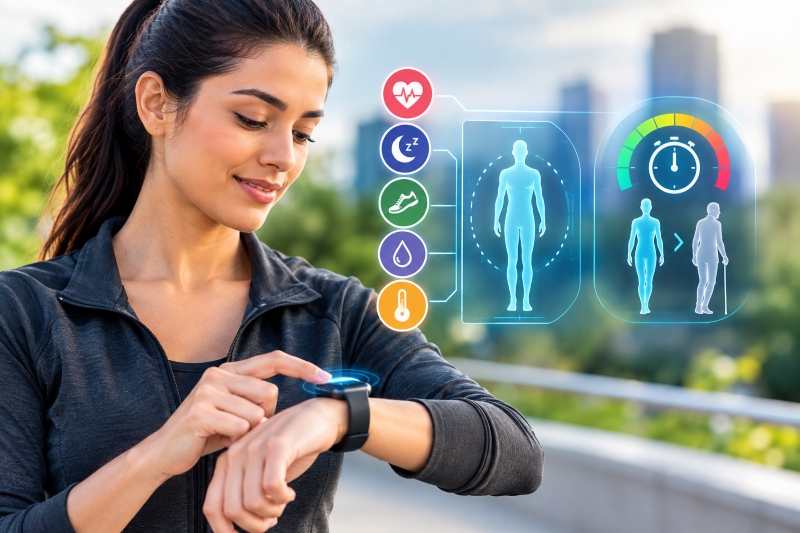
Smartwatches, fitness trackers and smart rings can now continuously collect information about:
- Heart rate
- Resting heart rate
- HRV
- Activity
- Sleep
- Recovery
- Exercise
- Respiratory patterns
Researchers are increasingly investigating whether these long-term patterns can provide information about biological ageing.
This is genuinely promising.
But a wearable does not directly measure the age of your cells.
A device measures physiological signals and an algorithm interprets them.
Therefore:
Fitness age ≠ biological age
Cardio age ≠ biological age
Sleep score ≠ biological age
And none of these is the same as predicting lifespan.
Wearables may become extremely useful as continuous health-monitoring tools, but consumers should be cautious about treating a proprietary score as a definitive medical measurement.
🟡 7. GLP-1 Drugs and Longevity
This is arguably one of the most interesting developments of 2026.
An NIH-funded study published in September 2026 found that semaglutide extended lifespan in older female mice. The treated mice also showed improvements in several measures associated with ageing, including muscle and cognitive function.
That’s an important discovery.
But here’s the crucial sentence:
The study was conducted in mice.
It does not prove that semaglutide extends human lifespan.
There is also some emerging human evidence around biological-age biomarkers. A 2026 randomized trial analysis in adults with HIV-associated lipohypertrophy found that semaglutide was associated with slower epigenetic ageing across several DNA-methylation clocks. However, the study was a post-hoc analysis, involved a relatively small and specific population and lasted 32 weeks. The authors themselves call for prospective trials.
So the evidence is becoming more interesting—but the conclusion remains:
GLP-1 drugs are established metabolic medicines with potentially important longevity implications that are still being investigated.
They are not yet proven human anti-ageing drugs.
🟠 8. Senolytics: The Search for “Zombie Cell” Therapies
Senescent cells are cells that have stopped dividing but remain metabolically active.
Some can release inflammatory signals and contribute to tissue dysfunction.
This has led scientists to investigate senolytics—treatments designed to selectively remove certain senescent cells.
The concept is scientifically compelling.
But humans are much more complicated than laboratory models.
Senescent cells can also have beneficial roles, including roles in tissue repair and protection against cancer.
This means that simply trying to remove all senescent cells would not necessarily be desirable.
Senolytic research therefore remains experimental.
Evidence status:
Interesting biology + promising preclinical research + early human investigation.
Not established:
“Take a senolytic and reverse ageing.”
🟠 9. Cellular Reprogramming
This may sound like science fiction.
Researchers are investigating whether cells can be partially reprogrammed to restore some characteristics associated with younger cells.
The concept is sometimes described as cellular rejuvenation or epigenetic reprogramming.
The challenge is enormous.
Scientists need to determine whether cells can be rejuvenated without:
- Losing their specialised identity
- Becoming dysfunctional
- Creating uncontrolled growth
- Increasing cancer risk
This is an extraordinary area of research—but it is not a consumer anti-ageing treatment.
Evidence status: 🟠 Experimental.
🟠 10. Metformin and Longevity
Metformin is another example of an intervention where the science is much more nuanced than the headlines.
It is an established medication for appropriate metabolic indications.
Researchers have also been interested in whether it affects ageing-related pathways.
Interestingly, a 2026 randomized controlled trial in North Indian adults with prediabetes reported changes in telomere length, telomerase activity and longevity-related gene expression after 24 weeks of metformin treatment. The findings are interesting, but the study measured surrogate biological markers rather than lifespan or long-term healthspan.
This is exactly why evidence grading matters.
A change in a biomarker is not automatically proof of longer life.
Evidence status:
Interesting longevity research.
Not established:
Metformin as a general-purpose anti-ageing medication for healthy people.
🟠 11. NAD+, NMN and Related Longevity Compounds
NAD+ is involved in fundamental cellular processes, including energy metabolism.
NMN and NR are being investigated because they can influence NAD-related biology.
The underlying science is legitimate.
But the leap from:
“This influences an important cellular pathway”
to:
“This will slow human ageing and extend lifespan”
is enormous.
The current evidence does not justify treating NAD+ boosters as proven human longevity therapies.
This is a recurring problem in the supplement industry:
Mechanism ≠ clinical outcome.
A compound can affect a pathway associated with ageing without demonstrating a meaningful improvement in human healthspan or lifespan.
🔴 The Biggest Longevity Hype: The “Perfect Stack”
The idea of a longevity stack is attractive.
Take:
NMN + resveratrol + magnesium + omega-3 + spermidine + creatine + CoQ10 + vitamin D + something else…
and perhaps you have a formula for longer life.
The problem is that evidence doesn’t work that way.
Each ingredient needs to be considered separately.
Questions should include:
- Is there a genuine nutritional need?
- Is there evidence for the specific outcome?
- What dose was studied?
- Was the study conducted in humans?
- How long did it last?
- Was it randomized?
- Was the outcome clinically meaningful?
- Are there potential interactions?
- Is long-term safety established?
A supplement can be useful without being a longevity drug.
For example, correcting a genuine nutrient deficiency can be important for health without proving that taking extra amounts beyond requirements extends lifespan.
🔴 The “One Anti-Ageing Supplement” Doesn’t Exist
This may be the most important message for consumers.
There is currently no universally proven supplement that has been demonstrated to make healthy humans live substantially longer.
That doesn’t mean supplements are unimportant.
Some can have legitimate roles in nutrition, correcting deficiencies, supporting exercise or addressing specific health needs.
But the evidence needs to match the claim.
Supporting muscle is not the same as extending lifespan.
Improving sleep is not the same as reversing ageing.
Changing a biomarker is not the same as preventing disease.
Improving cardiovascular health is not the same as proving longevity extension.
These distinctions make longevity science much more credible.
So What Does a Real Longevity Strategy Look Like?
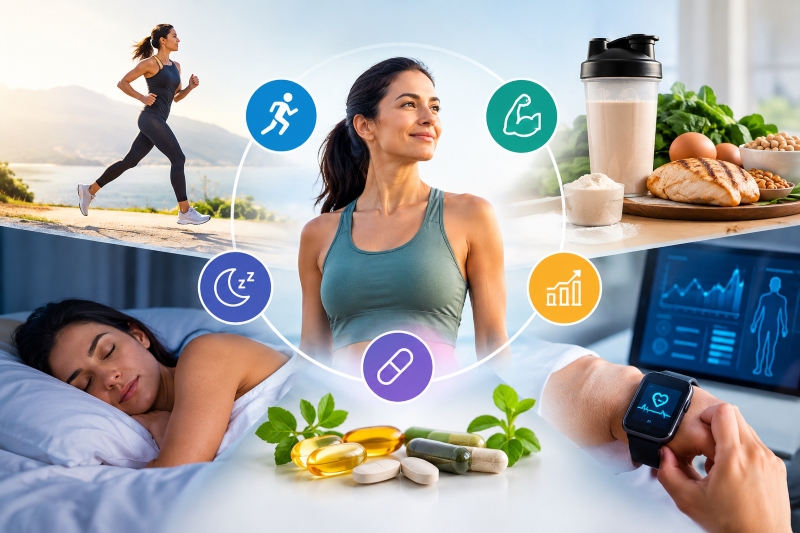
Perhaps surprisingly, the evidence-backed strategy is considerably less glamorous than the marketing. It starts with:
Move
Maintain cardiovascular fitness, strength, mobility and balance.
Eat well
Prioritise nutrient-dense foods and adequate protein while avoiding unnecessary extremes.
Sleep
Protect consistent, sufficient and restorative sleep.
Maintain muscle
Resistance exercise and adequate protein become increasingly important with age.
Manage metabolic health
Blood pressure, glucose, lipids, body composition and other appropriate health measures matter.
Avoid smoking
This remains one of the clearest ways to reduce major disease risk.
Use supplements strategically
Correct deficiencies and use evidence-based supplements where there is a reasonable individual indication.
Monitor trends
Blood tests, physical performance, body composition and wearable data can provide useful information when interpreted appropriately.
Work with healthcare professionals
Especially when considering medications, high-dose supplements or interventions targeting a medical condition.
The Future of Longevity May Be Personalised
One of the most exciting developments isn’t a particular supplement.
It is precision health.
Imagine a future system that combines:
Wearable data
•
Blood biomarkers
•
Body composition
•
Physical performance
•
Sleep
•
Nutrition
•
Genetics and epigenetics
•
Medical history
•
AI
Rather than simply telling you:
“Your biological age is 51.”
the system could potentially identify areas requiring attention.
For example:
Cardiovascular fitness — strong
Muscle strength — needs attention
Sleep regularity — moderate
Metabolic markers — monitor
Nutrient status — assess
Recovery — declining
That could be far more useful than a single “age” number.
The Fitcart Longevity Test
At Fitcart, we believe longevity should be approached with evidence rather than excitement alone.
Before believing a new longevity claim, ask five questions:
1. Was it tested in humans?
Animal research can be incredibly valuable, but it isn’t proof of a human outcome.
2. What was actually measured?
Was it lifespan?
Healthspan?
A disease outcome?
A blood marker?
A biological-age clock?
These are very different endpoints.
3. How long was the study?
A few weeks or months cannot necessarily tell us what happens over decades.
4. Was the study designed to test the claim?
A post-hoc analysis can generate an important hypothesis, but it is not equivalent to a prospective trial designed specifically to test longevity.
5. Is the claim bigger than the evidence?
This may be the most important question of all.
If the study shows an improvement in a biomarker but the marketing says “live longer,” there is a gap between the science and the claim.
What Should We Actually Be Excited About?
The good news is that we don’t need exaggerated claims to make longevity science exciting.
Researchers are developing increasingly sophisticated ways of studying ageing.
We are learning more about:
- Cellular senescence
- Epigenetic ageing
- Biological-age clocks
- Muscle ageing
- Brain ageing
- Metabolic ageing
- Immune ageing
- Nutrient sensing
- Mitochondrial biology
- Wearable-derived health data
- AI-assisted drug discovery
- Personalised health interventions
Some of these could eventually transform medicine.
But science needs time.
The most exciting discoveries today may become tomorrow’s medical treatments—but they need to pass through rigorous human research first.
The Bottom Line
The longevity field in 2026 is neither a miracle nor a scam.
There is genuine science happening.
But it exists alongside a rapidly growing commercial industry that sometimes moves faster than the evidence.
The strongest foundation remains remarkably familiar:
Exercise.
Strength.
Adequate nutrition and protein.
Sleep.
Healthy metabolic and cardiovascular function.
Avoidance of major risk factors.
Appropriate medical care.
Then, around that foundation, we can investigate newer tools—wearables, biomarkers, targeted supplementation, AI and emerging therapies.
The future of longevity may ultimately be less about finding a single “anti-ageing” pill and more about understanding which factors are driving ageing in each individual and how safely we can modify them.
That is where the concept of precision longevity becomes particularly interesting.
And perhaps the best rule for navigating the longevity industry is a simple one:
Be excited by new science—but make the size of the claim match the strength of the evidence.
Fitcart Perspective
At Fitcart, we believe supplements should complement—not replace—a balanced diet, appropriate exercise, adequate sleep, recovery, and healthy lifestyle practices.
Where supplements are used, consumers should consider ingredient transparency, appropriate manufacturing standards and independent quality or batch testing where relevant. Athletes should take additional care because they can be responsible for prohibited substances detected in their samples.
The future of healthy ageing is exciting.
But the goal shouldn’t be to take the biggest possible supplement stack.
It should be to make better-informed, evidence-aware decisions about healthspan, performance and long-term wellbeing.
Disclaimer
Health, Longevity & Research Disclaimer:
The information provided in this article is for general educational and informational purposes only and is not intended to diagnose, treat, cure or prevent any disease or medical condition, nor should it be considered medical advice.
Longevity and healthy-ageing research is an evolving field. Findings from laboratory studies, animal studies, observational research, biomarker studies and early-stage clinical trials do not necessarily demonstrate that an intervention will extend human lifespan or healthspan. Changes in biological-age markers or other surrogate measures should not automatically be interpreted as evidence of longer life or reduced disease risk.
The evidence classifications used in this article are intended to provide general context and should not be interpreted as clinical recommendations. Scientific understanding can change as new research becomes available.
Supplement Disclaimer:
Dietary and sports-nutrition supplements should complement, not replace, a balanced diet, appropriate physical activity, adequate sleep, recovery and a healthy lifestyle. No single supplement should be assumed to extend human lifespan unless supported by appropriate high-quality human evidence.
Individual nutritional and health requirements vary according to age, diet, physical activity, medical history, medications and other factors. Consult a qualified healthcare professional, registered dietitian or appropriately qualified practitioner before beginning a new supplement programme, making significant dietary changes or using supplements for a specific health condition.
Avoid unnecessary mega-dosing. Certain supplements may interact with medications or may not be appropriate for individuals with particular health conditions.
Sports Nutrition & Testing:
Athletes should exercise additional caution when selecting supplements because they may be held responsible for prohibited substances detected in their samples. Where appropriate, athletes should select products that have undergone independent quality and batch-level testing and verify the specific product and batch/lot through the relevant certification programme.
Fitcart supports evidence-aware supplement use, ingredient transparency, responsible product selection and appropriate quality testing. The inclusion or discussion of an ingredient, product category or emerging longevity intervention on Fitcart does not constitute an endorsement, medical recommendation or guarantee of a particular health, performance or longevity outcome.
Always consider the quality of the available evidence and seek professional advice where appropriate.
Follow us on X: https://x.com/fitcartofficial and Instagram: https://www.instagram.com/fitcartofficial/ for the latest updates, health insights, and exclusive content.
Follow Smart Nutrition India X: https://x.com/SmartNutrition1 and Instagram: https://www.instagram.com/smartnutritionindia/ for trusted sports nutrition, supplement education, wellness tips, and the latest news from the world of health and performance.
Fitcart believes in True Play and Clean Sport
#trustedbrandsbetterhealth