



Fitcart Sports News Blog.
Authored by S. Kannan (Sports Analyst) and Fitcart Editorial Team Ritu Makhija.
Reading time: 8–10 minutes.
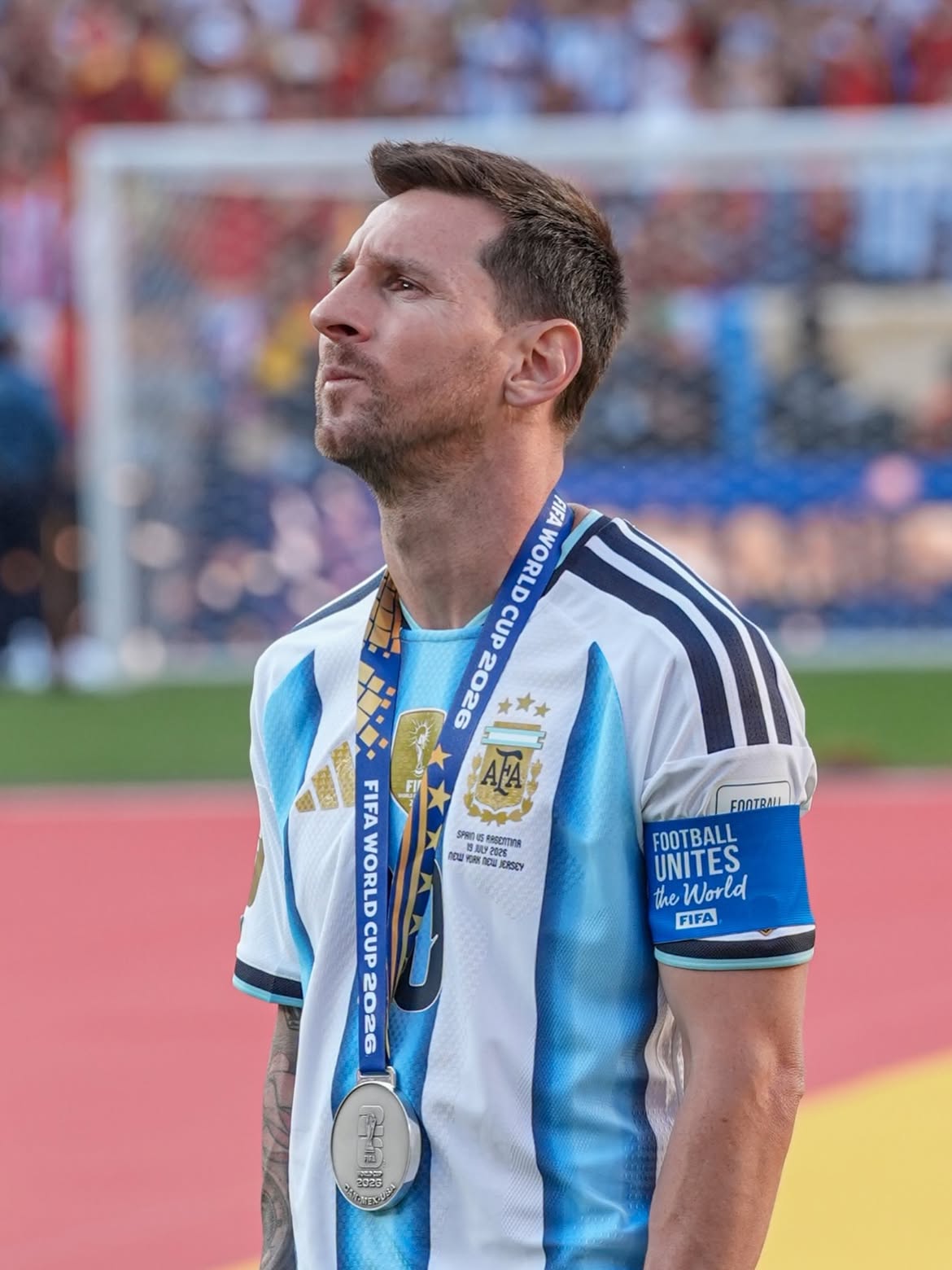
News of Lionel Messi retiring from international football has left fans teary-eyed. For the talismanic star from Argentina, who was heir apparent to Diego Maradona, life in the last few years has been tough. At 39 years of age, when many players in any sport retire, Messi had outlived his shelf-life. Yet, the kind of energy he produced at the 2026 FIFA World Cup was defining.
It is one thing that Argentina failed to win the World Cup this time, losing 0-1 to Spain in the final, but the kind of impact Messi made was massive. The five feet and seven inches tall icon was battling bottled emotions, which he tried to conceal during the World Cup. But then. Midway through the World Cup, it became clear that Messi’s father was unwell. Messi has been close to his father, Jorge Messi. The grand old man died on August 8, after which Leo Messi was in mourning.
Reading his social media post on Monday, it became clear that Messi was struggling. He has talked of struggling in the days after the World Cup concluded. Clearly, playing for Argentina, even in 2026, was a decision which surprised many. He had lost speed, said some. Messi was not the same guy as a force, reckoned others. Despite the negative news surrounding him, Messi played as well as he could. His footwork was music on the turf. We enjoyed it, even as he unleashed the left and right footers with immense grace. Alas, in his last hurrah in the USA, he could not score.
Legacies are not measured by statistics alone. Legacies are memories; legacies are emotions. What Lionel Messi leaves behind is a treasure trove as the face of Argentinian football. It is only after he has walked away into the sunset that people now realise what they are going to miss. For someone who has scored 927 goals till now, in club and country football, Messi has been a legend. He will still play in Spain for FC Barcelona, as a star who has built a massive reputation there.
For a previous generation that loved rascal Diego Maradona, a rascal and someone who defined boorish behaviour, comparisons with Messi are wrong. Maradona’s generation was different, and he was audacious. Nobody will forget the (in)famous Hand of God incident from Maradona. It has been dubbed outright cheating.
No, Messi never had any action like this where his image was sullied. In an age where AI (Artificial Intelligence) uses all tricks to show the various shades of Messi, he has been portrayed as someone who is ageing, Heck, from his long mane to his posture, Messi has been criticised by heartless hacks. It never mattered, since Messi is far above all this.
In a career where he has attained stardom and rose to Himalayan heights, what was defining about Messi was his stage presence and how he loved pressure. Dealing with high performance has never been easy for many athletes. In the case of Messi, perhaps, being away from home and plying his trade in Spain made him grow differently.
Imagine, for someone from Argentina to be so far away in Spain, break barriers and soar was not easy. More than an Argentine star, Spaniards have loved Messi even more. One look at European newspapers on Tuesday, Messi is all over. His retirement has hit all, that he will never ever again play for Argentina. It’s a bit like what happens with cricketers like Virat Kohli and Rohit Sharma. They have quit two formats, and only limited-overs ODIs and the IPL is what fans still thirst for. Messi, too, will ensure more people watch him at FC Barcelona.
As regards fitness, how Messi prepared, trained, and lasted so long, it has been a scientific approach. Messi used all modern methods in diet, training, hydration, and pressure. It is his inbuilt nature as a natural athlete; he has survived for so long. There is more to come in club football, but what Messi achieved for Argentina gives him the status of GOAT – Greatest Of All Time.
FITCART ANALYSIS: What Can We Learn From Messi’s Extraordinary Athletic Longevity?
Lionel Messi’s international retirement is not simply the end of an era in football. It is also an opportunity to look at something that interests athletes, coaches, sports scientists and ordinary fitness enthusiasts alike:
How can an athlete remain capable of performing at an elite level for more than two decades?
Messi’s longevity cannot be attributed to one food, one supplement, one training programme, or one recovery technique.
Elite longevity is generally the result of hundreds of small decisions repeated consistently over many years.
And this is perhaps the biggest lesson for everyday fitness enthusiasts.
You do not need to train like Messi to learn from Messi.
You need to understand the principles behind elite performance.
1. Nutrition becomes more important with age
One of the most frequently discussed changes in Messi’s career was his approach to nutrition.
Reports dating back to his work with nutritionist Giuliano Poser described a greater emphasis on water, olive oil, whole grains, fruits and vegetables, while reducing highly processed foods and excess sugar.
The important Fitcart lesson isn’t to copy Messi’s exact diet.
It is this:
As training demands increase, nutrition needs to become more intentional.
A serious training diet should provide:
- Adequate protein for muscle repair
- Carbohydrates to support high-intensity exercise
- Healthy fats
- Vitamins and minerals
- Fibre and plant foods
- Adequate fluids and electrolytes
- Sufficient calories to support training and recovery
For recreational athletes, this can be achieved through relatively simple foods: eggs, fish, chicken, dairy or suitable alternatives, pulses, whole grains, fruits, vegetables, nuts and seeds.
The objective is not a “celebrity diet”.
The objective is nutritional adequacy and consistency.
2. Carbohydrates are fuel — especially for football
There is sometimes a misconception that athletes should minimise carbohydrates to remain lean.
For a sport such as football, that can be counterproductive.
Repeated sprinting, acceleration, changes of direction and high-intensity running place considerable demands on muscle glycogen.
Research into professional footballers demonstrates substantial energy expenditure and significant carbohydrate requirements during training and competition.
This is why an athlete’s carbohydrate intake may need to increase around demanding training or competition.
Good options can include:
- Rice
- Potatoes
- Oats
- Whole grains
- Bananas
- Other fruit
- Wholegrain breads
- Other minimally processed carbohydrate sources
For the general population, the message is simple:
Carbohydrates are not automatically the enemy of fitness.
The quantity, quality and timing matter.
3. Hydration is performance nutrition
Football played at elite level places enormous demands on fluid balance.
The 2026 FIFA World Cup presented another reminder of the importance of hydration because matches and training took place across varying environmental conditions.
Sports medicine guidance for the 2026 World Cup emphasised individualised hydration strategies, accounting for sweat losses, fluid requirements, electrolytes and carbohydrate utilisation.
For recreational athletes, particularly in India, this is highly relevant.
Training in Delhi, Mumbai, Chennai, Bengaluru or other hot and humid environments can produce significant sweat losses.
Depending on the intensity and duration of exercise, water alone may not always be enough.
During prolonged or intense exercise, particularly in significant heat, electrolytes and carbohydrate-containing fluids can have a role.
However, more electrolytes are not automatically better.
Hydration should be individualised according to exercise duration, sweat rate, climate and the athlete’s needs.
4. Recovery may be the most underrated part of training
One of the biggest differences between professional athletes and recreational athletes is often not how hard they train.
It is how seriously they take recovery. At the elite level, recovery can include:
- Sleep
- Nutrition
- Hydration
- Mobility work
- Physiotherapy
- Load management
- Injury prevention
- Medical monitoring
- Appropriate rest
Modern football has increasingly adopted sports-science approaches to training-load management and recovery. Experts have noted that professional players now have far greater awareness of how to manage their bodies and recover from training than previous generations.
This has important implications beyond football.
If you exercise hard seven days a week without allowing recovery, you may not necessarily become fitter.
You may simply become more fatigued.
5. Training changes as athletes get older
A 20-year-old athlete and a 39-year-old athlete cannot necessarily train in exactly the same way.
As athletes age, maintaining muscle mass, mobility, strength, tendon health and recovery capacity becomes increasingly important.
This doesn’t mean older athletes should stop training hard.
It means training should become smarter.
Strength training can be particularly valuable because maintaining muscle and functional strength becomes increasingly important with age.
A recent 2026 review on physical activity, fitness and longevity highlighted the importance of individualised exercise prescriptions and incorporating resistance training alongside cardiorespiratory fitness.
For the ordinary fitness enthusiast, the lesson is powerful:
Don’t simply exercise more. Exercise better.
6. Messi’s longevity isn’t something a supplement can reproduce
This is an important Fitcart point.
There is no magic supplement capable of turning somebody into Lionel Messi.
Protein powder cannot create Messi’s football intelligence.
Creatine cannot create his ball control.
Omega-3 cannot create his acceleration.
Magnesium cannot reproduce decades of elite training.
And no supplement can replace sleep, nutrition, coaching and disciplined training.
Supplements can potentially help fill specific nutritional gaps or support particular performance goals, but they should sit on top of a good lifestyle foundation, not replace it.
For athletes, commonly considered evidence-based sports nutrition ingredients may include protein, creatine, caffeine and carbohydrate/electrolyte products depending on the sport, training load and individual circumstances.
The important words are:
depending on the individual.
7. The Fitcart approach: personalise sports nutrition
One of the biggest changes taking place in modern nutrition is the movement away from the idea that everyone needs exactly the same supplement stack.
An elite footballer training twice a day has completely different nutritional demands from:
- A 25-year-old recreational gym-goer
- A weekend runner
- A 45-year-old executive
- A competitive cyclist
- A teenage athlete
- A woman going through hormonal changes
- Someone trying to lose body fat while maintaining muscle
The future of nutrition is increasingly about personalisation.
Training volume, age, diet, body composition, sleep, goals and, where appropriate, laboratory information can all influence nutritional decisions.
8. What the Messi story teaches the everyday athlete
You don’t need to score hundreds of goals to benefit from the Messi philosophy.
The broader lessons are remarkably universal:
Eat well
Build your diet around nutrient-dense foods rather than depending on highly processed foods.
Train consistently
Fitness is built over years, not weeks.
Recover seriously
Rest is part of training.
Stay hydrated
Especially when training in heat.
Maintain muscle
Strength and lean mass become increasingly important with age.
Manage training load
More is not always better.
Look after your body
Small injuries and persistent fatigue should not simply be ignored.
Use supplements intelligently
Choose products based on evidence, need, quality and individual suitability.
Think long-term
The goal isn’t to be at your absolute peak for one month.
The goal is to remain healthy and capable for decades.
Messi’s Real Secret? Consistency
There is an understandable temptation to search for a secret behind extraordinary athletes.
Was it the diet?
Was it the training?
Was it genetics?
Was it supplements?
Was it recovery?
The answer is probably a combination of many factors.
Talent provided the foundation.
But talent alone doesn’t explain a career lasting more than two decades at the very highest level.
Modern sports science has transformed how elite athletes approach nutrition, recovery, training load and injury prevention. Messi’s career illustrates the enormous value of combining exceptional natural ability with professional preparation.
And perhaps that is the most useful message for Fitcart readers.
You don’t need Messi’s genetics to adopt Messi’s discipline.
You can eat better.
You can train consistently.
You can sleep more.
You can hydrate properly.
You can strength train.
You can manage stress.
You can recover.
And you can use supplements intelligently when there is a genuine reason to do so.
Those habits may not turn anyone into the next Messi.
But they can potentially make a significant difference to your own performance, health and longevity.
A Note on Messi’s Club Career
One factual clarification is important for readers.
The original article says Messi will continue playing for FC Barcelona in Spain. Messi currently plays for Inter Miami, not Barcelona. His Inter Miami contract runs through the end of the 2028 season, according to reporting following his international retirement.
His international retirement therefore marks the end of his Argentina career, rather than necessarily the end of his professional playing career.
That distinction matters: Messi has retired from international football, not necessarily from football itself.
Fitcart Supplement Quality Advisory
For athletes and fitness enthusiasts considering supplements, Fitcart recommends choosing products that are manufactured to recognised quality standards and, wherever possible, are batch-tested and independently verified for identity, purity and contents.
Athletes competing in tested sport should pay particular attention to products carrying credible third-party sports certification, because contamination with prohibited substances can create significant risks.
Supplements should complement a sound diet and training programme rather than substitute for either.
Medical & Sports Nutrition Disclaimer
This article is intended for general educational and informational purposes only and should not be considered medical, nutritional, diagnostic or performance advice.
Individual nutritional and supplement requirements vary according to age, sex, health status, training volume, diet, medications and individual goals. Consult a qualified physician, registered dietitian, sports nutritionist or other appropriate healthcare professional before beginning a new exercise, nutrition or supplementation programme.
Athletes subject to anti-doping regulations should check every supplement carefully and use products that have undergone appropriate third-party testing for prohibited substances. No supplement should be assumed to be risk-free simply because it is marketed for athletes.
Fitcart does not suggest that the use of any particular supplement was responsible for Lionel Messi’s performance or longevity.
Image credit to leomessi on Instagram.
Follow us on X: https://x.com/fitcartofficial and Instagram: https://www.instagram.com/fitcartofficial/ for the latest updates, health insights, and exclusive content.
Follow Smart Nutrition India X: https://x.com/SmartNutrition1 and Instagram: https://www.instagram.com/smartnutritionindia/ for trusted sports nutrition, supplement education, wellness tips, and the latest news from the world of health and performance.
Fitcart believes in True Play and Clean Sport
#trustedbrandsbetterhealth