



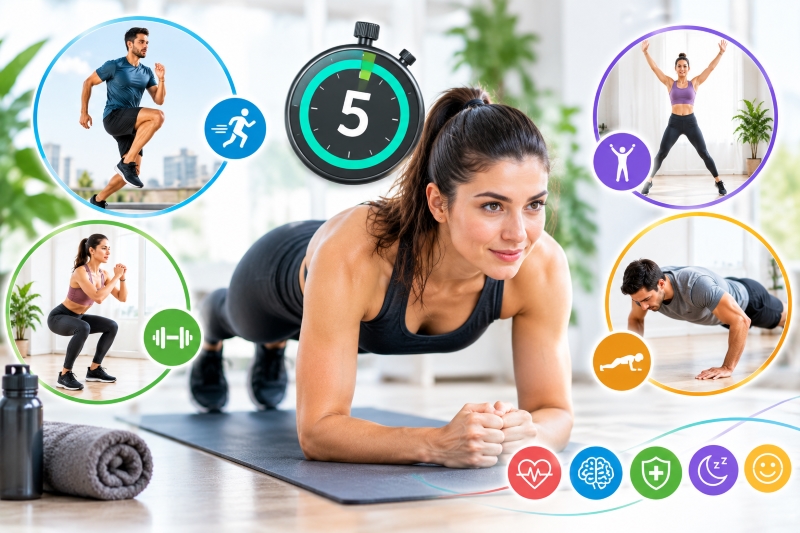
How exercise snacks, everyday movement, and smarter training habits may help you build fitness, support metabolism, and stay active for longer.
Reading time: 8–10 minutes.
Author: Ritu Makhija.
Co-Founder, Fitcart.com.
Head of Editorial Team, Fitcart Blog.
Introduction: What If Your Next Workout Took Just Five Minutes?
Between work, family responsibilities, travel, and everyday commitments, finding time to exercise can be difficult. Many people assume that if they cannot fit in a 45-minute gym session, there is little point in exercising at all.
Exercise science offers a more encouraging perspective: short bouts of physical activity spread throughout the day may provide meaningful benefits, particularly for people who are currently inactive.
This approach is often called exercise snacking — brief periods of movement performed several times a day rather than one long workout.
Examples include taking the stairs for a couple of minutes, performing a short bodyweight routine, briskly walking between meetings or completing a few sit-to-stand repetitions during a break.
These short sessions are not a magic shortcut to fitness, but they can help make movement more achievable and consistent.
At Fitcart, we believe that effective fitness is about building sustainable habits, combining appropriate exercise with good nutrition and recovery, and choosing supplements only when they have a clear purpose.
1. What Is Exercise Snacking?
Exercise snacking involves brief, repeated bouts of physical activity distributed throughout the day.
Unlike a traditional workout, which may take place in a single session, exercise snacks can be incorporated into existing routines.
Examples include:
- Two minutes of brisk stair climbing, if safe and appropriate.
- A short set of chair squats or sit-to-stand movements.
- A few minutes of brisk walking after a meal.
- A brief resistance-band routine between periods of desk work.
- Short movement breaks during prolonged sitting.
The intensity can vary. Some exercise-snack studies have used moderate-to-vigorous or near-maximal activity, while everyday movement breaks can be gentler.
The important distinction is that not every five-minute movement break needs to be intense. Beginners and people returning to exercise can start with comfortable activity and progress gradually.
2. What Does the Research Say?
A systematic review and meta-analysis published in the British Journal of Sports Medicine in 2026 examined brief exercise bouts in physically inactive adults and older adults.
The review included 11 randomised controlled trials involving 414 participants. The interventions generally involved exercise bouts lasting five minutes or less, performed at least twice daily on three or more days each week.
The researchers found improvements in cardiorespiratory fitness among adults and improvements in muscular endurance among older adults. However, the number of studies was relatively small, and the certainty of evidence differed between outcomes.
Other research published in 2025 has also investigated the effects of exercise snacks on cardiometabolic health and body composition.
Together, these findings suggest that short, structured bouts of activity can be a useful way to build fitness, especially for people who are otherwise inactive. They do not establish that five-minute sessions are equivalent to every form of longer-duration exercise, nor do they guarantee weight loss.
The most useful takeaway is that movement does not have to be all-or-nothing.
3. How Can Five Minutes of Movement Help?
Supporting cardiovascular fitness
Activities that raise the heart rate can challenge the cardiovascular system. Repeated short bouts may help improve cardiorespiratory fitness when performed at a suitable intensity and consistently over time.
For someone who currently spends most of the day sitting, a short period of brisk movement may be a practical starting point.
Breaking up sedentary time
Long periods of uninterrupted sitting are common in office-based work and other sedentary routines.
Standing up, walking around and performing gentle movements throughout the day can help break up sedentary time. These breaks are especially useful when they become part of a consistent daily routine.
Building muscular endurance
Simple exercises such as chair squats, wall push-ups and resistance-band movements can challenge muscles.
However, building substantial strength or muscle mass generally requires a progressive training plan that challenges the muscles sufficiently over time. Five-minute sessions can contribute to that plan, but the amount of stimulus matters.
Making exercise easier to sustain
One of the biggest advantages of exercise snacks may be behavioural.
A short session can feel less intimidating than a full workout. Once movement becomes habitual, some people may find it easier to build up to longer sessions or more structured training.
Consistency is more useful than an ambitious plan that is repeatedly abandoned.
4. Your Fitcart Five-Minute Movement Routine
Here is a simple routine for generally healthy adults who can exercise comfortably. Move at a controlled pace and adapt the exercises to your ability.
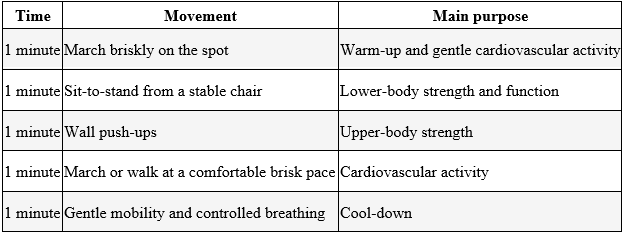
This is a simple movement break, not a validated treatment protocol or a complete exercise programme.
If you are a beginner, reduce the duration, rest as needed and use support where appropriate. If you have balance problems, joint pain or a medical condition, seek advice about suitable movements.
You can repeat a short routine at different times of day, but the appropriate frequency depends on your fitness, recovery and health.
5. Can Exercise Snacks Help with Weight Management?
Short bouts of activity contribute to total daily energy expenditure, and regular movement can support metabolic health.
However, weight management depends on several factors, including overall dietary intake, activity levels, sleep, health conditions and long-term habits.
Five minutes of exercise does not automatically burn a large number of calories or produce visible fat loss. The energy expenditure of a short session is usually modest.
For sustainable weight management, combine regular movement with:
- A balanced dietary pattern and appropriate portions.
- Adequate protein to support muscle maintenance.
- Fibre-rich foods, including vegetables, fruits, legumes and whole grains.
- Regular sleep and recovery.
- A realistic exercise routine that can be maintained.
The aim is to move a normal part of everyday life rather than relying on short workouts to compensate for an otherwise inactive routine.
6. Do Exercise Snacks Replace Gym Training?
Not necessarily.
Short exercise sessions are useful, particularly for people who struggle to find time for activity. However, different forms of exercise serve different purposes.
For general health, adults should work towards established physical activity recommendations, including aerobic exercise and muscle-strengthening activities.
If your goal is to build muscle, improve athletic performance or increase strength substantially, a structured programme with progressive resistance and appropriate recovery is likely to be more effective than occasional movement breaks alone.
Exercise snacks can complement gym training by increasing movement throughout the day, breaking up sedentary periods and helping maintain consistency between formal workouts.
Think of them as another tool in your fitness routine, not a replacement for every other form of exercise.
7. Nutrition and Recovery: The Other Half of the Equation
Exercise provides a stimulus, but the body also needs appropriate nutrition and recovery to adapt.
Protein: Include adequate protein from foods such as eggs, dairy, fish, poultry, tofu, beans and lentils. Protein powders can be convenient when dietary intake falls short, but they are not essential for everyone.
Carbohydrates: Whole grains, fruits, vegetables and other carbohydrate-containing foods can provide energy for physical activity. The amount required depends on the intensity and duration of exercise.
Hydration: Drink regularly and adjust fluid intake to the weather, activity and your individual needs.
Sleep: Sufficient sleep supports recovery, mood and exercise performance.
Progression: As fitness improves, gradually increase the duration, frequency or challenge of your activity rather than suddenly introducing intense workouts.
Do you need pre-workout supplements?
For a short movement break, most people do not need a pre-workout supplement.
For longer or more demanding training, some people use products containing caffeine or other ingredients, but the benefits and risks depend on the formulation and the individual. Caffeine can interfere with sleep and may cause unwanted effects in sensitive individuals.
Start with consistent training, adequate food, hydration, and sleep before considering performance supplements.
If you do use supplements, review the ingredient list, dose, potential interactions, and relevant quality testing. Athletes should pay particular attention to prohibited-substance contamination risk.
8. A Simple Seven-Day Movement Challenge
Try making movement part of your daily schedule over the next week.
Days 1–2: Take a short walking or mobility break during a prolonged sitting period.
Days 3–4: Add one or two brief sessions of chair squats, wall push-ups, or other suitable bodyweight movements.
Days 5–6: Build in a few additional walking breaks and notice which times of day move easiest.
Day 7: Review what felt manageable and plan how to continue.
The goal is not to achieve a perfect score or maximise calorie burn. It is to identify an approach that fits your life and can be sustained.
The Fitcart Takeaway
The five-minute fitness revolution is not about finding a shortcut around exercise. It is about making regular movement more accessible.
Research suggests that repeated short bouts of exercise can improve certain measures of fitness, particularly in people who are physically inactive. The evidence is promising, but it is still developing, and short sessions do not replace every benefit of a well-rounded exercise programme.
Start with movements you can perform safely, build consistency and gradually progress as your fitness improves. Combine everyday activity with appropriate strength training, balanced nutrition and adequate recovery.
At Fitcart, we believe that better health is built through practical, evidence-informed habits — not unrealistic promises.
Five minutes may be a starting point. The lasting benefit comes from what you do consistently.
Health, Exercise and Supplement Disclaimer
This article is for general educational purposes only and is not a substitute for medical advice or individualised exercise guidance. Exercise suitability varies according to age, fitness, medical history and physical ability.
If you have a chronic medical condition, significant mobility limitations or symptoms such as chest pain, dizziness or unusual breathlessness, consult a qualified healthcare professional before starting or increasing exercise. Stop exercising if you experience concerning symptoms.
Supplements are not required for every workout and should not replace balanced nutrition, hydration, sleep or appropriate training. Consult a qualified healthcare professional before using supplements if you take medication, have a medical condition, are pregnant or breastfeeding, or have other relevant health considerations.
Choose products from reputable sources, check ingredient labels and follow recommended directions. Independent testing and certification may help verify specific quality attributes but cannot guarantee that a product is risk-free or effective. Athletes should verify relevant sports certification and batch information where available.
Fitcart encourages safe, evidence-based exercise, balanced nutrition and responsible supplementation. Individual results may vary.
References and Further Reading
- Effect of exercise snacks on fitness and cardiometabolic health in physically inactive individuals: systematic review and meta-analysis. British Journal of Sports Medicine, 2026.
- Effects of Exercise Snacks on Cardiometabolic Health and Body Composition in Adults: A Systematic Review and Meta-Analysis. Scandinavian Journal of Medicine & Science in Sports, 2025.
- World Health Organization. WHO Guidelines on Physical Activity and Sedentary Behaviour, 2020.
Follow us on X: https://x.com/fitcartofficial and Instagram: https://www.instagram.com/fitcartofficial/ for the latest updates, health insights, and exclusive content.
Follow Smart Nutrition India X: https://x.com/SmartNutrition1 and Instagram: https://www.instagram.com/smartnutritionindia/ for trusted sports nutrition, supplement education, wellness tips, and the latest news from the world of health and performance.
Fitcart believes in True Play and Clean Sport
#trustedbrandsbetterhealth