



By Ritu Makhija | CEO, Founder & Head of Fitcart Editorial Team.
Reading time: 7 minutes.
What if one of the simplest exercises you could do for cardiovascular health involved nothing more than squeezing your hand?
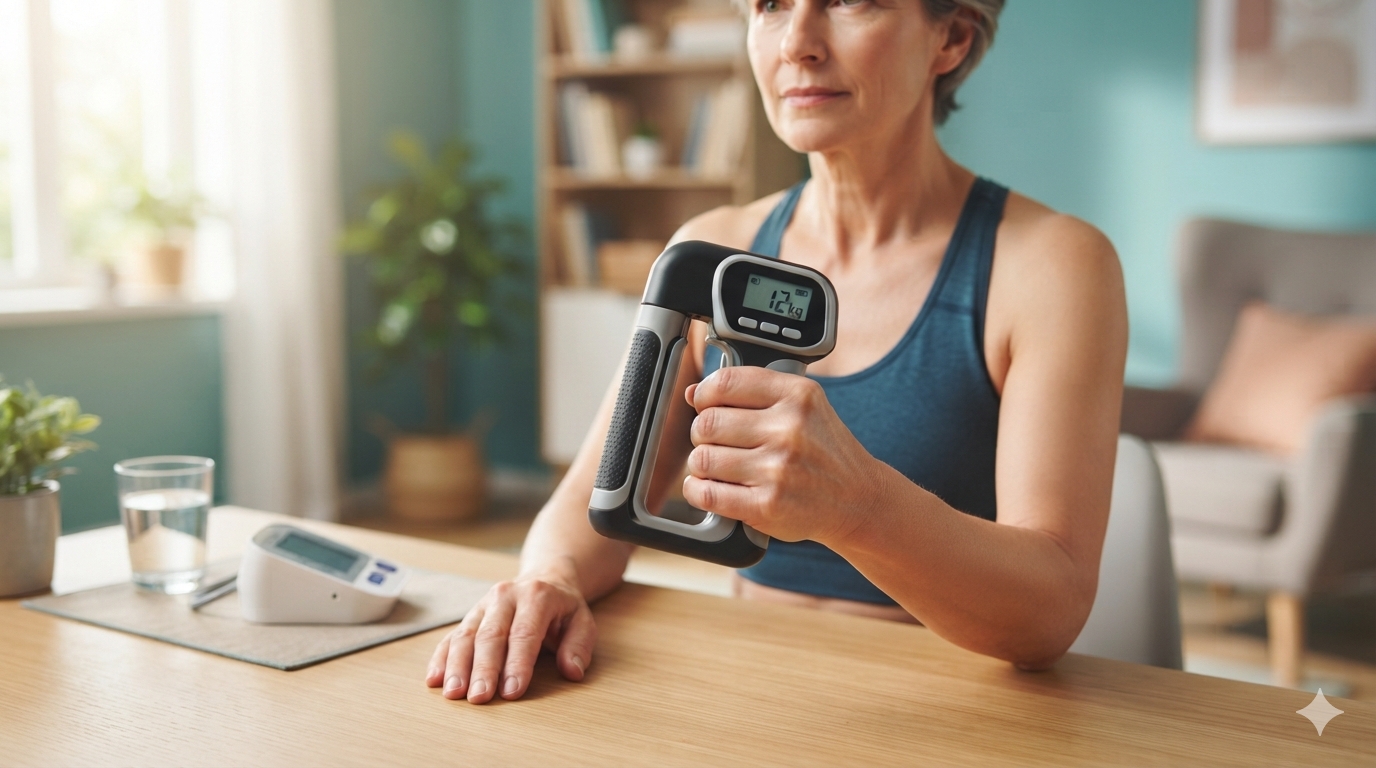
Isometric handgrip training — repeatedly contracting the muscles of the hand and forearm without moving the joint — has attracted increasing attention for its potential effect on blood pressure.
It is simple. It can be done sitting down. It requires very little space. And you don’t necessarily need a gym.
Research suggests that regular low-intensity isometric handgrip training can reduce resting blood pressure, particularly in people with elevated blood pressure or hypertension. A 2023 systematic review and meta-analysis of randomised controlled trials found that regular handgrip training reduced systolic blood pressure by about 6.7 mmHg and diastolic blood pressure by about 4.5 mmHg in adults with hypertension.
A newer 2025 meta-analysis covering 31 studies and 905 participants also found average reductions of approximately 5.4 mmHg in systolic blood pressure and 2.7 mmHg in diastolic blood pressure.
So could something as simple as a handgrip become part of your daily health routine?
The answer appears to be potentially yes — but the details matter.
What Is an Isometric Handgrip Exercise?
An isometric exercise involves contracting a muscle without significantly changing its length or moving the joint.
With a handgrip exercise, you squeeze a grip device and hold the contraction.
You aren’t lifting a weight through a range of motion.
Instead:
Squeeze → hold → relax → recover → repeat.
This creates a relatively small but sustained muscular demand.
Over time, regular isometric training may produce adaptations in the cardiovascular system that can help regulate blood pressure.
Why Could Handgrip Exercise Affect Blood Pressure?
Blood pressure is influenced by many factors, including cardiac output, blood vessel resistance, nervous-system activity, and the elasticity of the cardiovascular system.
Regular exercise can influence several of these systems.
Isometric exercise appears to have some particularly interesting effects on vascular regulation.
Research into handgrip training suggests that repeated sessions may improve the body’s ability to regulate vascular resistance and blood pressure.
The exact mechanisms are still being investigated, but the evidence is increasingly supportive of isometric exercise as one possible adjunctive strategy for blood-pressure management.
Importantly, it isn’t a replacement for prescribed medication, medical care, aerobic exercise or an overall healthy lifestyle.
The Research Is Interesting
One controlled study in Indian adults with hypertension used a protocol of four 2-minute handgrip contractions, with four-minute recovery periods, performed over eight weeks. The handgrip group experienced significant reductions in resting blood pressure compared with controls.
Another study in treated Japanese adults with hypertension found that eight weeks of handgrip training — four 2-minute contractions at approximately 30% of maximum voluntary contraction, at least three days per week — reduced both morning and evening home blood pressure.
And a 2025 study in older adults found that eight weeks of home-based isometric handgrip training reduced office systolic and diastolic blood pressure, although it did not significantly reduce 24-hour ambulatory blood pressure.
This distinction is important.
Handgrip exercise is promising, but it isn’t magic — and not every study produces exactly the same result.
How Much Handgrip Exercise Do You Need?
This is where we need to move away from the idea that “twice a day is always better.”
Many research protocols have used:
4 sets × 2 minutes
with approximately:
1 minute rest between sets
at roughly:
30% of maximum voluntary contraction
performed around 3 times per week.
Some protocols have used different intensities, durations and frequencies.
A recent meta-analysis found that lower-intensity protocols can still have effects, but the relationship between intensity, frequency and blood-pressure reduction is complex.
Therefore, rather than prescribing an exact twice-daily medical protocol for everyone, a sensible approach is to think of handgrip exercise as a small, repeatable movement habit.
The Fitcart Handgrip Starter Routine
If you are new to handgrip training, start gently.
Morning
1 minute: gentle warm-up
2 minutes: handgrip contractions
1 minute: rest
2 minutes: handgrip contractions
Total:
Approximately 6 minutes
You can alternate hands or use both hands depending on the equipment and protocol.
The contraction should feel moderate and controlled, not like an all-out maximal squeeze.
What About Twice a Day?
A morning and evening routine can be an easy way to build consistency.
For example:
Morning — 5–6 minutes
Handgrip training after your morning routine.
Evening — 5–6 minutes
Another short session while sitting, reading or relaxing.
However, twice-daily training isn’t required by the evidence for everyone, and more is not necessarily better.
Current research supports regular training, while optimal frequency and dosage are still being studied.
If your goal is blood-pressure management, discuss the appropriate protocol with your healthcare professional — particularly if you already have hypertension or take blood-pressure medication.
The Grip Strength Connection
Handgrip exercise is also interesting because grip strength itself is an important functional measure.
Your grip is involved in:
- carrying shopping bags
- opening containers
- lifting weights
- holding a suitcase
- climbing
- using tools
- supporting yourself during certain exercises
- everyday independence as we age
Grip strength is therefore more than a measure of how hard you can squeeze a device.
It can provide information about overall muscular function and physical capability.
However, a stronger grip does not automatically mean a healthier cardiovascular system, and grip strength should not be used as a standalone diagnostic test.
Could Handgrip Training Help With Healthy Ageing?
This is where the exercise becomes particularly interesting for Fitcart.
As we age, maintaining muscle strength and functional capacity becomes increasingly important.
Handgrip training is not a substitute for full-body strength training, but it can complement it.
Think of it as one small piece of a larger longevity strategy:
Grip strength
•
Leg strength
•
Core strength
•
Balance
•
Mobility
•
Aerobic fitness
•
Healthy body composition
•
Good nutrition
•
Sleep and recovery
Together, these provide a much stronger foundation for healthy ageing than any single exercise.
Other Potential Benefits
The strongest evidence for isometric handgrip training relates to blood-pressure outcomes. But there are several other potential advantages.
1. Improved grip strength
Repeated resistance can strengthen the muscles involved in gripping.
2. Convenient exercise
You can train almost anywhere.
3. Minimal equipment
A small handgrip device is inexpensive and portable.
4. Useful for sedentary periods
It can provide a small amount of muscular activity during otherwise inactive periods.
5. Supports functional fitness
Grip strength contributes to many everyday activities.
6. Easy to track
You can monitor resistance, duration and repetitions over time.
7. Complements full-body training
It can be incorporated alongside walking, resistance training and mobility work.
But Don’t Stop Walking
This is extremely important. Handgrip training should be viewed as an addition, not a replacement for aerobic exercise.
Walking, cycling, swimming and other forms of cardiovascular activity remain important components of cardiovascular health.
The best routine might look like:
Daily walking
•
2–3+ days of resistance training
•
Mobility
•
Handgrip/isometric exercise
•
Good nutrition
•
Adequate sleep
•
Stress management
That is a much more complete health strategy.
A Simple Weekly Fitcart Plan
Monday
Walking + handgrip
Tuesday
Strength training + handgrip
Wednesday
Walking + mobility + handgrip
Thursday
Strength training + handgrip
Friday
Walking + handgrip
Saturday
Strength training + mobility
Sunday
Walking + gentle recovery
The handgrip sessions can be short.
The bigger goal is consistency.
The 5-Minute Health Habit
One of the most powerful ideas in health and fitness is that exercise doesn’t always have to be complicated.
A five-minute movement break can be easier to maintain than an elaborate programme.
Handgrip exercise fits beautifully into this concept.
You can do it:
while watching television
at your desk
while travelling
during a work break
while listening to a podcast
after a walk
as part of your morning routine
The best exercise is often the one you can perform consistently.
One Important Safety Point: Don’t Hold Your Breath
When performing isometric exercise, people can instinctively hold their breath while squeezing hard.
Avoid this.
Holding your breath and performing a maximal contraction can cause a temporary rise in blood pressure.
This is particularly important for people with hypertension or cardiovascular conditions.
Instead:
Breathe normally.
Use a controlled contraction.
Avoid maximal squeezing.
Relax between contractions.
Research protocols commonly use controlled submaximal contractions rather than repeated maximal efforts.
Who Should Be Careful?
If you have:
- diagnosed hypertension
- cardiovascular disease
- a history of stroke
- significant vascular disease
- uncontrolled blood pressure
- an arrhythmia
- significant hand or wrist problems
- recent surgery or injury
Speak with your healthcare professional before beginning a new exercise programme.
If you experience chest pain, severe breathlessness, dizziness, fainting or other concerning symptoms, stop exercising and seek appropriate medical attention.
And if you are taking blood-pressure medication, do not change your medication because your blood pressure improves with exercise without discussing it with your doctor.
Fitcart’s Bigger Message: Small Habits, Big Health
The handgrip story is really a story about something much bigger.
Health doesn’t always require complicated interventions. Sometimes it starts with a five-minute habit.
A short walk.
A few squats.
A mobility routine.
A set of resistance exercises.
A few minutes of controlled breathing.
Or a simple handgrip session.
Over time, these small behaviours can become part of a much larger health strategy.
At Fitcart, we believe in evidence before hype.
Handgrip exercise is not a miracle cure for high blood pressure.
But the growing research around isometric training makes it an interesting, accessible tool that may complement a broader cardiovascular and fitness programme.
Squeeze. Hold. Breathe. Release. Repeat.
Small movements can become meaningful habits.
And meaningful habits can become part of a healthier life.
Health & Wellness Disclaimer
The information in this article is provided for general educational and wellness purposes only. It is not intended to diagnose, treat, cure or prevent hypertension, cardiovascular disease or any other medical condition, and it should not replace advice from a qualified doctor, physiotherapist, exercise professional or other healthcare provider.
The research on isometric handgrip exercise and blood pressure is promising, but results vary between individuals and study protocols. Handgrip exercise should be considered an adjunct to, rather than a replacement for, prescribed medication, medical care, a balanced diet, aerobic activity, resistance training, healthy weight management, adequate sleep and other recommended lifestyle measures.
People with hypertension, cardiovascular disease or other medical conditions should obtain appropriate professional guidance before beginning a new exercise programme.
Do not stop or change prescribed medication because of changes in blood pressure without speaking with your healthcare professional.
When performing isometric exercise, avoid maximal effort and breath-holding unless specifically instructed by a qualified professional. Stop if you experience chest pain, severe breathlessness, dizziness, fainting or unusual symptoms.
Supplement Disclaimer
Supplements are not required to perform handgrip exercises and should not be used as a substitute for a balanced diet or medical treatment.
Where supplements are used for sports nutrition or general nutritional support, Fitcart recommends choosing products with transparent ingredients, appropriate manufacturing standards and, where relevant, independent or batch-level testing and recognised sport-certification programmes.
Athletes should remember that they can be responsible for prohibited substances found in their bodies. A label or marketing claim alone does not guarantee that a product is free from prohibited or undeclared substances. Where certification databases are available, athletes should verify the specific product and batch/lot number.
Fitcart supports evidence-aware nutrition, responsible supplementation, and tested-clean sports nutrition.
Follow us on X: https://x.com/fitcartofficial and Instagram: https://www.instagram.com/fitcartofficial/ for the latest updates, health insights, and exclusive content.
Follow Smart Nutrition India X: https://x.com/SmartNutrition1 and Instagram: https://www.instagram.com/smartnutritionindia/ for trusted sports nutrition, supplement education, wellness tips, and the latest news from the world of health and performance.
Fitcart believes in True Play and Clean Sport
#trustedbrandsbetterhealth