




By Ritu Makhija | Co-Founder, Fitcart & Head of Fitcart Editorial Team, Fitcart Blog.
Reading Time: 10 minutes.
Could one essential mineral help support your brain, muscles, sleep, heart, and healthy ageing?**
Magnesium is often associated with muscle cramps, relaxation and sleep. But this essential mineral does much more.
Magnesium is involved in more than 300 biochemical reactions throughout the body, including processes involved in energy production, nerve signalling, muscle contraction, protein synthesis, DNA production, blood glucose regulation and blood pressure.
And now, researchers are taking a closer look at magnesium’s potential role in brain health and cognitive ageing.
One recent clinical trial has attracted particular attention: adults taking magnesium L-threonate for six weeks showed improvements in overall cognitive performance, working and episodic memory, and reaction time. The researchers also reported a 7.5-year reduction in estimated cognitive brain age compared with placebo.
So, can magnesium actually make you younger?
The science is more nuanced — and arguably more interesting.
Magnesium and the Brain: Why It Matters
The brain requires a constant supply of energy and relies on carefully regulated electrical and chemical signalling.
Magnesium participates in processes that help maintain neuronal function, regulate ion channels, and support normal neurotransmission. It is also involved in cellular energy production and helps regulate calcium and potassium movement across cell membranes — processes essential for nerve impulses and normal muscle and heart function.
Research has also explored magnesium’s relationship with inflammation, oxidative stress and neuronal excitability — mechanisms that are increasingly important in discussions around healthy brain ageing. Reviews suggest that maintaining adequate magnesium status may support neuronal health and help regulate pathways associated with inflammation and oxidative stress.
This does not mean magnesium is a treatment for dementia or neurodegenerative disease. Human evidence is still developing.
But maintaining adequate magnesium intake is one part of creating a nutritional environment that supports long-term brain health.
The “Younger Brain” Connection
The phrase “younger brain” has become increasingly popular in longevity research.
But there is an important distinction between:
Biological age and estimated cognitive age.
A person’s chronological age is simply how many years they have lived. Cognitive or brain-age estimates attempt to describe how an individual’s cognitive performance compares with expected performance for their age.
In the recent magnesium L-threonate trial, 100 adults aged 18–45 with self-reported dissatisfied sleep received either 2 g per day of magnesium L-threonate or placebo for six weeks.
The magnesium group showed:
* Improved overall cognitive performance
* Improvements in working and episodic memory
* Faster reaction time
* A reported **7.5-year reduction in estimated cognitive age**
* Improvements in some measures of sleep-related impairment
* Changes in heart rate and heart-rate variability
However, not every cognitive or sleep measure improved, and the trial was relatively small and short. The researchers also disclosed commercial funding and provision of the investigational ingredient by the ingredient developer.
The right interpretation is therefore not “magnesium reverses ageing.”
A more scientifically responsible interpretation is:
Early clinical evidence suggests that certain forms of magnesium may support cognitive performance and may influence measures used to estimate cognitive age. Larger and longer independent trials are needed to determine whether this translates into meaningful long-term protection against cognitive ageing.
That distinction matters.
At Fitcart, we believe that good nutrition should be built around evidence rather than hype.
Magnesium and Healthy Ageing
Magnesium is also attracting interest in the wider field of longevity.
A scientific review examining magnesium in relation to the biological “hallmarks of ageing” discussed potential links with inflammation, mitochondrial function, cellular senescence, genomic stability, nutrient sensing, autophagy and other biological pathways involved in ageing. The authors proposed that maintaining adequate magnesium may contribute to healthy ageing — while emphasizing that more well-designed human research is needed.
This is an important distinction.
Magnesium should not be described as an anti-ageing pill.
Instead, it may be better understood as a foundational mineral that supports many of the biological systems involved in maintaining health as we age.
And that makes magnesium particularly relevant to a healthy-longevity strategy.
7 Potential Benefits of Magnesium
1. Brain and cognitive function
Magnesium supports normal neurological function and is involved in neuronal signalling and cellular energy metabolism.
Emerging research, particularly around magnesium L-threonate, suggests potential benefits for memory and cognitive performance. However, a 2024 systematic review concluded that the number of randomized controlled trials was still too limited to draw firm conclusions about magnesium supplementation and cognitive health.
2. Muscle function and exercise
Magnesium is essential for normal muscle contraction and nerve function.
It is also involved in ATP production — the energy system that powers cellular activity and physical performance.
For active adults, adequate magnesium intake therefore forms part of a sound nutrition strategy supporting normal muscle and energy metabolism.
Research has also investigated whether magnesium supplementation can improve measures of muscle fitness, although results are not strong enough to position magnesium as a performance-enhancing substitute for proper training and nutrition.
3. Sleep and relaxation
Magnesium is frequently used in evening nutrition routines because of its relationship with nervous-system and muscle function.
There is some promising evidence, particularly in older adults, but the overall picture remains mixed.
A recent systematic review of randomized controlled trials found inconsistent results across sleep outcomes and rated the certainty of evidence as low or very low. The evidence therefore does not support magnesium currently as a routine treatment for insomnia.
In other words:
Magnesium may be part of a healthy sleep strategy — but it is not a sleeping pill.
4. Heart and blood pressure
Magnesium contributes to normal cardiovascular and neuromuscular function.
Some research suggests that higher magnesium intake is associated with better cardiovascular outcomes, while supplementation may produce modest reductions in blood pressure in some people. However, the NIH notes that evidence for magnesium supplementation and cardiovascular disease prevention remains incomplete.
Magnesium should therefore complement — not replace — exercise, a healthy diet, weight management, sleep and appropriate medical care.
5. Blood glucose and metabolic health
Magnesium participates in glucose metabolism and numerous enzymatic reactions.
Observational research has found that people with higher dietary magnesium intake tend to have a lower risk of developing type 2 diabetes, although this does not establish that magnesium supplements prevent diabetes.
6. Bone health
Magnesium contributes to normal bone structure and metabolism.
Because healthy ageing involves maintaining muscle, bone and balance together, adequate magnesium is one piece of the broader nutrition picture alongside sufficient protein, calcium, vitamin D, resistance exercise and regular physical activity.
7. A foundation for healthy ageing
Perhaps the most interesting way to think about magnesium is not as a single-purpose supplement.
It is a mineral involved in energy production, DNA and protein synthesis, nervous-system function, muscle function, bone health and antioxidant defence.
That makes adequate magnesium intake relevant at almost every stage of life.
Food First: Where Can You Get Magnesium?
Before reaching for a supplement, look at your diet.
Good food sources include:
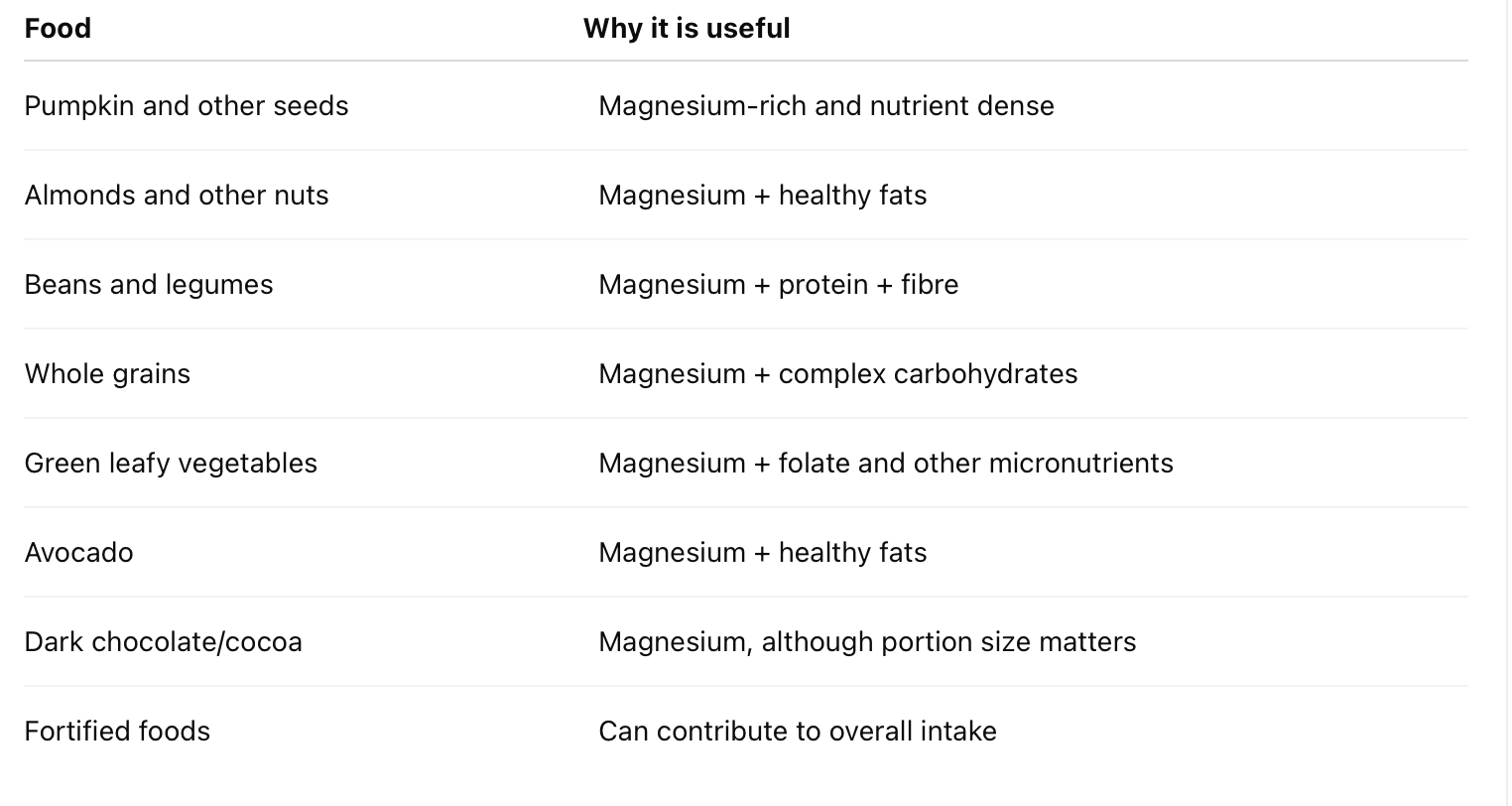
The NIH recommends approximately **310–320 mg/day for adult women and 400–420 mg/day for adult men**, with requirements varying according to age and life stage.
Food remains the foundation.
A supplement is best considered a way of filling a nutritional gap, rather than an excuse to replace a nutrient-dense diet.
Which Magnesium Should You Choose?
This is where consumers need to pay attention. “Magnesium” is not one single supplement.
Different magnesium compounds have different properties and absorption profiles.
Common forms include:
* Magnesium citrate
* Magnesium glycinate
* Magnesium chloride
* Magnesium lactate
* Magnesium oxide
* Magnesium L-threonate
The NIH notes that citrate, lactate, chloride and aspartate generally have better bioavailability than magnesium oxide and magnesium sulfate.
Magnesium L-Threonate and Brain Health
Magnesium L-threonate has attracted particular interest because researchers have investigated its potential effects on brain magnesium and cognition.
Recent human research has produced encouraging findings, including the 2026 randomized trial described above.
However, it is important to remember that promising evidence for one magnesium form does not mean every magnesium supplement will produce the same effect.
Form, dose, elemental magnesium content, formulation, quality, and individual nutritional status all matter.
Elemental Magnesium: The Number That Matters
One common mistake when buying magnesium is looking only at the weight of the magnesium compound.
The Supplement Facts panel generally reports the amount of **elemental magnesium** rather than the total weight of the entire magnesium compound.
For example, two products may both say “magnesium 500 mg” on the front but deliver very different amounts of elemental magnesium depending on the form and formulation.
Always check the actual elemental magnesium per serving.
How Much Magnesium Should You Supplement With?
More is not necessarily better.
For adults, the U.S. National Academies’ tolerable upper intake level for **magnesium from supplements and medications** is 350 mg per day. This limit does not include magnesium naturally present in food.
Higher supplemental amounts can cause:
* Diarrhoea
* Nausea
* Abdominal cramping
Very high intakes can cause serious toxicity, particularly in people with impaired kidney function.
This is why magnesium supplementation should be individualised rather than megadosed.
If someone has kidney disease, takes regular medication, is pregnant, or is considering higher-dose supplementation, professional guidance is particularly important.
Magnesium can also interfere with absorption of certain medicines, including some antibiotics and oral bisphosphonates.
How to Choose a High-Quality Magnesium Supplement
At Fitcart, we believe the question should not simply be:
“Does this magnesium look good?”
The better question is:
“Can I verify what is actually in this product?”
A high-quality magnesium supplement should ideally provide clear information about:
1. Exact magnesium form
The label should clearly identify whether it contains citrate, glycinate, L-threonate or another magnesium compound.
2. Elemental magnesium
The actual elemental magnesium per serving should be clearly stated.
3. Transparent ingredients
Look for a straightforward ingredient list without unnecessary proprietary blends that prevent consumers from knowing what they are actually consuming.
4. Good manufacturing standards
The manufacturer should have appropriate quality-control and manufacturing systems, ideally operating under recognised GMP/cGMP standards.
5. Independent testing
Testing by an appropriately qualified independent laboratory adds another layer of confidence.
6. Batch or lot testing
This is most important. A certificate associated with a specific batch or lot number is more meaningful than simply displaying a generic quality logo.
Where applicable, consumers should be able to verify testing for:
* Identity
* Potency
* Purity
* Heavy metals
* Microbiological contaminants
* Relevant adulterants or contaminants
For athletes, additional consideration should be given to sport-specific contamination risk and appropriate prohibited-substance screening.
7. Traceability
A quality supplement should ideally have traceability through its raw materials, manufacturing process, packaging, and finished product.
Don’t Judge a Supplement by the Label Alone
A premium-looking bottle does not automatically mean a premium supplement.
Likewise, a certification logo should not be treated as the entire quality story.
For serious supplement users — particularly athletes — the goal should be:
Ingredient transparency → reputable manufacturing → independent testing → batch verification → traceability.
This is especially important because athletes can be held responsible for prohibited substances found in their supplements, even when contamination was not intentional.
For sports nutrition, consumers should look for appropriate third-party certification and, where available, verify the **actual product and batch/lot number** through the relevant certification system.
Tested and traceable beats simply “labelled.”
Magnesium and Your Longevity Strategy
If your goal is to age well, magnesium should not sit at the centre of the strategy.
It should sit **inside the strategy**.
A stronger longevity framework includes:
Resistance training
Daily movement and cardiovascular fitness
Adequate protein
Fibre-rich whole foods
Healthy body composition
Quality sleep
Stress management
Adequate micronutrients
Targeted supplementation where appropriate
Regular health and biomarker monitoring
Magnesium can support several of these physiological systems, but no single supplement can replicate the effects of exercise, nutrition, and sleep.
The Fitcart Takeaway
Magnesium is much more than a mineral for muscle cramps.
It is fundamental to **energy production, nerve function, muscle contraction, cardiovascular function, bone health, and hundreds of biochemical reactions throughout the body.**
The emerging research on magnesium and the brain is particularly interesting.
A recent randomized controlled trial found that magnesium L-threonate was associated with improvements in cognitive performance and a **7.5-year reduction in estimated cognitive age** over six weeks.
But responsible science requires context.
This does not prove that magnesium reverses biological ageing or prevents dementia.
Instead, it adds to an emerging body of research suggesting that maintaining adequate magnesium status — and investigating specific forms such as magnesium L-threonate — may have an important role in **brain health and healthy ageing.**
The bigger message is simple:
Don’t chase an “anti-ageing” pill. Build an anti-fragile body and brain.
Eat well. Train consistently. Sleep properly. Manage stress. Maintain muscle. Support metabolic health. And where supplementation is appropriate, choose **well-formulated, independently tested and batch-verified products rather than simply trusting the label.**
That is the Fitcart approach to smarter supplementation:
Science. Transparency. Quality. Testing. Trust.
FITCART SUPPLEMENT & HEALTH DISCLAIMER
This article is for educational and informational purposes only and is not intended to diagnose, treat, cure or prevent any disease or medical condition. Magnesium supplements should complement, not replace, a balanced diet, regular exercise, adequate sleep and appropriate medical care.
Always check the **elemental magnesium content** and follow the manufacturer’s recommended serving. More is not necessarily better. Excessive supplemental magnesium may cause diarrhoea, nausea and abdominal discomfort, and very high amounts can be dangerous, particularly in people with impaired kidney function.
Magnesium may interact with certain medications, including some antibiotics and oral bisphosphonates. Individuals taking medication, those with kidney or other medical conditions, pregnant or breastfeeding women, and anyone considering higher-dose supplementation should seek advice from a qualified healthcare professional.
For athletes, supplements should be selected carefully because contamination with prohibited substances can present a sporting risk. Product labels and certification logos should not be the sole basis for decision-making. Where available, consumers and athletes should verify appropriate **third-party certification, independent testing, and the specific batch/lot number**.
Fitcart supports a **tested-clean, transparent approach to sports nutrition and supplementation**, with an emphasis on quality manufacturing, appropriate independent testing, batch verification, and traceability wherever available.
Fitcart.com — Science. Evidence. Quality. Tested Nutrition.
Follow us on X: https://x.com/fitcartofficial and Instagram: https://www.instagram.com/fitcartofficial/ for the latest updates, health insights, and exclusive content.
Follow Smart Nutrition India X: https://x.com/SmartNutrition1 and Instagram: https://www.instagram.com/smartnutritionindia/ for trusted sports nutrition, supplement education, wellness tips, and the latest news from the world of health and performance.
Fitcart believes in True Play and Clean Sport
#trustedbrandsbetterhealth