


Fitcart Editorial Team Ritu Makhija.
The science behind combining whey protein and creatine for muscle growth, strength, and training performance.
What if your post-workout protein shake could do more than provide protein?
Adding creatine monohydrate to a protein shake has become one of the most popular combinations in sports nutrition—and there is good science to back it.
In fact, a study examining six weeks of resistance training found that participants taking whey protein plus creatine gained significantly more lean tissue than those taking whey protein alone or a placebo.
The 6-Week Protein + Creatine Study
One of the studies that makes this combination particularly interesting followed 36 men through six weeks of resistance training.
Participants were divided into groups receiving whey protein, whey protein plus creatine monohydrate, or placebo.
The whey group consumed approximately 1.2 g of protein per kilogram of body weight per day, while the whey + creatine group consumed the same protein intake along with approximately 0.1 g/kg/day of creatine.
After six weeks of resistance training, the researchers found that lean tissue mass increased to a greater extent in the whey + creatine group compared with the other groups. Strength and muscle performance were also assessed.
This provides an important insight:
Protein supplies the building blocks. Creatine helps support the energy demands of hard training. Together, alongside progressive resistance training, they can create a powerful muscle-building nutrition strategy.
Lean tissue measurements can include changes in muscle water as well as actual increases in muscle tissue.
Creatine increases the amount of creatine and phosphocreatine stored in skeletal muscle, and this can increase intracellular water.
Why Does Creatine Work?
Creatine is naturally found in skeletal muscle, where it contributes to the phosphocreatine system.
During short, intense activities such as weight training, muscles need ATP—the body’s immediate energy currency. Phosphocreatine helps regenerate ATP rapidly.
More available creatine in the muscle can therefore help support repeated high-intensity efforts.
That can translate into the ability to perform more quality work during training—more repetitions, greater training volume or better maintenance of performance across sets.
Over time, that training stimulus can contribute to greater muscle adaptation.
Creatine doesn’t build muscle simply because you swallow it.
Its biggest value comes from helping support the training that stimulates muscle growth.
And What Does Protein Do?
Protein provides amino acids, which are required for muscle protein synthesis and the repair and remodeling of muscle tissue following exercise.
Resistance training creates the stimulus.
Adequate dietary protein provides the raw materials.
Creatine helps support high-intensity exercise capacity.
Put those pieces together, and you have a much more complete approach to muscle development.
What Does the Larger Body of Science Say?
The six-week whey + creatine study isn’t an isolated finding.
A 2024 systematic review and meta-analysis of 12 studies examined the effect of creatine supplementation combined with resistance training on body composition.
Compared with resistance training alone, creatine supplementation was associated with approximately 1.14 kg greater lean body mass, on average. The researchers also found reductions in body-fat percentage and fat mass.
That doesn’t mean 1.14 kg of pure new muscle is guaranteed.
It means that across the studies included in the analysis, creatine supplementation produced an average additional increase in measured lean body mass compared with resistance training alone.
That’s a meaningful result.
Creatine Can Also Improve Strength
Muscle size isn’t the only benefit.
A separate systematic review and meta-analysis examining adults under 50 found that creatine combined with resistance training significantly improved both upper- and lower-body strength compared with placebo and resistance training.
And this matters because getting stronger can help you progressively challenge your muscles.
For example:
Week 1: 8 kg dumbbells
Week 3: 9 kg dumbbells
Week 6: 10 kg dumbbells
Progressive overload provides an ongoing stimulus for adaptation.
Creatine can help support the energy requirements of this type of high-intensity training.
Why Put Creatine in Your Protein Shake?
There is nothing magical about mixing creatine directly into protein powder.
The important thing is consistent daily creatine intake, rather than the precise timing or whether it is physically mixed into your shake.
But combining them can be extremely convenient.
Your post-workout routine could simply be:
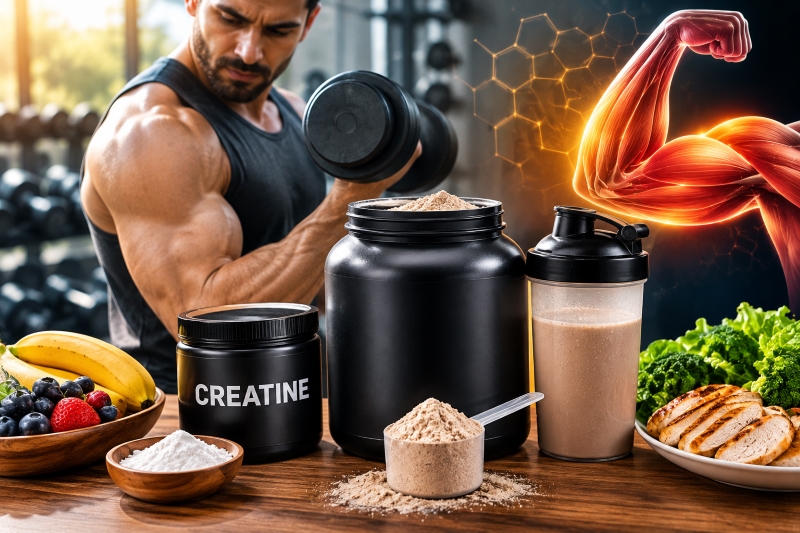
Protein shake + creatine monohydrate + water or milk
That makes it easier to remember your daily creatine dose while simultaneously helping you meet your protein requirements.
How Much Creatine?
Creatine monohydrate is the most extensively studied form of creatine.
A commonly used maintenance amount is around 3–5 grams per day.
Some protocols use a loading phase with larger doses for several days, followed by a maintenance dose. However, a loading phase isn’t essential; taking a smaller daily dose consistently will also increase muscle creatine stores over time.
For most recreational resistance-training programmes, consistency matters far more than trying to find a complicated timing strategy.
What About Women?
Creatine isn’t just a bodybuilding supplement for men.
Women also have skeletal muscle creatine stores and can respond to creatine supplementation.
However, research on creatine and muscle growth has historically included considerably more male participants than female participants, so results shouldn’t automatically be extrapolated identically to every woman.
This is an area where research continues to develop.
Creatine + Protein + Resistance Training: The Fitcart Formula
For anyone looking to build or preserve lean muscle, think of the combination as three connected pieces:
1. Resistance Training
The training provides the stimulus.
Progressively challenging the muscles is essential.
2. Protein
Protein provides the amino acids required for muscle repair and growth.
Aim to obtain sufficient protein from your overall diet, using a protein shake when it helps you conveniently reach your requirements.
3. Creatine
Creatine supports the phosphocreatine energy system and can improve strength and high-intensity exercise performance, helping you get more from resistance training.
The supplement supports the programme—the programme builds the muscle.
What About the Scale?
Don’t panic if the number on the weighing scale rises after beginning creatine.
Creatine can increase water stored within muscle cells. Therefore, some early weight gain can reflect water associated with increased muscle creatine storage rather than increased body fat.
This is one reason why judging progress only by body weight can be misleading.
Instead, track:
- Strength
- Training performance
- Measurements
- Progress photographs
- Body composition where appropriate
- Recovery
- How your clothes fit
These measurements provide a much better picture of your progress.
The Bottom Line
Adding creatine to a protein shake is one of the simplest combinations in sports nutrition.
Research shows that creatine combined with resistance training can increase lean body mass and strength, and a six-week study specifically found greater lean-tissue gains when whey protein was combined with creatine compared with whey protein alone or placebo.
Creatine + adequate protein + progressive resistance training + sufficient recovery = a science-supported strategy for improving strength and supporting lean muscle development.
And perhaps the most important lesson is that supplements work best when they complement the fundamentals—not replace them.
Fitcart Supplement Disclaimer
Creatine and protein supplements are intended to complement a balanced diet and appropriate exercise programme. Individual responses vary, and increases in lean body mass may include changes in muscle water as well as actual tissue growth. Consult a qualified healthcare professional before starting supplementation, particularly if you have a medical condition, take medication, are pregnant or breastfeeding, or have been advised to restrict protein or fluid intake. Choose supplements that are appropriately batch tested and independently verified for identity, purity and contents, and check where the raw materials are produced and where the finished product is manufactured and packaged.
Follow us on X: https://x.com/fitcartofficial and Instagram: https://www.instagram.com/fitcartofficial/ for the latest updates, health insights, and exclusive content.
Follow Smart Nutrition India X: https://x.com/SmartNutrition1 and Instagram: https://www.instagram.com/smartnutritionindia/ for trusted sports nutrition, supplement education, wellness tips, and the latest news from the world of health and performance.
Fitcart believes in True Play and Clean Sport
#trustedbrandsbetterhealth