


Reading Time: 7 minutes.
Author: Ritu Makhija.
Co-Founder, Fitcart.com.
Head of Editorial Team, Fitcart Blog.
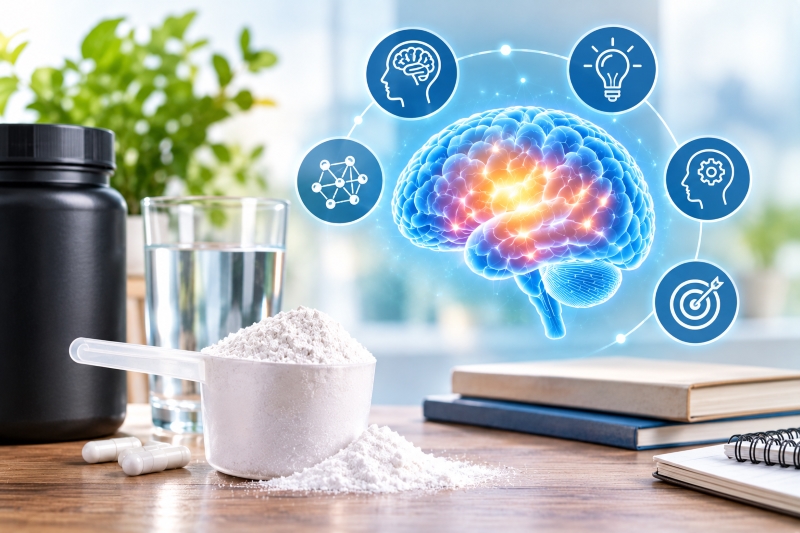
For years, creatine has been associated almost exclusively with muscle, strength, and athletic performance. But creatine has another interesting side.
The brain needs energy too.
Creatine is part of the body’s phosphocreatine system, which buffers and rapidly regenerates ATP—the cellular energy currency used by tissues with high energy demands.
That has led researchers to investigate whether creatine supplementation could influence memory, attention, and cognitive performance.
And the evidence is becoming increasingly interesting—but it is not a licence to call creatine a “brain booster.”
Creatine Is Not Just a Muscle Compound
Creatine is naturally present in the body and can also be obtained from foods such as meat and fish.
The brain contains creatine and uses the creatine-phosphocreatine system to help manage cellular energy.
This has created a logical question:
If creatine supports energy availability in muscle, could it also support energy-demanding processes in the brain?
Research suggests there may be potential—but the effect isn’t universal.
What Does the Research Show?
A 2024 systematic review and meta-analysis of 16 randomised controlled trials involving 492 participants found that creatine supplementation was associated with improvements in memory, attention time and processing speed.
However, the researchers did not find significant improvements in overall cognitive function or executive function, and they rated some areas of evidence as low certainty.
An earlier meta-analysis specifically examining memory also found an overall improvement in memory performance, with particularly interesting findings in older adults.
But another 2024 systematic review concluded that the cognitive evidence remains equivocal, highlighting limitations in study designs and supplementation protocols.
That’s an important distinction.
The evidence is promising—but not definitive.
Who Might Be Most Interested in Creatine for Brain Health?
Research has generated particular interest around:
Older adults
Ageing is associated with changes in muscle mass, physical performance, and brain energy metabolism, making creatine an interesting area of research.
Vegetarians and vegans
Dietary creatine comes predominantly from animal foods, so people consuming little or no meat may have different baseline creatine stores.
People experiencing high physiological stress
Sleep deprivation and other forms of metabolic stress have also been investigated.
However, these are areas of research—not automatic indications that everyone in these groups needs creatine.
Creatine and Healthy Ageing
One of the most exciting questions isn’t simply:
“Does creatine make you stronger?”
It is:
Can maintaining muscle and potentially supporting cognitive function help us age better?
That is where creatine becomes particularly interesting.
Muscle health and brain health are both important components of healthy ageing.
But creatine should be considered one potential tool, not a longevity shortcut.
How Much Creatine?
For most healthy adults using creatine for sports performance, creatine monohydrate is the most extensively studied form.
A commonly studied maintenance amount is around 3–5 g per day.
You don’t necessarily need a loading phase for general supplementation.
More is not automatically better.
And because research into cognition has used different doses and protocols, it would be inappropriate to claim that one specific dose is definitively optimal for brain health.
What Should You Look For in a Creatine Supplement?
This is where Fitcart’s tested-clean philosophy becomes particularly important.
Look for:
Creatine monohydrate
A well-studied form with substantial research behind it.
Transparent labelling
The ingredient and quantity should be clearly stated.
Quality manufacturing
Look for reputable manufacturing and quality-control standards.
Independent testing where available
Third-party testing can provide additional reassurance regarding identity, purity and contaminants.
Batch traceability
Where possible, consumers should be able to identify the specific batch or lot.
For athletes, supplement contamination is particularly important because athletes can be responsible for prohibited substances found in their supplements.
A logo on a tub should never replace proper verification.
Fitcart principle:
Label → Certification → Manufacturing → Independent Testing → Batch Testing → Traceability
The Bigger Brain-Health Picture
Before reaching for a supplement, don’t overlook the fundamentals:
Sleep.
Exercise.
Adequate protein.
Omega-3-rich foods.
Vegetables and fruit.
Fibre.
Hydration.
Stress management.
Mental stimulation and social connection.
Creatine may become an increasingly interesting component of healthy-ageing nutrition, but it works best within a much larger lifestyle framework.
The Fitcart Takeaway
Creatine isn’t simply a “gym supplement.”
The brain also uses creatine, and emerging research suggests that supplementation may support certain aspects of cognitive performance, particularly memory, although the evidence is still developing.
The smartest approach is not to oversell the science.
Use creatine because the evidence is interesting—not because the marketing is exciting.
Supplement & Health Disclaimer
This article is for educational and informational purposes only and is not medical advice.
Creatine supplementation may not be appropriate for everyone. People with kidney disease, other medical conditions, those who are pregnant or breastfeeding, or individuals taking medications should discuss supplementation with a qualified healthcare professional.
Choose appropriately manufactured products with transparent ingredients and, particularly for athletes, consider independent and batch-level testing for prohibited substances and contaminants.
For competitive athletes, always check the specific product and batch against an appropriate recognised certification or testing database. Certification status can change and should be independently verified before use.
Fitcart supports evidence-based, tested-clean sports nutrition and responsible supplementation.
Follow us on X: https://x.com/fitcartofficial and Instagram: https://www.instagram.com/fitcartofficial/ for the latest updates, health insights, and exclusive content.
Follow Smart Nutrition India X: https://x.com/SmartNutrition1 and Instagram: https://www.instagram.com/smartnutritionindia/ for trusted sports nutrition, supplement education, wellness tips, and the latest news from the world of health and performance.
Fitcart believes in True Play and Clean Sport
#trustedbrandsbetterhealth