



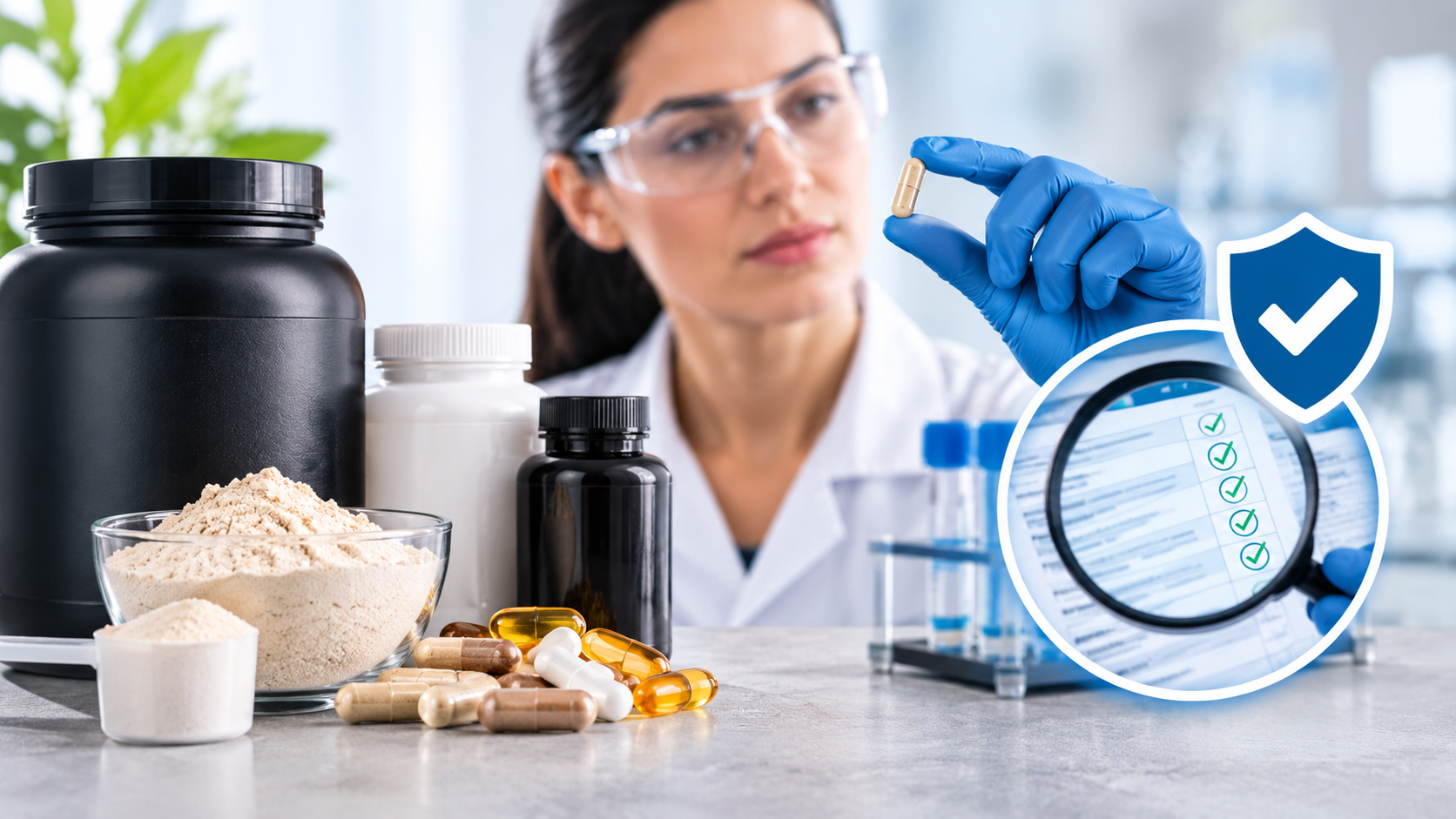
Fitcart Editorial Team Ritu Makhija.
Why the future of supplement quality may be about what is verified—not simply what is printed on the bottle.
Walk into a sports nutrition store or browse supplements online, and the labels can be impressive.
Clinically studied.
Premium quality.
Scientifically formulated.
Advanced performance.
Clean ingredients.
Athlete-friendly.
Third-party tested.
But there is an important question consumers and athletes should ask:
What evidence is behind those claims?
A supplement label tells you what a manufacturer says is in the product.
Testing can provide independent information about what was actually found in the product.
That distinction is becoming increasingly important as the supplement industry grows more sophisticated—and as athletes face additional risks from contaminated or inaccurately labelled products.
For Fitcart, the future of supplement quality should be built around a progression:
Label → Manufacturing → Certification → Independent Testing → Batch Testing → Traceability
The more of these layers that can be independently verified, the more information consumers have when deciding whether a product is appropriate.
A Label Is the Starting Point—Not the Finish Line
Most people start with the label. It should clearly identify:
- Ingredients
- Amounts per serving
- Serving size
- Allergen information where relevant
- Manufacturer information
- Directions for use
- Warnings and precautions
- Batch or lot number
- Expiry or best-before information
This is essential. But a label is ultimately a manufacturer’s declaration.
It does not, by itself, independently demonstrate that every ingredient is present at the stated amount or that the product is free from contaminants.
The NIH Office of Dietary Supplements advises consumers to consider whether manufacturers have appropriate quality-control systems to confirm that products contain what their labels state and are free from contaminants. Independent organisations can provide additional quality testing, although certification seals do not guarantee that a supplement is safe or effective for every individual.
That is why the conversation needs to move beyond the label.
What Does Supplement Testing Actually Mean?
“Tested” is a word that can sound reassuring—but it needs context.
Tested for what?
A supplement might be tested for:
- Ingredient identity
- Ingredient potency
- Microbial contamination
- Heavy metals
- Pesticide residues
- Solvents
- Allergens
- Adulterants
- Prohibited substances
- Product stability
- Physical characteristics
Different tests answer different questions.
A product tested for heavy metals has not necessarily been tested for banned substances in sport.
A product tested for ingredient identity has not necessarily been tested for microbial contamination.
And a product that has undergone manufacturing quality checks does not automatically have independent verification of every performance claim.
Testing needs to be specific.
What was tested?
Who tested it?
How was it tested?
When was it tested?
Which batch was tested?
What were the results?
Those questions are much more informative than simply seeing the word “tested” on a website.
Ingredient Identity Matters
One of the most fundamental questions in supplement quality is:
Is the ingredient actually what the manufacturer says it is?
For example, if a product says it contains a particular form of creatine, protein, botanical extract or vitamin, appropriate quality control should establish the identity of the ingredient.
This becomes particularly important with botanical ingredients, where the source material can be complex.
Ingredient identity is the first layer. But it isn’t enough.
You also need to know:
How much is actually present?
Does the Dose Match the Label?
Imagine a product labelled as containing:
5 g of an active ingredient per serving.
If the actual quantity is substantially different, the consumer is not receiving what the label suggests.
This is one reason quality systems look at identity, purity, strength and composition.
The NIH Office of Dietary Supplements notes that good manufacturing practices are intended to help prevent problems such as incorrect ingredients, too much or too little of a dietary ingredient, contamination and improper packaging or labelling.
For athletes, this becomes particularly important.
The difference between:
“Contains ingredient X”
and
“Contains the stated amount of ingredient X”
can be significant.
Contamination Is a Different Problem
A product can contain the correct ingredients and still have a quality problem.
Contamination can occur during:
- Raw-material production
- Ingredient processing
- Manufacturing
- Equipment handling
- Storage
- Packaging
- Transportation
Potential contaminants can include:
- Microorganisms
- Heavy metals
- Pesticide residues
- Undeclared pharmaceuticals
- Prohibited substances
- Other unwanted compounds
Good manufacturing practices are designed to reduce these risks, but independent testing provides another layer of information.
The Athlete Has a Bigger Problem
For an ordinary consumer, a contaminated supplement may present a health risk.
For an athlete subject to anti-doping rules, there can be another consequence:
A prohibited substance can potentially result in an anti-doping rule violation.
The World Anti-Doping Agency’s 2026 Prohibited List came into effect on January 1, 2026, and includes substances prohibited in and/or out of competition. The 2026 update also notes that certain synthetic substances prohibited under the List have been found in supplements.
This is why supplement quality is not simply a wellness issue. For competitive athletes, it can become a career issue.
“Natural” Does Not Mean Risk-Free
The word natural is one of the most heavily used terms in the wellness industry.
But natural does not automatically mean:
- Safe
- Effective
- Contamination-free
- Suitable for athletes
- Free from prohibited substances
- Appropriate with medication
Botanical products can have biologically active compounds.
They can also vary in composition.
And a natural ingredient does not remove the need for appropriate quality control.
“Clean” Needs a Definition Too
The same issue applies to the word:
Clean
What does “clean supplement” actually mean? It might mean:
- No artificial colours
- No certain additives
- No banned substances
- Third-party tested
- Simple ingredient list
- No unnecessary fillers
Different companies can use the term differently.
For Fitcart, a more useful approach is to move from vague claims toward verifiable characteristics.
Instead of simply saying:
“This is a clean supplement.”
Ask:
What makes it clean, and what evidence supports that claim?
From Certification to Independent Testing
Certification can provide another level of assurance.
Independent certification programmes may evaluate products against defined standards, and some specifically test supplements for substances prohibited in sport.
The NIH Office of Dietary Supplements identifies independent organisations that provide quality testing and explains that such seals can indicate that a product has met specified quality requirements, while also stressing that certification does not guarantee safety or effectiveness.
This distinction is important.
Certification is not the same as:
“This product is guaranteed to work.”
It may instead provide evidence that a product has met certain defined quality criteria.
Batch Testing Takes the Conversation Further
For athletes, perhaps one of the most important concepts is:
Batch testing.
A supplement manufacturer may produce thousands of units across multiple batches.
Testing one batch does not automatically prove that every future batch is identical.
This is why the actual batch or lot number matters.
The International Testing Agency explains that batch testing involves third-party quality assurance and, in the anti-doping context, checking products for prohibited substances. It recommends that athletes use products with valid third-party batch-testing records and retain evidence of the testing.
UK Anti-Doping similarly recommends batch-tested supplements and advises athletes to check the actual batch number before use.
This is a crucial distinction:
Brand tested
is not necessarily the same as:
Your batch tested
Why the Batch Number Matters
Imagine an athlete purchases:
Product X
The manufacturer has previously tested one production batch.
The athlete’s bottle is:
Batch 240826
But the publicly available certificate relates to:
Batch 190526
Those are not the same batch.
The previous test can provide useful information about the manufacturer’s testing programme, but it should not be presented as proof that the athlete’s particular batch was tested.
The International Testing Agency specifically warns that different batches can contain different ingredients or quantities and advises athletes to verify valid third-party batch-testing records.
This is why batch verification matters.
A Logo Is Not Enough
A certification logo can be useful.
But athletes should not simply look at a logo and stop there.
They should ideally be able to verify:
Product → Manufacturer → Certification programme → Specific product → Batch/lot number → Valid testing record
This is much stronger than:
Logo on bottle → assume safe
There is another important point:
WADA does not “approve” individual supplements.
UK Anti-Doping explicitly warns that WADA, UKAD and other anti-doping organisations do not endorse or approve supplement products. Claims that a supplement has been “approved by WADA” or “approved by UKAD” are inaccurate.
What Should Athletes Look For?
For athletes subject to anti-doping regulations, a practical supplement checklist could be:
1. Is the supplement actually necessary?
Start with the nutritional need.
2. Is there evidence for the ingredient?
Don’t confuse marketing with scientific evidence.
3. Is the full ingredient list disclosed?
Avoid unnecessary ambiguity.
4. Are the amounts disclosed?
Proprietary blends can make this difficult.
5. Is the manufacturer transparent?
Look for appropriate quality-control information.
6. Is there independent certification?
If relevant to the product and sport.
7. Is the specific batch tested?
Not just the brand.
8. Can the result be independently verified?
Ideally through the certifier’s database or documentation.
9. Is the product appropriate for the athlete?
Consider health, medication, age, sport and competition status.
10. Has the athlete retained evidence?
Keep the packaging, batch information and relevant certification records.
The International Testing Agency specifically recommends that athletes retain evidence of batch testing, including information showing the product and batch number.
What About Multi-Ingredient Supplements?
This is another area where caution is needed.
Pre-workouts, recovery formulas, fat burners and muscle-building products can contain numerous ingredients.
The problem?
Research may examine individual ingredients while the commercial product contains a combination of many ingredients.
The NIH Office of Dietary Supplements notes that many performance supplements contain multiple ingredients, while research often focuses on individual ingredients. It may therefore be difficult to know the effects and safety of the particular combination in a commercial product.
This makes transparent labelling particularly valuable.
More ingredients does not automatically mean a better supplement.
Sometimes it simply means:
More variables.
Proprietary Blends: The Transparency Problem
A proprietary blend may list several ingredients but provide only the total amount of the blend rather than the quantity of each ingredient.
For example:
Performance Matrix — 4,000 mg
containing:
- Ingredient A
- Ingredient B
- Ingredient C
- Ingredient D
But how much of each?
The consumer may not know.
The NIH Office of Dietary Supplements notes that proprietary blends can make it difficult to determine the amount of individual ingredients and that products can vary considerably in their ingredient quantities.
For consumers—and particularly competitive athletes—ingredient transparency is valuable.
Testing Cannot Prove Everything
It is also important not to oversell testing.
No testing system can answer every question.
A certificate doesn’t necessarily tell you:
- Whether the supplement will work for you
- Whether you personally need it
- Whether the dose is appropriate for you
- Whether it interacts with medication
- Whether it will improve athletic performance
- Whether it is suitable for a specific medical condition
And even batch testing cannot provide a guarantee against contamination.
The International Testing Agency explicitly states that batch testing can reduce risk but does not guarantee that a product is completely free of prohibited substances.
This is an important part of responsible supplement communication.
The Athlete’s Nutrition Foundation Still Comes First
Supplement testing is important.
But testing a supplement doesn’t make a poor nutrition programme a good one.
Athletes still need to prioritise:
Energy availability
Adequate carbohydrate
Adequate protein
Healthy fats
Micronutrients
Hydration
Electrolytes where appropriate
Sleep
Recovery
Training
A supplement should sit on top of this foundation.
It should not become a replacement for it.
The NIH notes that responses to performance supplements vary according to factors including training status, activity type, intensity, duration and environmental conditions.
Supplements Should Have a Purpose
Before an athlete adds a product to their programme, a useful question is:
What problem am I trying to solve?
For example:
Protein powder
Potential purpose: helping meet protein requirements when food alone is inconvenient.
Creatine
Potential purpose: supporting high-intensity exercise and training adaptations.
Electrolytes
Potential purpose: replacing fluids and electrolytes during appropriate training or competition situations.
Dietary nitrate
Potential purpose: a specific evidence-based performance strategy for some athletes.
Iron
Potential purpose: correcting a documented deficiency under appropriate professional guidance.
The key principle is:
The supplement should follow the need—not the other way around.
Traceability Could Become the Next Big Quality Standard
The future of supplement quality may go beyond simply asking:
“Was this product tested?”
The next question may be:
“Can we trace it?”
That could mean understanding the journey:
Raw material
↓
Ingredient supplier
↓
Manufacturing facility
↓
Production batch
↓
Quality testing
↓
Packaging
↓
Distribution
↓
Consumer
Traceability can provide greater confidence in the integrity of the supply chain.
It is particularly relevant to ingredients where origin, purity and identity can vary.
From Label to Laboratory
The supplement industry is entering an era where consumers have access to more information than ever.
But more information isn’t automatically better information.
A sophisticated consumer should be able to distinguish between:
Marketing
“This is the world’s most advanced recovery formula.”
and
Evidence
“Here are the ingredients, quantities, quality controls and independent testing records.”
That is a very different standard.
What Should Consumers Ask?
Before buying a supplement, consider asking:
What is actually in it?
How much is in it?
Where did the ingredients come from?
How was it manufactured?
What quality controls are used?
Has the finished product been independently tested?
What exactly was tested?
Was my specific batch tested?
Can I verify the result?
Is there a reason for me to take it?
Could it interact with medication or other supplements?
For athletes:
Could it create an anti-doping risk?
These questions shift supplementation from impulse purchasing to informed decision-making.
The Fitcart Quality Framework
Fitcart’s approach to supplement quality can be summarised as:
1. Transparent Label
Know what the product claims to contain.
↓
2. Quality Manufacturing
Appropriate manufacturing controls and facility standards.
↓
3. Ingredient Quality
Identity, purity and appropriate sourcing.
↓
4. Independent Verification
Testing beyond the manufacturer’s own marketing claims where available.
↓
5. Batch Testing
Verify the actual production batch, particularly for athletes.
↓
6. Traceability
Know where the product and ingredients come from where possible.
↓
7. Evidence
Understand whether the ingredients have credible evidence for the intended use.
↓
8. Individual Need
Determine whether the product is actually appropriate for the consumer or athlete.
This is a much more useful definition of supplement quality than simply putting a “premium” or “clean” label on a bottle.
The Next Generation of Supplement Consumers
The supplement consumer of the future may become much more demanding.
Not:
“Does this look premium?”
But:
“Show me the evidence.”
Not:
“Does it have a certification logo?”
But:
“What does the certification cover?”
Not:
“Has the brand tested its products?”
But:
“Has my batch been tested?”
Not:
“Is this marketed for athletes?”
But:
“Can I verify its suitability and reduce my anti-doping risk?”
The Fitcart Takeaway
Supplement quality should not be based on a single claim, logo or marketing message.
A strong quality system is layered:
Label → Manufacturing → Ingredient Quality → Certification → Independent Testing → Batch Testing → Traceability
Each layer answers a different question. And for athletes, the stakes are higher.
A contaminated or inaccurately labelled supplement can potentially create both health concerns and anti-doping consequences. Current anti-doping guidance recommends reducing risk through careful assessment, independent batch testing, and verification of the actual product and batch.
But testing should never be confused with a guarantee of safety or effectiveness.
The smartest approach is still:
Need first.
Evidence second.
Quality third.
Testing fourth.
Monitoring always.
The future of supplement quality may not be about louder claims.
It may be about better verification.
Fitcart — Evidence. Quality. Tested. Transparent.
Fitcart Supplement & Sports Nutrition Disclaimer
Information published by Fitcart is intended for general educational and informational purposes only and should not be considered medical advice, diagnosis or treatment. Dietary supplements are not a substitute for a balanced diet, appropriate training, adequate sleep or professional medical care.
Individual nutritional and supplement requirements vary according to age, diet, training status, health conditions, medications, allergies, goals and other factors. Consumers should consult an appropriately qualified healthcare professional, registered dietitian, sports nutrition professional or sports physician where individual advice is required.
For athletes subject to anti-doping regulations, supplement use carries additional risks. No supplement can be guaranteed completely free of prohibited substances. Athletes should assess whether a supplement is necessary, review its ingredients, consider independent third-party certification and, where available, verify the specific product and batch/lot number through the relevant certification system before use.
Third-party testing and batch testing can reduce contamination risk but cannot eliminate it. Certification does not guarantee that a product is effective or suitable for every individual, and anti-doping organisations do not approve or endorse individual supplements.
Athletes remain responsible for substances found in their bodies under the anti-doping rules applicable to their sport. Fitcart supports transparent ingredient information, responsible supplement use, appropriate manufacturing and quality controls, independent testing and batch verification where available.
Follow us on X: https://x.com/fitcartofficial and Instagram: https://www.instagram.com/fitcartofficial/ for the latest updates, health insights, and exclusive content.
Follow Smart Nutrition India X: https://x.com/SmartNutrition1 and Instagram: https://www.instagram.com/smartnutritionindia/ for trusted sports nutrition, supplement education, wellness tips, and the latest news from the world of health and performance.
Fitcart believes in True Play and Clean Sport
#trustedbrandsbetterhealth