



Fitcart Editorial Team Ritu Makhija.
Estimated Reading time: 7–8 minutes.
There is growing interest in magnesium—not just for muscles, sleep and recovery, but also for the brain.
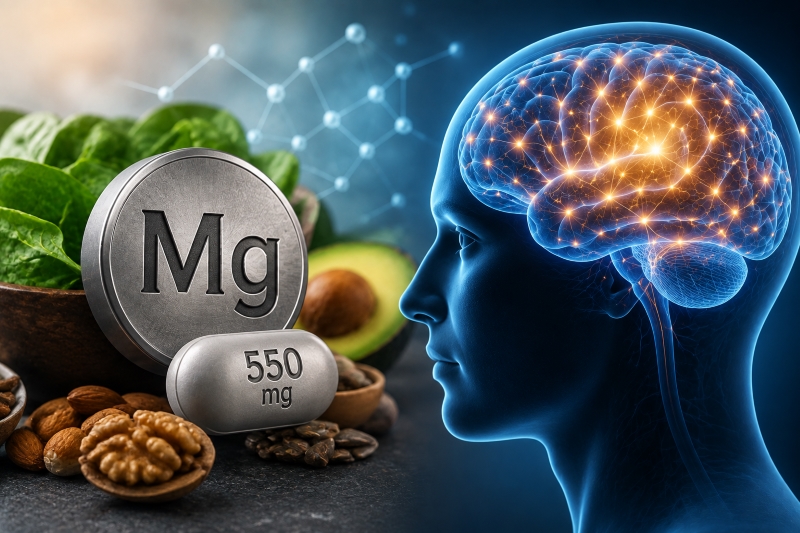
A fascinating study involving more than 6,000 cognitively healthy adults found that people consuming more than 550 mg of magnesium per day through their diet had larger brain volumes than those consuming around 350 mg per day. Researchers estimated that the difference was equivalent to having a brain approximately one year younger by age 55. The relationship was particularly interesting in women. (PubMed)
But there is an important distinction.
This was 550 mg—not 550 grams—and it was dietary magnesium intake, not a recommendation to swallow a 550 mg magnesium supplement every day.
And the research showed an association, not proof that magnesium supplementation itself makes the brain younger.
So, can magnesium actually make your brain younger?
The short answer is: possibly, but the evidence is not strong enough to say that magnesium supplementation reverses brain ageing.
The research, published in the European Journal of Nutrition, analysed dietary magnesium intake in 6,001 UK Biobank participants aged 40–73. Researchers looked at MRI measurements of brain volume and examined magnesium intake patterns over time. (PubMed)
People consuming higher amounts of magnesium tended to have:
- Larger overall brain volumes
- Larger grey-matter volumes
- Larger hippocampal volumes
- Fewer or smaller white-matter lesions in some analyses
- Better indicators of brain health
The hippocampus is particularly interesting because it plays an important role in memory and learning.
The researchers reported that people consuming 550 mg or more of magnesium daily had approximately 0.20% larger grey-matter volume and 0.46% larger right hippocampal volume compared with people consuming around 350 mg daily. The authors described this difference as roughly equivalent to one year of brain ageing. (PubMed Central (PMC))
That’s exciting—but it needs to be interpreted carefully.
The study did NOT prove that magnesium reverses ageing
This is where health headlines can become misleading.
The study was observational. Researchers looked at magnesium intake and brain measurements rather than randomly assigning people to take magnesium supplements and then measuring whether their brains became younger.
Therefore, we cannot conclude that taking magnesium will literally reverse brain ageing.
People who consume more magnesium may also have healthier overall diets, higher vegetable and whole-grain consumption, better lifestyle habits or other factors that contribute to brain health.
The researchers themselves describe their findings as an association between dietary magnesium and better brain health. (PubMed)
Why is magnesium important for the brain?
Magnesium is involved in hundreds of biochemical processes throughout the body.
It contributes to normal nerve and muscle function, energy metabolism, protein synthesis and regulation of blood glucose and blood pressure. (ODs at NIH)
The brain is highly metabolically active, so maintaining adequate levels of essential nutrients is important for normal neurological function.
There is also emerging research exploring relationships between magnesium, inflammation and brain health.
A later analysis found that higher dietary magnesium intake was associated with lower levels of certain inflammatory markers and larger grey- and white-matter volumes. The authors suggested that reduced inflammation may partly explain the relationship between magnesium intake and brain structure. (PubMed Central (PMC))
Again, this is an association—not proof that magnesium supplements prevent dementia or reverse neurodegeneration.
Why the findings may be especially interesting for women
One of the most intriguing aspects of the research was the difference observed between men and women.
The researchers found that the apparent relationship between magnesium intake and brain health was particularly pronounced in women, including post-menopausal women. (PubMed)
This is particularly interesting because midlife and menopause are periods when women experience significant hormonal and metabolic changes.
However, it would be premature to claim that magnesium specifically prevents menopause-related brain ageing. More research is needed.
What the study does provide is another reason to pay attention to overall nutritional quality during midlife.
How much magnesium do you actually need?
According to the U.S. National Institutes of Health, adult women generally require around 310–320 mg of magnesium per day, while adult men generally require 400–420 mg per day. Requirements can vary with age, pregnancy and breastfeeding. (ODs at NIH)
The 550 mg figure from the brain study therefore represents a relatively high total dietary intake, rather than a standard supplement dose.
This distinction is extremely important.
Food first: how to reach higher magnesium intake
The good news is that magnesium doesn’t have to come from a supplement.
Magnesium-rich foods include:
Nuts and seeds
Almonds, cashews, pumpkin seeds, chia seeds and other seeds can contribute meaningful amounts.
Green leafy vegetables
Spinach and other leafy greens are useful magnesium sources.
Legumes
Beans, lentils and chickpeas can provide both magnesium and plant protein.
Whole grains
Whole-grain foods can contribute magnesium while also providing fibre.
Other foods
Some fish, dairy products and other whole foods also contribute magnesium.
A diet built around vegetables, legumes, nuts, seeds and whole grains can make it considerably easier to achieve adequate magnesium intake.
What about magnesium supplements?
This is where consumers need to be careful.
A headline saying “550 mg magnesium for a younger brain” could easily lead someone to buy a 550 mg magnesium supplement.
That is not what the study demonstrated.
In the United States, the NIH lists 350 mg per day as the upper limit for magnesium from dietary supplements and medications for adults. This limit does not apply to magnesium naturally present in food. (ODs at NIH)
Why the difference?
Because the recommended daily intake refers to magnesium from the overall diet, while the supplemental upper limit is specifically designed around magnesium from supplements and medications.
Too much supplemental magnesium can cause:
- Diarrhoea
- Nausea
- Abdominal cramping
Very large amounts can cause much more serious toxicity, including dangerous heart-rhythm problems. The risk is especially important for people with impaired kidney function because the kidneys play a major role in eliminating excess magnesium. (ODs at NIH)
Never interpret the 550 mg dietary figure as permission to take 550 mg of elemental magnesium from a supplement.
Magnesium and sleep: another reason people are interested
Magnesium is also popular in the sports-nutrition and wellness world because of its potential role in relaxation and sleep.
However, the evidence for magnesium supplements as a universal sleep solution remains mixed.
Rather than viewing magnesium as a sleeping pill, it makes more sense to ensure adequate magnesium intake as part of an overall healthy lifestyle.
Good sleep, regular exercise, sufficient protein, stress management, exposure to daylight and a consistent sleep schedule remain fundamental.
Magnesium for active people
For people who exercise regularly, magnesium is relevant because it participates in normal muscle and nerve function and energy metabolism. (ODs at NIH)
But more is not necessarily better.
An athlete who already consumes enough magnesium from food does not automatically need a high-dose supplement.
The better approach is to assess the whole diet first.
A well-balanced sports nutrition plan should provide:
Protein + carbohydrates + healthy fats + micronutrients + fibre + fluids + adequate electrolytes
Magnesium is one piece of that much bigger puzzle.
The Fitcart Brain-Health Formula
If you want to translate the research into everyday habits, don’t obsess over a single mineral.
Think bigger.
1. Eat magnesium-rich foods regularly
Make nuts, seeds, legumes, leafy greens and whole grains regular parts of the diet.
2. Exercise
Regular aerobic activity and resistance training support cardiovascular and brain health.
3. Protect your sleep
Poor sleep can negatively affect cognitive performance, mood and recovery.
4. Keep blood pressure under control
Brain health is closely connected to vascular health.
5. Stay socially and mentally active
Learning, reading, meaningful relationships and challenging the brain are all valuable components of healthy ageing.
6. Don’t smoke and keep alcohol moderate
Lifestyle choices can have substantially greater effects on long-term brain health than any single supplement.
7. Use supplements strategically
If dietary intake is inadequate or a healthcare professional identifies a specific need, supplementation can be considered.
The real headline: feed your brain for the long term
The magnesium research is exciting because it shifts the conversation away from “anti-ageing pills” and towards something much more practical:
What we eat throughout midlife may influence how well our brains age.
The study doesn’t prove that magnesium makes your brain several years younger.
It suggests that people consuming higher amounts of magnesium—particularly more than 550 mg per day from their diet—had brain-volume differences corresponding to approximately one year of brain ageing by age 55 compared with those consuming around 350 mg daily. (Australian National University)
That’s an important distinction.
And perhaps the most encouraging message is that reaching adequate magnesium intake doesn’t require an expensive supplement.
It can begin with something as simple as adding spinach, beans, lentils, nuts, seeds and whole grains to the plate.
The brain, like the rest of the body, benefits from consistency.
Don’t chase a magic number. Build a magnesium-rich diet, move your body, sleep well and protect your health for decades—not just for the next few weeks.
Fitcart News & Science Disclaimer
This article is based on published scientific research and is intended for general education about magnesium, nutrition and brain health. The cited observational research demonstrates associations between dietary magnesium intake and brain-volume measures; it does not prove that magnesium supplementation makes the brain younger, prevents dementia or reverses brain ageing.
The “550 mg” figure refers to total dietary magnesium intake, not a recommendation to take 550 mg of magnesium as a supplement. Readers should not use this article to self-prescribe high-dose magnesium.
Magnesium requirements vary between individuals. People with kidney disease or other medical conditions, and those taking medications, should consult a qualified healthcare professional before using magnesium supplements. Magnesium can interact with certain medications, including some antibiotics and other drugs. (ODs at NIH)
Fitcart Supplement Quality Advisory: Where supplements are used, choose reputable products with transparent labels and appropriate quality controls. Prefer products that are independently batch tested and verified for ingredient content, manufacturing and packaging standards. Competitive athletes should additionally consider recognised anti-doping/sport certification where appropriate.
This article is not medical advice and does not replace consultation with a doctor, registered dietitian or qualified healthcare professional.
Follow us on X: https://x.com/fitcartofficial and Instagram: https://www.instagram.com/fitcartofficial/ for the latest updates, health insights, and exclusive content.
Follow Smart Nutrition India X: https://x.com/SmartNutrition1 and Instagram: https://www.instagram.com/smartnutritionindia/ for trusted sports nutrition, supplement education, wellness tips, and the latest news from the world of health and performance.
Fitcart believes in True Play and Clean Sport
#trustedbrandsbetterhealth