


Fitcart Editorial Team Ritu Makhija.
How Resilience, Technology, and Smart Recovery Help World-Class Athletes Perform at Their Best.
When people watch elite athletes compete, they often see strength, speed, and seemingly limitless endurance. What they don’t see are the health challenges many of these athletes manage behind the scenes every day.
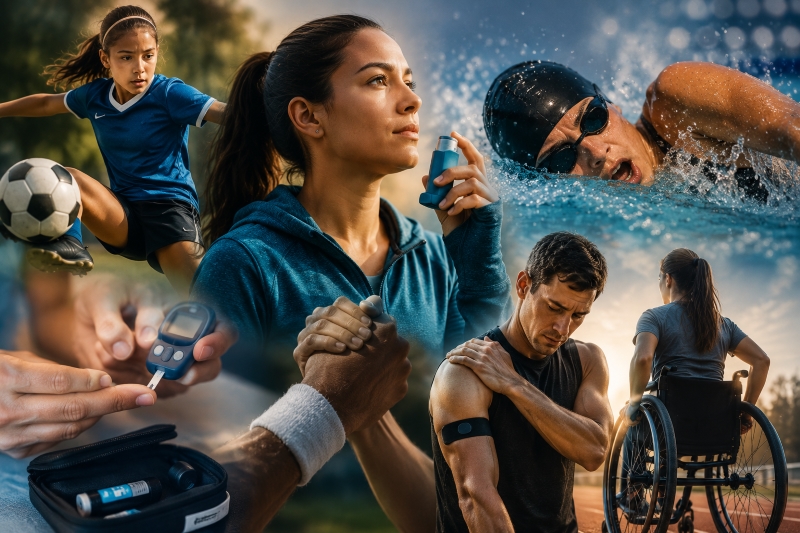
Chronic health conditions are often viewed as obstacles to athletic achievement. Yet some of the world’s most accomplished competitors have proven that with the right mindset, medical support, and performance strategies, it is possible to excel at the highest level.
From diabetes and asthma to autoimmune disorders and chronic pain conditions, these athletes demonstrate that success is not defined by perfect health but by how effectively they manage challenges.
Their stories offer valuable lessons not only for athletes but for anyone striving to improve their health, resilience, and performance.
Alexander Zverev: Winning with Type 1 Diabetes
Professional tennis star Alexander Zverev was diagnosed with Type 1 diabetes at the age of four. For many families, such a diagnosis might seem incompatible with a future in professional sports.
Zverev chose a different path.
Today, he competes among the world’s best tennis players while carefully managing blood glucose levels, insulin requirements, nutrition, and recovery. His journey highlights the growing role of wearable technology and data-driven health management in elite sports.
Rather than allowing diabetes to define him, he has transformed disciplined health management into a competitive advantage.
Gary Hall Jr.: Swimming to Olympic Glory
Few stories are more remarkable than that of Gary Hall Jr..
After being diagnosed with Type 1 diabetes in 1999, many experts believed his swimming career was effectively over. Hall ignored those predictions and went on to win multiple Olympic medals, becoming one of the most successful swimmers of his era.
His achievements helped challenge misconceptions about diabetes and inspired countless people living with the condition.
Venus Williams: Competing Through Autoimmune Disease
Tennis legend Venus Williams was diagnosed with Sjögren’s syndrome, an autoimmune disease that can cause fatigue, joint pain, and chronic inflammation.
For a professional athlete competing on the global stage, persistent fatigue can be particularly challenging.
Williams adapted her training, nutrition, and recovery routines to accommodate her condition while continuing to compete at the highest level. Her experience demonstrates how personalized health strategies can help athletes maintain performance despite ongoing medical challenges.
Michael Phelps: Redefining Mental Health in Sports
The most decorated Olympian in history, Michael Phelps has spoken openly about his struggles with depression and mental health.
His willingness to discuss these experiences helped shift public conversations around mental wellness in elite sports.
Phelps’ story serves as a reminder that health is not limited to physical conditions. Mental health plays a crucial role in performance, recovery, and overall well-being.
Monica Seles: Overcoming Chronic Health Challenges
Former world number one Monica Seles faced significant physical and emotional challenges throughout her career.
Despite setbacks that would have ended many athletic journeys, she returned to competition and remained one of the most respected figures in tennis.
Her resilience remains a powerful example of perseverance in professional sports.
David Beckham: Living with Obsessive-Compulsive Disorder
Global football icon David Beckham has discussed living with obsessive-compulsive disorder (OCD).
While OCD is often misunderstood, it can significantly affect daily life.
Beckham’s openness helped bring greater awareness to mental health conditions while demonstrating that individuals can succeed at the highest levels while managing them.
Missy Franklin: Managing Chronic Pain and Mental Health
Olympic swimmer Missy Franklin has spoken about chronic pain, depression, and anxiety following her competitive career.
Her journey highlights the importance of recovery, mental wellness, and long-term health beyond athletic achievement.
In recent years, athletes have become increasingly vocal about the need to prioritize both physical and emotional well-being.
Wilma Rudolph: From Childhood Illness to Olympic Champion
Before becoming one of the fastest women in history, Wilma Rudolph battled polio and wore leg braces as a child.
Doctors doubted she would ever walk normally.
She went on to become an Olympic champion and a symbol of determination around the world.
Her story remains one of the most inspiring examples of overcoming physical adversity through persistence and belief.
Bethany Hamilton: Redefining Possibility
Professional surfer Bethany Hamilton lost her arm in a shark attack at the age of thirteen.
Rather than abandoning her dreams, she returned to competitive surfing and achieved international success.
Hamilton’s story continues to inspire athletes and non-athletes alike by demonstrating the extraordinary adaptability of the human spirit.
Jessica Long: A Champion Beyond Limits
Paralympic swimmer Jessica Long was born with a condition that led to the amputation of both legs below the knee.
She has since become one of the most decorated Paralympians in history.
Her achievements illustrate how determination, innovation, and training can overcome challenges that many people would consider insurmountable.
What These Athletes Teach Us About Performance
Although their conditions differ, these athletes share several common traits.
They embrace technology, seek expert guidance, prioritize recovery, and remain committed to long-term consistency. They understand that success is rarely about having perfect circumstances. Instead, it comes from adapting to challenges and making the most of available resources.
Modern advances in health technology have also played a significant role. Wearables, continuous glucose monitors, recovery tools, sleep tracking devices, and personalized nutrition strategies allow athletes to better understand and optimize their bodies than ever before.
The Rise of Performance-Focused Health Management
The stories of these athletes reflect a larger shift occurring throughout the health and wellness industry.
Today, people are increasingly taking a proactive approach to managing their health. Whether through better nutrition, recovery therapies, wearable technology, sleep optimization, or biohacking tools, individuals now have access to strategies that were once reserved for elite performers.
The goal is no longer simply treating illness.
It is maximizing quality of life, performance, resilience, and longevity.
What Indian Athletes Can Learn From These Champions
India is witnessing a growing focus on sports performance, fitness, and wellness. From cricket and badminton to tennis, wrestling, athletics, and endurance sports, Indian athletes are increasingly adopting science-backed approaches to training and recovery.
The stories of these elite athletes offer several valuable lessons.
Your Health Condition Doesn’t Have to Define Your Potential
Many people assume that a chronic condition automatically limits what they can achieve. Alexander Zverev’s success with Type 1 diabetes and Venus Williams’ ability to compete with an autoimmune condition prove otherwise.
For Indian athletes living with diabetes, asthma, thyroid disorders, autoimmune diseases, or other chronic conditions, the key lesson is that proper management can often make continued participation in sport possible.
The goal is not to ignore the condition but to understand it, monitor it, and work with healthcare professionals to optimize performance safely.
Data Is Becoming a Competitive Advantage
Modern athletes no longer rely solely on instinct.
They use data.
Wearables, recovery trackers, continuous glucose monitors, heart rate monitors, sleep trackers, and performance analytics help athletes make better decisions about training and recovery.
Indian athletes at every level can benefit from tracking key metrics such as:
- Sleep quality
- Resting heart rate
- Recovery status
- Hydration
- Daily activity levels
- Training load
Even simple health data can provide valuable insights that improve performance over time.
Recovery Is No Longer Optional
One common trait among elite athletes is their commitment to recovery.
Many amateur athletes focus heavily on training while neglecting sleep, mobility, nutrition, and recovery protocols.
Top performers understand that adaptation happens during recovery, not during the workout itself.
Recovery strategies gaining popularity among athletes include:
- Red light therapy
- Compression recovery systems
- Massage therapy
- Mobility training
- Cold water immersion
- Sleep optimization
As competition becomes more demanding, recovery is increasingly becoming a performance differentiator.
Consistency Beats Intensity
The athletes featured in this article achieved success not because they occasionally worked harder than everyone else, but because they remained consistent over many years.
Indian athletes often face challenges such as academic pressures, work commitments, travel, limited access to facilities, or injury setbacks.
The lesson is simple: sustainable habits usually outperform short bursts of extreme effort.
Small improvements repeated consistently can produce extraordinary long-term results.
Mental Resilience Is a Skill
Athletes like Michael Phelps and Bethany Hamilton remind us that mental strength is just as important as physical strength.
Learning to handle setbacks, injuries, pressure, and uncertainty is an essential part of athletic development.
Techniques such as meditation, mindfulness, breathwork, visualization, and structured recovery can help athletes build resilience and maintain focus during difficult periods.
Embrace Technology, But Master the Fundamentals
Technology can be a powerful tool, but it cannot replace the basics.
The world’s best athletes still prioritize:
- Quality sleep
- Balanced nutrition
- Hydration
- Regular training
- Recovery
- Mental well-being
Indian athletes should view technology and biohacking tools as enhancements rather than shortcuts.
The strongest performance foundation will always be built on healthy daily habits.
The Future of Indian Sports Performance
As India continues to produce world-class athletes, the integration of sports science, recovery technologies, personalized nutrition, and health tracking will become increasingly important.
The next generation of Indian athletes has access to tools and knowledge that previous generations could only dream of. By combining these innovations with discipline, consistency, and resilience, athletes can unlock new levels of performance while maintaining long-term health.
The stories of Alexander Zverev, Venus Williams, Michael Phelps, and others show that greatness is not reserved for those with perfect circumstances. It belongs to those who learn to adapt, persevere, and keep moving forward despite the challenges they face.
Final Thoughts
The journeys of these ten athletes remind us that chronic health conditions do not automatically define our limitations.
While each faced unique challenges, they refused to let those challenges determine their future. Through discipline, adaptation, and perseverance, they reached the highest levels of their respective sports and inspired millions around the world.
Their stories offer a powerful message for anyone facing obstacles in their own health journey: success is not about having a perfect body or perfect circumstances. It is about consistently moving forward, learning to adapt, and believing that progress is still possible.
In a world increasingly focused on optimization and performance, these athletes prove that resilience may be the most powerful advantage of all.
Follow us on X: https://x.com/fitcartofficial and Instagram: https://www.instagram.com/fitcartofficial/ for the latest updates, health insights, and exclusive content.
Follow Smart Nutrition India X: https://x.com/SmartNutrition1 and Instagram: https://www.instagram.com/smartnutritionindia/ for trusted sports nutrition, supplement education, wellness tips, and the latest news from the world of health and performance.
Fitcart believes in True Play and Clean Sport
#trustedbrandsbetterhealth