


Suggested reading time: 11-13 minutes.
Fitcart Editorial Series: Skin, Hormones & Metabolic Health.
Author: Ritu Makhija.
Co-Founder, Fitcart.com.
Head of Editorial Team, Fitcart Blog.
How everyday food choices support skin structure, repair, hydration and healthy ageing — and what the science really says about beauty supplements.
Healthy-looking skin is influenced by much more than the products we apply to it. Skin is a living organ that constantly renews itself, repairs everyday damage and relies on a steady supply of nutrients to maintain its structure and normal function.
Protein provides the building blocks for tissue repair. Vitamins and minerals support processes involved in collagen formation, cell renewal and antioxidant protection. Essential fatty acids are important components of cell membranes and help maintain normal skin function.
This is why a balanced diet matters. However, it is equally important to separate nutritional science from beauty marketing. Eating more collagen, taking high-dose vitamins or adding multiple supplements does not automatically produce clearer, firmer or younger-looking skin.
In this article, we explore the nutrients that matter, the Indian foods that provide them, and what current research tells us about collagen supplements and other popular skin-health products.
1. Understanding the relationship between nutrition and skin health
The skin is made up of several layers, each with different functions. The outermost layer, the epidermis, acts as a protective barrier. Beneath it, the dermis contains structural proteins such as collagen and elastin, which contribute to strength and elasticity.
Skin cells continually renew themselves. The body also needs to repair minor tissue damage, maintain its protective barrier and respond to environmental stressors such as ultraviolet radiation and pollution.
Nutrition supports these processes by providing:
- Amino acids for the production and repair of proteins.
- Vitamins and minerals involved in normal cell function and tissue maintenance.
- Essential fatty acids that contribute to cell membranes.
- Antioxidant nutrients that help protect cells from oxidative damage.
Poor dietary variety, inadequate protein intake or specific nutrient deficiencies can affect normal tissue maintenance and wound healing. But there is no single food, vitamin or supplement that can independently prevent wrinkles, stop skin ageing or treat every skin condition.
Genetics, hormones, age, sun exposure, smoking, sleep, stress, skincare and underlying medical conditions all influence how skin looks and functions.
The goal should therefore be to support skin health through consistent nutrition and healthy lifestyle habits rather than searching for a quick cosmetic solution.
2. Protein: The foundation for skin structure and repair
Protein is often discussed in relation to muscle development, exercise and weight management. However, it is also essential for the normal maintenance and repair of body tissues, including skin.
The skin contains several important proteins:
Collagen provides structural strength and contributes to firmness.
Elastin helps skin stretch and return towards its original shape.
Keratin is an important structural protein found in the epidermis, hair and nails.
The body produces these proteins using amino acids obtained from dietary protein. Inadequate protein intake can compromise normal tissue maintenance and healing, particularly when combined with illness, ageing or other nutritional deficiencies.
How much protein do you need?
The ICMR–National Institute of Nutrition’s 2024 Dietary Guidelines for Indians give a recommended protein allowance of approximately 0.83 g per kg of body weight per day for healthy adults. For a person weighing 65 kg, this is approximately 54 g daily. Individual requirements may differ with health status, pregnancy, recovery, age and training demands.
Eating more protein than you need does not automatically mean better skin. The priority is to meet your requirements consistently and include a variety of protein sources.
Indian protein-rich foods to include
- Pulses and legumes
- Moong dal, masoor dal, chana, rajma, lobia and other beans provide protein, fibre and minerals. Combining pulses with cereals helps create a varied amino acid intake.
- Dairy, eggs and soy
- Milk, curd, paneer, eggs, tofu and soy foods offer useful protein options for vegetarian and non-vegetarian diets.
- Fish, chicken and lean meats
- These provide complete protein and can help people who include animal foods meet their daily protein requirements.
- Nuts and seeds
- Almonds, walnuts, pumpkin seeds, sesame and peanuts contribute protein alongside healthy fats and micronutrients.
Fitcart perspective: Protein powders can be convenient when someone struggles to meet their requirements through food, but they are not essential for everyone and should not replace a varied diet. Choosing a protein product should involve checking its complete ingredient list, protein content, allergens and independently verifiable quality information.
3. Collagen: What it does and whether supplements work
Collagen is one of the main structural proteins in the skin. It contributes to the strength and organisation of the dermis.
As we age, collagen production and the organisation of the skin’s supporting structures change. Sun exposure and other environmental factors can accelerate these changes. Hormonal transitions, including menopause, can also influence skin structure.
This has made collagen supplements popular in the beauty and wellness industry.
Can taking collagen improve skin?
Hydrolysed collagen supplements contain collagen peptides that are broken down during digestion into smaller peptides and amino acids. These are absorbed and used within the body’s normal metabolic processes.
Some clinical trials suggest that oral collagen supplementation may improve certain measured skin characteristics, particularly hydration and elasticity. However, the evidence is not conclusive.
A 2023 systematic review and meta-analysis of 26 randomised controlled trials involving 1,721 participants reported improvements in skin hydration and elasticity. However, the authors also identified limitations in the available studies and called for larger, better-designed trials.
A particularly important 2025 systematic review and meta-analysis in The American Journal of Medicine examined 23 trials involving 1,474 participants. Although the overall analysis reported improvements, the researchers found that studies without pharmaceutical-company funding did not show significant benefits. Higher-quality studies also did not demonstrate significant improvements across the measured skin outcomes. The authors concluded that the available clinical evidence did not support collagen supplements as a proven way to prevent or treat skin ageing.
An updated 2026 review of 35 trials and 2,534 participants reported improvements in measured hydration and elasticity. However, it also highlighted substantial variation between studies and uncertainty around structural outcomes such as wrinkle reduction.
What does this mean for consumers?
Collagen peptides are an area of active research, and some people may experience modest changes in skin hydration or elasticity. But current evidence does not establish that collagen supplements reliably reverse ageing, remove wrinkles, restore lost collagen or produce the same results for everyone.
Does vitamin C help collagen production?
Yes. Vitamin C is required for the body’s normal collagen biosynthesis. It is an essential nutrient for connective tissue maintenance and wound healing.
However, this does not mean that everyone taking collagen needs an additional high-dose vitamin C supplement. A varied diet that provides sufficient vitamin C is generally the sensible starting point.
Food sources of collagen and its building blocks
Collagen is naturally present in animal connective tissues, skin and bones. Foods such as fish, chicken and meat provide protein, while eggs, dairy, legumes and soy provide amino acids used in the body’s protein synthesis.
Bone broth may contain collagen-derived proteins, but its nutritional content varies considerably depending on how it is prepared. It should not be treated as a standardised collagen treatment.
People following vegetarian or vegan diets do not obtain collagen directly from plant foods. They can, however, consume the nutrients and amino acids needed for normal collagen production through a varied diet.
4. Vitamin C: Essential for collagen formation and tissue repair
Vitamin C is one of the most important nutrients to consider when discussing skin nutrition.
It supports collagen formation, acts as an antioxidant and contributes to normal wound healing. It also helps the body absorb non-haem iron from plant foods.
Good Indian food sources include:
– Amla.
– Guava.
– Oranges and sweet lime.
– Lemon.
– Tomatoes.
– Capsicum.
– Broccoli and other vegetables.
A practical way to improve vitamin C intake is to include fruit or vegetables rich in the nutrient every day. For example, guava as a snack, lemon with dal or a salad containing tomatoes and capsicum can contribute to overall intake.
Vitamin C supplements may be useful when dietary intake is inadequate or a deficiency is identified. Taking very high doses does not guarantee additional collagen production or improved skin appearance.
5. Vitamin A: Supporting normal skin-cell renewal
Vitamin A is involved in cell growth, differentiation and the maintenance of normal tissues. It is therefore important for healthy skin function.
There are two main dietary forms:
– Preformed vitamin A, found in foods such as eggs, dairy and some animal products.
– Provitamin A carotenoids, found in colourful plant foods such as carrots, pumpkin, spinach and other dark-green vegetables.
A varied diet containing these foods can help provide vitamin A and related carotenoids.
It is important to distinguish dietary vitamin A from prescription retinoid medicines used in dermatology. These are not interchangeable.
A safety point worth remembering: High intakes of preformed vitamin A from supplements can be harmful. Excessive intake during pregnancy can cause serious birth defects. Anyone who is pregnant, planning pregnancy or breastfeeding should avoid high-dose vitamin A supplements unless specifically prescribed and supervised by a qualified clinician.
6. Vitamin E: An antioxidant nutrient
Vitamin E is a fat-soluble antioxidant that helps protect cell membranes from oxidative damage.
It is found in:
– Almonds and sunflower seeds.
– Peanuts and hazelnuts.
– Sunflower and other vegetable oils.
– Green leafy vegetables.
– Some wholegrain and fortified foods.
Vitamin E is part of a balanced nutritional pattern, but there is insufficient evidence to recommend high-dose vitamin E supplements as a routine treatment for wrinkles, pigmentation or other cosmetic skin concerns.
Food sources are generally preferable to unnecessary high-dose supplementation. Supplements may also interact with medicines, so professional advice is important before using them.
7. Zinc: Important for normal skin function and wound healing
Zinc is an essential mineral involved in protein synthesis, immune function, cell division and wound healing.
A deficiency can affect normal tissue repair. Zinc is therefore important, but taking extra zinc does not mean that skin will necessarily become clearer or heal faster if zinc intake is already adequate.
Indian food sources include:
– Pumpkin seeds and sesame seeds.
– Chickpeas and lentils.
– Peanuts and nuts.
– Whole grains.
– Eggs, meat and seafood.
People who eat predominantly plant-based diets can obtain zinc from legumes, nuts, seeds and whole grains. Soaking, sprouting and fermenting pulses can help reduce phytate content, which can otherwise reduce mineral absorption.
Zinc supplements are sometimes used in dermatology, including in selected cases of acne, but the evidence and appropriate dose depend on the condition. High-dose zinc taken for prolonged periods can interfere with copper absorption and cause other adverse effects.
8. Essential fats and omega-3: Supporting cell membranes and skin function
Fats are not something to eliminate from a healthy diet. Essential fatty acids are needed for normal cell function, and omega-3 fatty acids form part of cell membranes.
There are three commonly discussed omega-3 fatty acids:
– ALA (alpha-linolenic acid): Found mainly in plant foods.
– EPA (eicosapentaenoic acid): Found primarily in fish and seafood.
– DHA (docosahexaenoic acid): Also found primarily in fish and seafood.
The body can convert some ALA into EPA and DHA, but the conversion is limited.
Indian food sources of omega-3
- Flaxseed and chia seeds
- Useful plant sources of ALA. Ground flaxseed can be added to curd, porridge or smoothies.
- Walnuts
- Provide ALA alongside other nutrients and healthy fats.
- Oily fish
- Sardines, mackerel and other oily fish can provide EPA and DHA.
- Algal oil
- A vegetarian source of EPA and/or DHA, depending on the formulation.
Can omega-3 supplements improve skin?
Omega-3 fatty acids are being investigated for their potential role in inflammatory skin conditions, including eczema, psoriasis and acne. A review of dermatological research reported promising findings in some areas, but this does not establish omega-3 supplements as a universal treatment for skin problems.
For most people, including omega-3-containing foods as part of a balanced diet is a sensible approach. Fish oil or algal oil supplements may be considered when dietary intake is limited or there is another clinical reason to use them.
The appropriate product and dose depend on individual needs, medications and health circumstances. More is not necessarily better.
9. Hydration, fibre and the wider dietary pattern
Healthy skin depends on more than individual nutrients.
Hydration is important for normal body function. Dehydration can affect overall wellbeing, but drinking excessive amounts of water does not automatically produce hydrated, glowing skin. Skin hydration is also influenced by the skin barrier, environment, age and skincare.
Fibre-rich foods support digestive and metabolic health. Vegetables, fruit, whole grains, pulses, nuts and seeds also provide a range of vitamins, minerals and plant compounds.
For Indian diets, useful everyday choices include:
– A variety of seasonal vegetables rather than relying on one or two familiar options.
– Whole fruit rather than routinely replacing fruit with juice.
– Dal, beans, chana and other pulses.
– Whole grains and millets in suitable portions.
– Nuts and seeds in moderate amounts.
– Curd or other suitable fermented foods if tolerated.
– Adequate protein at meals.
A balanced dietary pattern may also support healthier blood glucose regulation and overall metabolic health. However, there is no need to eliminate entire food groups or follow an extreme diet in the name of skin health.
Some people notice changes in acne with particular dietary patterns or foods, but responses vary. If a food appears to trigger a problem, it is more useful to assess the pattern carefully with a healthcare professional than to adopt broad, unnecessary restrictions.
10. A practical Indian meal pattern for healthy skin
The following is an example of how to bring several skin-supportive nutrients together through everyday foods. It is not a prescribed diet or a guaranteed skin-improvement programme.
An example day of skin-supportive eating
- Breakfast
- Moong dal chilla with curd, plus guava or another seasonal fruit.
- Protein, fibre and vitamin C
- Lunch
- Roti or millet, dal or rajma, green vegetables, salad and curd. Add fish or chicken if preferred.
- Protein, zinc, fibre and micronutrients
- Afternoon snack
- A small portion of almonds or walnuts, roasted chana and fruit.
- Healthy fats, protein and plant nutrients
- Dinner
- Paneer, tofu, eggs, fish or another protein source with cooked vegetables and a suitable portion of whole grains.
- Protein and essential nutrients for normal tissue maintenance
Portion sizes should be adapted to age, activity, appetite, medical needs and overall energy requirements.
11. Do skin supplements really work?
The beauty supplement market includes collagen powders, biotin, vitamin C, zinc, vitamin E, omega-3, antioxidants and multi-ingredient hair, skin and nail formulas.
Some supplements have a legitimate role when a deficiency or specific clinical need is present. Others are marketed with claims that go beyond the available evidence.
A useful way to assess them is to ask three questions:
Is there a nutritional need?
A supplement is more likely to be useful when it addresses an inadequate intake, a diagnosed deficiency or a specific medical requirement.
Is there good human clinical evidence?
Laboratory studies and theoretical mechanisms do not necessarily demonstrate a visible benefit in people. Look for well-designed human studies and systematic reviews, while considering study size, duration, funding and limitations.
Is the product quality independently verifiable?
Ingredient transparency, accurate labelling, batch identity and appropriate testing matter. A product’s marketing claims or certification logo should not be treated as proof that every batch has been independently verified.
What about popular beauty supplements?
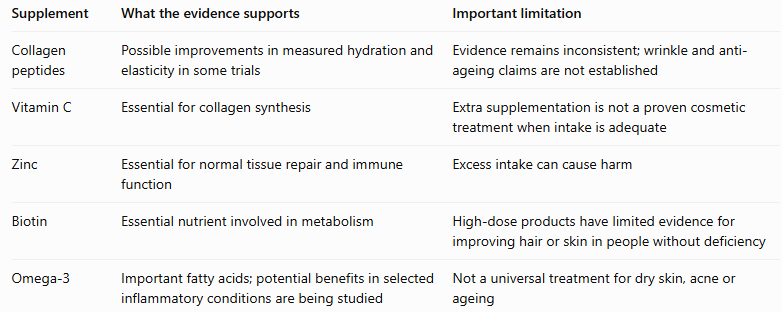
Omega-3 Important fatty acids; potential benefits in selected inflammatory conditions are being studied Not a universal treatment for dry skin, acne or ageing
One additional safety issue deserves attention: high-dose biotin, often marketed in hair, skin and nail products, can interfere with certain laboratory tests and produce misleading results. Always tell your doctor and laboratory team if you take biotin-containing supplements.
Fitcart’s approach to responsible supplementation
At Fitcart, the focus should be on helping consumers make informed choices rather than encouraging unnecessary supplementation.
When selecting a skin, hair or nutrition supplement, consumers should look for:
– Clear ingredient lists and accurately stated quantities.
– Identifiable batch or lot numbers and expiry information.
– Appropriate testing for identity, purity, contaminants and microbiological quality.
– Independently verifiable batch reports or certificates of analysis where available.
– Relevant quality and sport-certification information, where applicable.
– Transparent manufacturer and product information.
Batch testing and recognised certification programmes can provide useful assurance, but their scope matters. A certification logo alone does not prove that every possible contaminant has been tested for, or that a product is appropriate for every individual.
Science-backed nutrition, transparent ingredients and verifiable quality information should be central to responsible supplementation.
12. Other lifestyle habits that support healthy skin
Nutrition is one part of the picture. Everyday habits also influence skin health.
- Protect your skin from ultraviolet radiation. Regular use of appropriate broad-spectrum sunscreen, protective clothing and shade helps reduce UV-related skin damage. A good diet cannot replace sun protection.
- Prioritise sleep. Consistent sleep supports normal physiological repair and overall health. Persistent sleep disruption can affect general wellbeing and may influence inflammatory and hormonal pathways.
- Exercise regularly. Walking, resistance training and other forms of physical activity support metabolic health, circulation and overall fitness. Exercise is beneficial for health, although it should not be presented as a direct treatment for wrinkles or pigmentation.
- Avoid smoking. Smoking is associated with oxidative stress and premature skin ageing.
- Use suitable skincare. Gentle cleansing, moisturising and appropriate sun protection help support the skin barrier. Persistent acne, eczema, pigmentation or unexplained skin changes deserve professional assessment rather than relying on nutritional changes alone.
13. The Fitcart takeaway: Build healthy skin from the inside out
Healthy skin is supported by a consistent supply of nutrients, not by a single superfood or beauty supplement.
Adequate protein, vitamin C, vitamin A, vitamin E, zinc and essential fats all have recognised roles in normal body function and tissue maintenance. Indian diets can provide many of these nutrients through everyday foods such as dal, chana, curd, paneer, eggs, fish, nuts, seeds, amla, guava and green vegetables.
Collagen supplements remain an area of active scientific investigation. Some studies suggest possible benefits for skin hydration and elasticity, but important questions remain about the reliability, size and clinical significance of these effects.
The most sensible strategy is to prioritise a varied, balanced diet, meet individual nutritional requirements, maintain healthy lifestyle habits and use supplements selectively when there is a sound reason to do so.
At Fitcart, we believe that healthy skin, nutrition and long-term wellbeing should be approached through science, evidence and responsible product choices — not unrealistic beauty promises.
Medical, nutrition and supplement disclaimer
This article is intended for general educational and informational purposes only. It is not medical advice and should not be used to diagnose, treat, cure or prevent any disease or skin condition.
Nutritional requirements vary according to age, sex, health status, pregnancy, activity level, dietary pattern and individual circumstances. People with persistent skin concerns, suspected nutrient deficiencies, allergies, chronic conditions or unexplained changes in their skin should consult a qualified healthcare professional or registered dietitian.
Dietary supplements are not substitutes for a balanced diet, prescribed treatment or appropriate medical care. Supplements can have side effects, interact with medicines and be unsuitable for certain individuals, including pregnant or breastfeeding women. Do not begin high-dose vitamin, mineral, collagen or other supplement regimens without appropriate professional guidance.
Consumers should check product ingredients, allergens, batch information, testing documentation and applicable quality certifications. No supplement should be assumed to be risk-free or suitable for everyone.
Fitcart.com® provides health and nutrition information for educational purposes. Product decisions should be based on individual needs, credible evidence and appropriate professional advice.
Follow us on X: https://x.com/fitcartofficial and Instagram: https://www.instagram.com/fitcartofficial/ for the latest updates, health insights, and exclusive content.
Follow Smart Nutrition India X: https://x.com/SmartNutrition1 and Instagram: https://www.instagram.com/smartnutritionindia/ for trusted sports nutrition, supplement education, wellness tips, and the latest news from the world of health and performance.
Fitcart believes in True Play and Clean Sport
#trustedbrandsbetterhealth