


Suggested reading time: 12-14 minutes.
Fitcart Editorial Series: Skin, Hormones & Metabolic Health.
Author: Ritu Makhija.
Co-Founder, Fitcart.com.
Head of Editorial Team, Fitcart Blog.
How insulin, androgen hormones, nutrition, exercise, and metabolic health can influence skin changes and overall well-being.
Polycystic ovary syndrome (PCOS) is one of the most common hormonal conditions affecting women of reproductive age. Yet it is often misunderstood as simply an ovarian or reproductive disorder.
PCOS is a complex condition involving reproductive hormones, metabolic function and, in some women, insulin resistance.
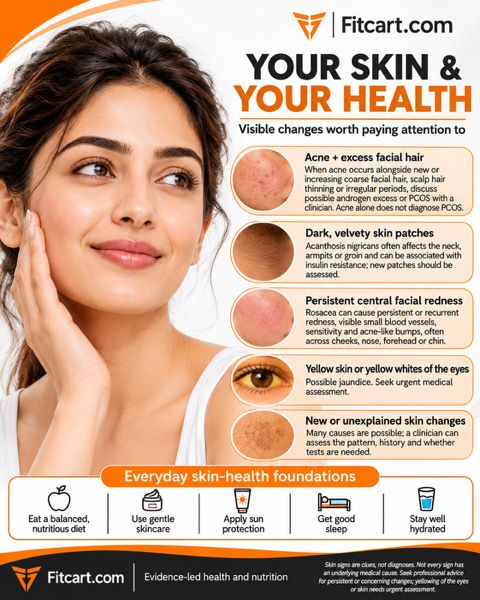
Its effects can extend beyond menstrual irregularities and fertility. Women may experience persistent acne, excessive facial hair, scalp hair thinning, weight-management difficulties, and changes in skin pigmentation.
One of the most important connections to understand is the relationship between insulin resistance and androgen hormones.
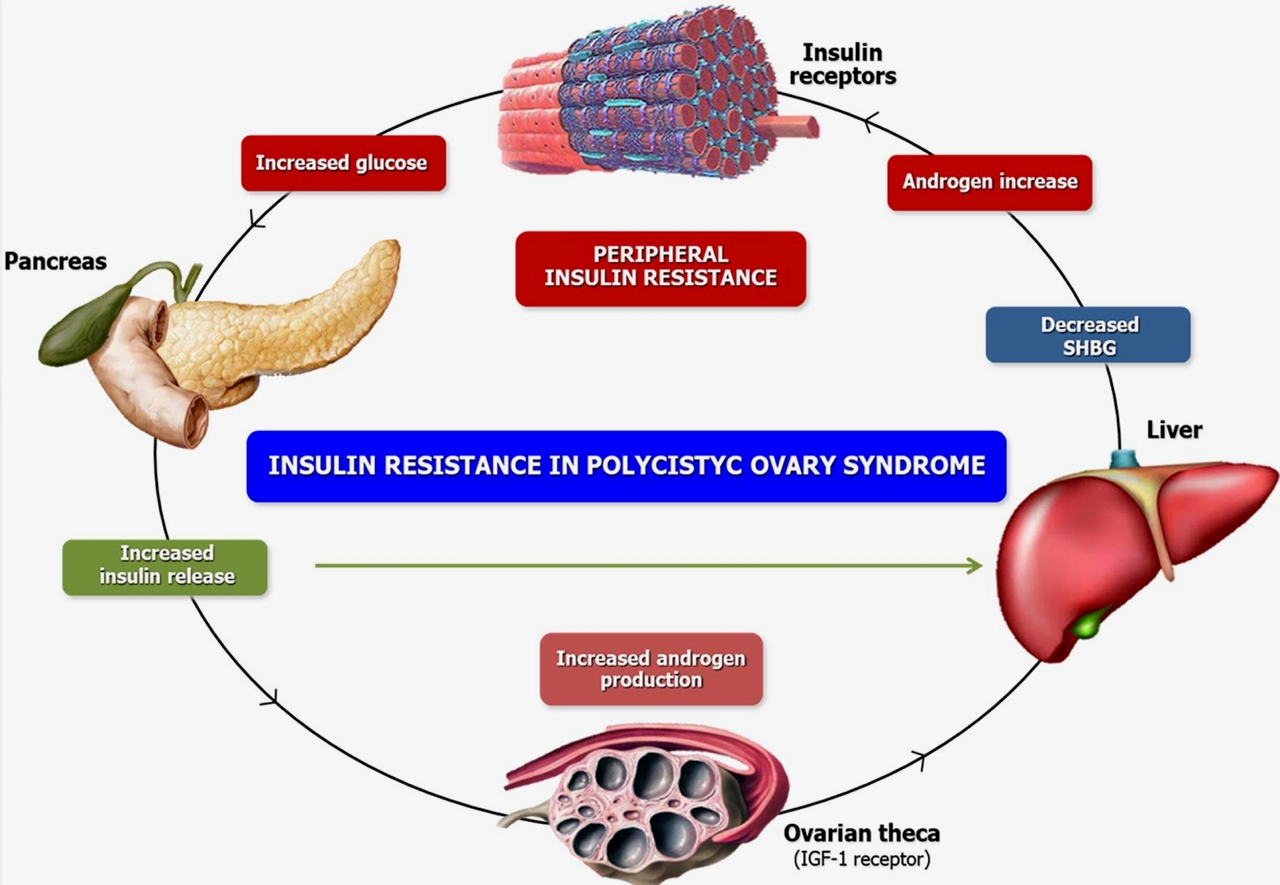
Insulin plays an essential role in blood glucose regulation. However, when insulin levels are elevated, they can influence ovarian androgen production and contribute to some of the hormonal features associated with PCOS.
Understanding this relationship helps explain why nutrition, physical activity, resistance training, sleep, and appropriate medical care are important parts of managing PCOS.
At Fitcart, we believe women’s health should be approached holistically, combining evidence-based medical understanding with practical nutrition and lifestyle guidance.
1. What Is PCOS and Why Does It Matter?
Polycystic ovary syndrome is a hormonal and metabolic condition that can affect ovulation, androgen activity and metabolic health.
The name can be misleading. Not every woman with PCOS has visible ovarian cysts, and the presence of ovarian cysts alone does not mean someone has PCOS.
The condition can present differently from one woman to another.
Some women primarily experience irregular periods and difficulty with ovulation. Others experience acne, unwanted facial hair, or scalp hair thinning. Some have additional metabolic features, including insulin resistance and an increased risk of developing type 2 diabetes.
Common features include:
- Irregular, infrequent or absent menstrual periods.
- Excessive coarse facial or body hair (hirsutism).
- Persistent acne.
- Female-pattern scalp hair thinning.
- Difficulty with ovulation or fertility.
- Insulin resistance in some women.
- A higher likelihood of weight gain or difficulty managing weight in some individuals.
PCOS can also affect psychological wellbeing, including body image, anxiety and mood.
It is important to recognise that PCOS is not caused simply by poor lifestyle choices, and women can have PCOS at different body weights.
2. Understanding the Insulin–Androgen Connection
To understand the metabolic side of PCOS, we first need to understand insulin.
Insulin is a hormone produced by the pancreas. Its primary function is to help glucose move from the bloodstream into cells, where it can be used for energy or stored.
After eating carbohydrate-containing foods, blood glucose rises and the pancreas releases insulin.
In insulin resistance, cells respond less effectively to insulin. The body may compensate by producing more insulin to maintain glucose regulation.
This can lead to higher circulating insulin levels, particularly in some women with PCOS.
How can insulin influence reproductive hormones?
Insulin can interact with ovarian hormone production and influence androgen activity.
Higher insulin levels may stimulate ovarian androgen production and reduce the liver’s production of sex hormone-binding globulin (SHBG).
SHBG is a protein that binds sex hormones, including testosterone. Lower SHBG can increase the proportion of testosterone that is biologically available.
This interaction can contribute to:
- Increased androgen activity.
- Excessive facial or body hair.
- Acne and oily skin.
- Changes in ovulation and menstrual regularity.
This is one reason PCOS is considered both a reproductive and metabolic condition.
However, insulin resistance is not present in every woman with PCOS, and the severity of metabolic changes varies considerably.
3. Why Can PCOS Affect Your Skin?
Hormones influence the activity of several structures within the skin, including sebaceous glands and hair follicles.
Androgens can stimulate sebaceous glands to produce more oil. When excess sebum combines with dead skin cells and blocked follicles, acne can develop.
Women with PCOS may experience:
Hormonal acne
Acne may be persistent or recurrent, sometimes involving the chin, jawline and lower face.
However, acne alone is not a reliable way to diagnose PCOS.
Hirsutism
Hirsutism refers to excessive coarse, dark hair growth in areas where men typically grow terminal hair, such as the chin, upper lip, chest and abdomen.
It is an important clinical sign of possible androgen excess.
Female-pattern hair thinning
Some women experience progressive thinning over the crown or central scalp, which may be associated with androgen activity and other contributing factors.
Acanthosis nigricans
Acanthosis nigricans is a skin condition characterised by darker, thicker and sometimes velvety-looking patches.
It commonly affects:
- The back and sides of the neck.
- The armpits.
- The groin.
- Other skin folds.
It can be associated with insulin resistance, although it has other possible causes.
It is not the same as ordinary pigmentation, melasma or post-acne marks.
New or unexplained dark, velvety patches should be assessed by a healthcare professional.
4. Does PCOS Always Mean Insulin Resistance?
No.
Insulin resistance is common in PCOS, but it is not universal. It can occur in women with different body compositions and is influenced by genetics, ethnicity, age and other factors.
Likewise, a woman can have insulin resistance without having PCOS.
This distinction matters because neither weight nor skin appearance alone can establish whether someone has insulin resistance.
Which tests are useful?
A healthcare professional may assess metabolic health using:
Oral glucose tolerance test (OGTT): Measures blood glucose before and after drinking a standard glucose solution. The 75 g OGTT is considered the most accurate test for assessing glycaemic status in PCOS.
Fasting blood glucose: Measures glucose after an overnight fast and can help identify impaired fasting glucose or diabetes.
HbA1c: Provides an estimate of average blood glucose over approximately three months.
The international PCOS guideline recommends assessing glycaemic status at diagnosis and repeating assessment every one to three years according to individual risk.
Routine measurement of fasting insulin or calculations such as HOMA-IR are not recommended as general diagnostic tests for insulin resistance in PCOS because available insulin assays and measures have important limitations.
Other investigations may include a lipid profile, blood pressure assessment, and additional hormone tests depending on symptoms.
5. How Is PCOS Diagnosed?
According to the 2023 International Evidence-Based Guideline, PCOS in adults is generally diagnosed when at least two of the following three features are present, after excluding other possible causes:
- Clinical or biochemical hyperandrogenism.
- Ovulatory dysfunction, often reflected in irregular menstrual cycles.
- Polycystic ovarian morphology on ultrasound, or an appropriately interpreted AMH test as an alternative in adults.
If irregular menstrual cycles and hyperandrogenism are already present, ultrasound or AMH is generally not required to establish the diagnosis.
In adolescents, both hyperandrogenism and ovulatory dysfunction are required. Ultrasound and AMH are not recommended for diagnosing PCOS in adolescents because of the risk of overdiagnosis.
A doctor may also investigate other conditions that can cause similar symptoms, such as thyroid disorders, elevated prolactin or non-classic congenital adrenal hyperplasia.
Important: Acne alone, weight gain alone or a scan showing polycystic-appearing ovaries does not establish PCOS.
6. Nutrition for PCOS and Better Metabolic Health
Nutrition is one of the most useful areas in which women can make practical changes.
However, there is no single PCOS diet that is superior for all women.
The 2023 international guideline recommends sustainable, balanced eating patterns tailored to individual preferences and health goals. It also advises against unnecessarily restrictive or nutritionally unbalanced diets.
The objective should be to support metabolic health, adequate nutrition and long-term consistency rather than follow extreme dietary trends.
A. Choose fibre-rich carbohydrates
Fibre slows digestion and can help moderate post-meal glucose responses.
Useful Indian food choices include:
- Oats and barley.
- Whole wheat and other whole grains.
- Moong dal, masoor dal and chana.
- Rajma and chickpeas.
- Vegetables and whole fruits.
- Nuts and seeds.
Combining carbohydrate foods with protein, fibre and healthy fats can also improve meal balance.
For example, instead of eating a large serving of refined carbohydrates alone, consider a meal containing roti, dal, vegetables, salad and curd.
B. Include adequate protein
Protein supports muscle maintenance, tissue repair and satiety.
For women with PCOS, maintaining muscle mass is particularly useful as part of a wider strategy to support metabolic health. Good sources include:
- Eggs.
- Fish and chicken.
- Paneer and plain yoghurt.
- Tofu and soy products.
- Lentils, beans and chickpeas.
- Nuts and seeds.
Protein requirements depend on body weight, age, activity levels and individual health circumstances.
C. Include healthy fats
Dietary fats are important for normal hormonal function, nutrient absorption and overall health. Include sources such as:
- Walnuts.
- Almonds.
- Flaxseeds.
- Chia seeds.
- Olive oil.
- Oily fish.
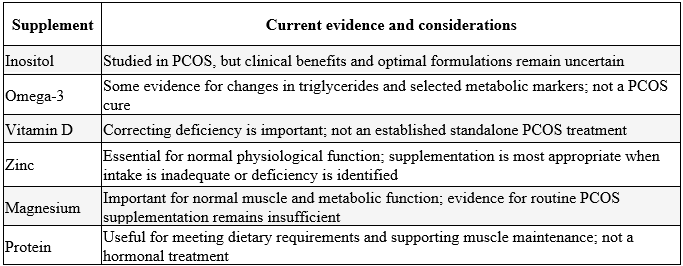
Omega-3 fatty acids have been investigated in PCOS for possible effects on triglycerides and metabolic and inflammatory markers. Results vary, and they should not be considered a treatment for PCOS itself.
D. Reduce excessive intake of highly processed foods
Frequent consumption of sugary beverages, sweets and highly refined snack foods can make it more difficult to maintain a balanced dietary pattern.
This does not mean all carbohydrates or traditional Indian foods should be eliminated.
Portion balance, dietary quality and consistency matter more than following a restrictive diet.
7. Exercise and Muscle: Why Resistance Training Matters
One of the most valuable lifestyle strategies for metabolic health is regular physical activity.
Muscle is an important site of glucose uptake. When muscles contract during exercise, they can take up glucose through pathways that do not depend entirely on insulin.
Over time, regular exercise can improve insulin sensitivity, cardiovascular fitness and physical function.
Why strength training deserves special attention
Resistance training helps develop and maintain skeletal muscle.
It may support:
- Better glucose regulation.
- Improved insulin sensitivity.
- Increased or maintained lean muscle mass.
- Better body composition.
- Bone health and functional strength.
- Healthy ageing.
Women with PCOS should not assume that cardio alone is sufficient.
A balanced exercise programme can include:
Resistance training: Two or three sessions per week, depending on ability and recovery.
Aerobic exercise: Brisk walking, cycling, swimming, dancing or other enjoyable activities.
Daily movement: Walking after meals, taking the stairs and reducing prolonged sitting.
The international guideline recommends aiming for 150–300 minutes of moderate-intensity aerobic activity per week, together with muscle-strengthening activities on at least two non-consecutive days.
For additional health benefits and modest weight management goals, higher activity levels may be appropriate where practical.
There is no single exercise programme that is best for every woman with PCOS. Consistency and individual suitability are more important than intensity alone.
8. Weight Management Without Extreme Dieting
Weight is a sensitive subject in PCOS, and it is important to avoid assuming that every woman with the condition needs to lose weight.
PCOS occurs in women across different body sizes.
For women who have excess weight or central adiposity, gradual, sustainable weight management may improve some metabolic and reproductive outcomes.
Even without weight loss, healthy eating and regular exercise can improve metabolic health.
A sensible approach includes:
- Eating balanced meals.
- Maintaining adequate protein intake.
- Increasing dietary fibre.
- Practising regular resistance training.
- Walking and remaining physically active.
- Prioritising sleep.
- Avoiding crash diets and unnecessary food restrictions.
Waist circumference and metabolic markers may provide additional information beyond weight alone, but they should be interpreted in clinical context.
The aim should be better health, not simply a smaller number on the weighing scale.
9. What About Metformin and Inositol?
Medical treatment may be appropriate depending on a woman’s symptoms, metabolic risk and reproductive goals.
Metformin
Metformin is a medication commonly used to improve glucose regulation in people with type 2 diabetes. It is also used in selected women with PCOS, particularly for metabolic indications.
The international guideline recommends considering metformin in adults with PCOS and a BMI of 25 kg/m² or above for metabolic and anthropometric outcomes, while recognising that it may also be considered in some women below this BMI with more limited evidence.
Possible benefits include:
- Improvements in glucose regulation.
- Improvements in some lipid measures.
- Support for metabolic health.
- Possible improvement in menstrual regularity in some women.
Metformin can cause gastrointestinal side effects, particularly when treatment begins or doses increase.
Long-term use may be associated with lower vitamin B12 levels, so monitoring may be appropriate in people with relevant risk factors.
It should only be used under medical supervision.
Inositol
Myo-inositol and D-chiro-inositol are compounds involved in cellular signalling and have been studied for their potential role in insulin signalling and reproductive function.
Some studies suggest possible improvements in selected metabolic or reproductive measures.
However, evidence remains uncertain regarding the most effective formulation, dose and clinical outcomes.
The international guideline considers the clinical benefits of inositol in PCOS limited and uncertain. It should not replace established medical treatment where that treatment is indicated.
Women considering inositol supplementation should discuss its suitability with their healthcare professional.
10. Other Medical Treatments for PCOS
Treatment should reflect the woman’s symptoms and priorities.
Depending on individual circumstances, a doctor may recommend:
Combined oral contraceptive pills: Can help manage irregular menstrual cycles and androgen-related symptoms such as acne and unwanted hair growth in suitable women.
Anti-androgen medications: May be considered for persistent hirsutism or other androgen-related symptoms when appropriate, with careful pregnancy-prevention precautions.
Ovulation-induction treatment: Women experiencing infertility due to anovulation may be offered treatments such as letrozole under specialist care.
Metabolic treatment: Metformin or other appropriate interventions may be considered according to individual metabolic risk and clinical indications.
PCOS treatment is not one-size-fits-all. Women should discuss reproductive plans, medication risks and treatment priorities with their healthcare team.
11. Sleep, Stress and Mental Wellbeing
PCOS can affect more than reproductive and metabolic health.
Women with PCOS have an increased prevalence of anxiety and depressive symptoms, and the international guideline recommends appropriate screening and support.
Sleep disturbances, including obstructive sleep apnoea, are also more common in PCOS.
Practical measures include:
- Maintaining a regular sleep schedule.
- Getting adequate sleep.
- Reducing prolonged sedentary time.
- Incorporating enjoyable physical activity.
- Seeking support for persistent anxiety, low mood or body-image concerns.
Stress management does not cure PCOS, but supporting psychological wellbeing is an important part of comprehensive care.
12. Supplements for PCOS: Evidence, Quality and Safety
The supplement market contains many products marketed for hormone balance, fertility, weight loss and insulin sensitivity.
It is important to distinguish between nutrients that support normal physiological function and products that have been shown to improve specific clinical outcomes.
Some areas of research include:
Choosing supplements responsibly
At Fitcart, we believe product quality and transparency are just as important as ingredient selection.
Where supplementation is appropriate, consumers should consider:
- Clearly declared ingredients and quantities.
- Transparent manufacturing and quality standards.
- Relevant independent batch-testing documentation.
- Verification of the specific product and batch through the certifier where applicable.
- Appropriate serving instructions and safety warnings.
- Potential interactions with medications and existing health conditions.
Certifications and testing programmes should be checked against the actual product and batch. A logo on packaging alone does not establish that every batch has been independently tested.
Supplements should complement a balanced diet and appropriate medical care, not replace them.
13. A Practical Indian Lifestyle Approach to PCOS
Managing PCOS does not require expensive foods, complicated meal plans or extreme exercise routines.
An everyday approach can be built around familiar Indian foods.
Breakfast: Moong dal chilla with curd, vegetable omelette or oats with nuts and seeds.
Mid-morning: Guava, apple, orange or another whole fruit.
Lunch: Dal, rajma or chole with vegetables, salad, curd and a suitable portion of roti or rice.
Evening: Roasted chana, nuts, plain yoghurt or another protein-rich snack.
Dinner: Fish, chicken, tofu or paneer with vegetables and a suitable portion of whole grains.
Physical activity: Regular walking, resistance training and enjoyable aerobic activity.
Recovery: Consistent sleep, stress management and adequate rest.
This is an illustrative approach rather than a prescribed diet. Food quantities should be adapted to individual energy needs, activity levels, preferences and medical requirements.
Fitcart’s Takeaway: Think Beyond Hormones – Support Your Metabolic Health
PCOS is a complex condition involving reproductive hormones, metabolism and, in some women, insulin resistance.
The connection between insulin and androgen activity helps explain why some women experience acne, unwanted facial hair, scalp hair thinning and changes in skin pigmentation.
However, these symptoms do not all occur in every woman, and no single symptom can diagnose PCOS.
A comprehensive approach combines appropriate medical assessment with sustainable nutrition, regular physical activity, resistance training, adequate sleep and attention to mental wellbeing.
For women who need them, medications and selected supplements can form part of a wider management plan under professional guidance.
At Fitcart, we believe informed nutrition, responsible supplementation and evidence-based lifestyle choices can help women make better decisions about their long-term health.
Fitcart.com – Science-backed nutrition. Trusted health. Better living.
Medical, Nutrition & Supplement Disclaimer
This article is intended for general educational and informational purposes only. It does not constitute medical advice, diagnosis, or treatment.
PCOS and insulin resistance require appropriate clinical assessment. Acne, weight changes, facial hair, and skin pigmentation alone cannot establish a diagnosis. Not all women with PCOS have insulin resistance or excess body weight.
Consult a qualified healthcare professional for menstrual irregularities, persistent acne, excessive facial or body hair, unexplained skin changes or concerns about metabolic health.
Medications such as metformin, hormonal contraceptives and anti-androgens must only be used under medical supervision. Supplements are not substitutes for diagnosis or treatment, and their benefits vary according to individual needs and product quality.
Consult a qualified healthcare professional before starting supplements, particularly if pregnant, planning pregnancy, breastfeeding, taking medication or managing an existing medical condition.
Follow us on X: https://x.com/fitcartofficial and Instagram: https://www.instagram.com/fitcartofficial/ for the latest updates, health insights, and exclusive content.
Follow Smart Nutrition India X: https://x.com/SmartNutrition1 and Instagram: https://www.instagram.com/smartnutritionindia/ for trusted sports nutrition, supplement education, wellness tips, and the latest news from the world of health and performance.
Fitcart believes in True Play and Clean Sport
#trustedbrandsbetterhealth