


Fitcart Editorial Team Ritu Makhija.
The Truth Behind “Made in India” Supplements: What Consumers Need to Know.
The Indian sports nutrition industry has grown rapidly over the past decade. Consumers are becoming more informed, athletes are demanding higher-quality products, and brands increasingly market themselves as “Made in India,” “Locally Manufactured,” “Clean,” and “Third-Party Tested.”
These claims are designed to build trust. They imply quality, accountability, and local production. But an important question often goes unasked:
How local is a supplement if the majority of its raw ingredients originate from overseas suppliers?
The answer highlights a growing challenge of transparency that affects athletes, testing authorities, regulators, and everyday consumers.
The Reality of Modern Supplement Manufacturing
Very few supplement companies anywhere in the world produce every ingredient themselves.
A typical sports nutrition product may contain:
- Whey protein sourced from Europe, New Zealand, or the United States
- Amino acids sourced from China or Japan
- Vitamins and minerals sourced from Europe
- Flavors and sweeteners sourced globally
- Specialty ingredients produced by international manufacturers
These ingredients are often imported into India as nutraceuticals or pharmaceuticals, blended, flavored, packaged, labeled, and sold as finished products.
Legally, many of these products can still qualify as manufactured in India because the final production process occurs domestically.
However, manufacturing location and ingredient origin are not the same thing.
Manufacturing vs. Sourcing: A Critical Difference
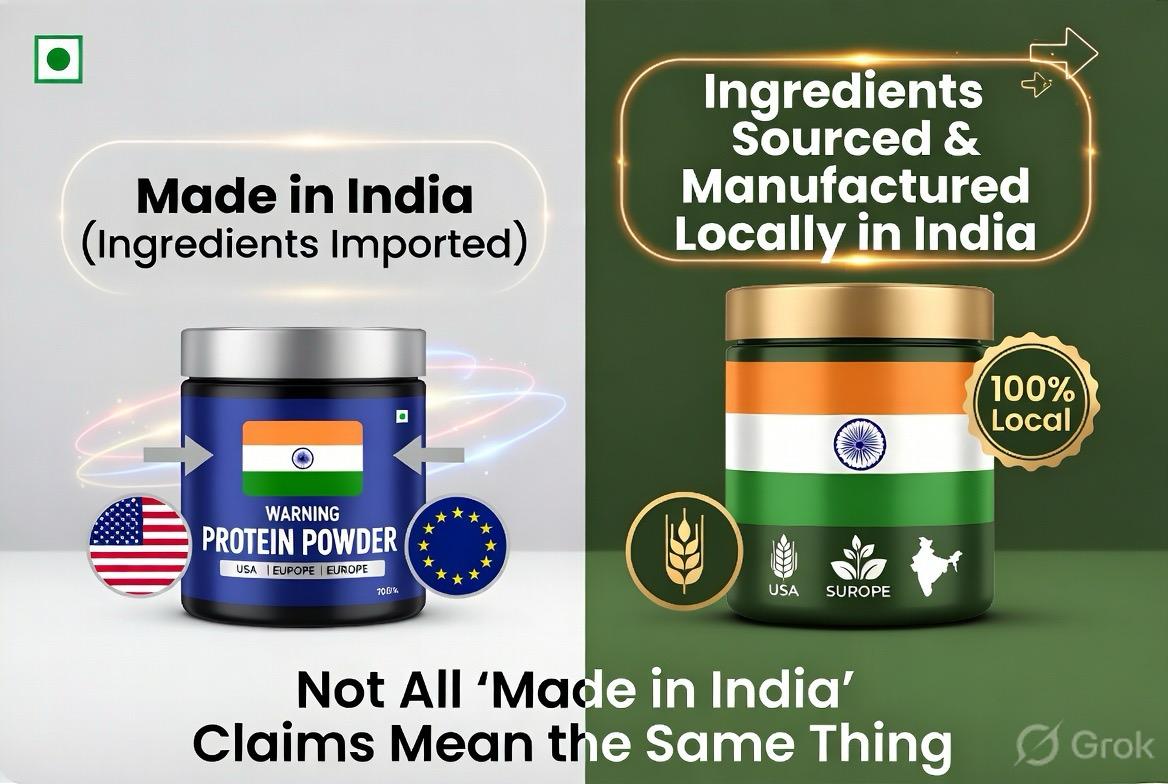
One of the biggest misconceptions in the sports nutrition industry is that “Made in India” automatically means the product’s ingredients are sourced from India.
In reality, a supplement can be:
- Manufactured in India
- Packaged in India
- Distributed in India
- Marketed as an Indian brand
While relying heavily on imported raw materials.
There is nothing inherently wrong with imported ingredients. In fact, many of the world’s most respected sports nutrition ingredients are produced by highly specialized international suppliers.
The issue is not importation.
The issue is transparency.
Consumers deserve to understand the difference between:
- Locally sourced ingredients
- Imported ingredients
- Locally blended products
- Fully integrated domestic manufacturing
Without this distinction, marketing claims can create a perception that may not accurately reflect the product’s actual supply chain.
Why Athletes Should Care
For athletes, sourcing is not simply a marketing issue. It is a performance and compliance issue.
Every stage of a supplement’s journey introduces potential risks:
- Supplier inconsistencies
- Cross-contamination
- Documentation gaps
- Transportation risks
- Storage issues
- Manufacturing errors
When ingredients travel across multiple countries and facilities before reaching the final consumer, maintaining complete traceability becomes increasingly important.
Athletes operating under anti-doping rules need confidence not only in the final product but in the entire supply chain behind it.
Is Final Product Batch Testing Enough?
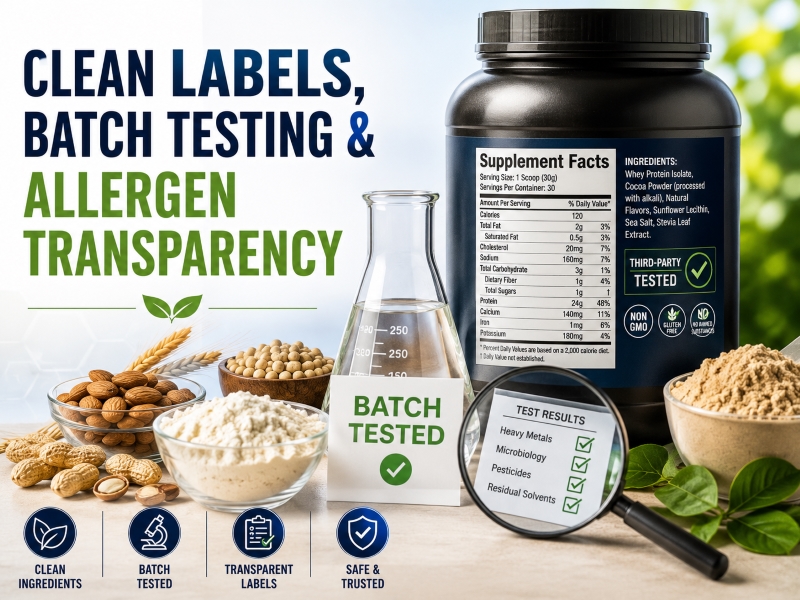
One of the most common quality claims in sports nutrition is third-party batch testing.
While final-product testing plays an important role in quality assurance, it should not be viewed as the sole indicator of product integrity.
Many raw materials already arrive from suppliers that have conducted their own testing and quality verification. These ingredients may then move through multiple stages of handling before becoming the finished product sold to consumers.
A batch test evaluates a sample from a finished production run.
What it may not fully reveal is:
- The quality systems of every supplier involved
- The conditions under which ingredients were transported
- Manufacturing hygiene controls
- Shared equipment risks
- Potential contamination points throughout production
A clean batch result is valuable.
However, it should not be mistaken for complete supply-chain transparency.
The Missing Piece: Facility and Process Verification
The sports nutrition industry often places significant emphasis on testing the finished product.
But contamination risks can occur long before a product reaches the testing laboratory.
Potential risk points include:
- Raw material storage
- Shared manufacturing lines
- Blending equipment
- Packaging facilities
- Transportation and warehousing
This is why many quality experts advocate for a broader approach that includes:
- Raw material verification
- Supplier qualification programs
- Manufacturing facility audits
- Cleaning and contamination-control validation
- Traceability systems
- Independent quality certifications
- Final product testing
Testing should be viewed as one layer of quality assurance—not the entire system.
The strongest quality programs evaluate not only the final product but also the environment, equipment, and processes used to create it.
The Rise of Transparency Marketing
Today’s consumers actively seek products that are:
- Clean
- Tested
- Certified
- Athlete-approved
- Pharmaceutical-grade
- Made in India
Unfortunately, these terms often lack detailed context.
A supplement may technically satisfy these claims while still relying on a complex international sourcing network.
Again, this does not automatically indicate poor quality.
The question is whether consumers are being provided with enough information to make informed decisions.
Transparency should extend beyond marketing slogans.
How Authorities Can Improve Oversight
Regulators and certification bodies have an opportunity to strengthen consumer confidence by enhancing supply chain visibility.
Potential improvements include:
- Ingredient-origin disclosure requirements
- Supplier qualification standards
- Manufacturing facility audits
- Enhanced traceability systems
- Verification of contamination-control procedures
- Greater transparency around testing methodologies
A more holistic approach would evaluate the entire production journey rather than focusing solely on the final packaged product.
How Athletes Can Protect Themselves
Athletes should look beyond front-label claims and ask deeper questions:
- Where was the protein sourced?
- Which company manufactured the raw material?
- Was the ingredient imported or domestically produced?
- Is the manufacturing facility independently audited?
- Are anti-contamination procedures documented?
- Is there complete batch traceability?
Brands that openly provide this information typically demonstrate a stronger commitment to transparency.
What Consumers Should Look For
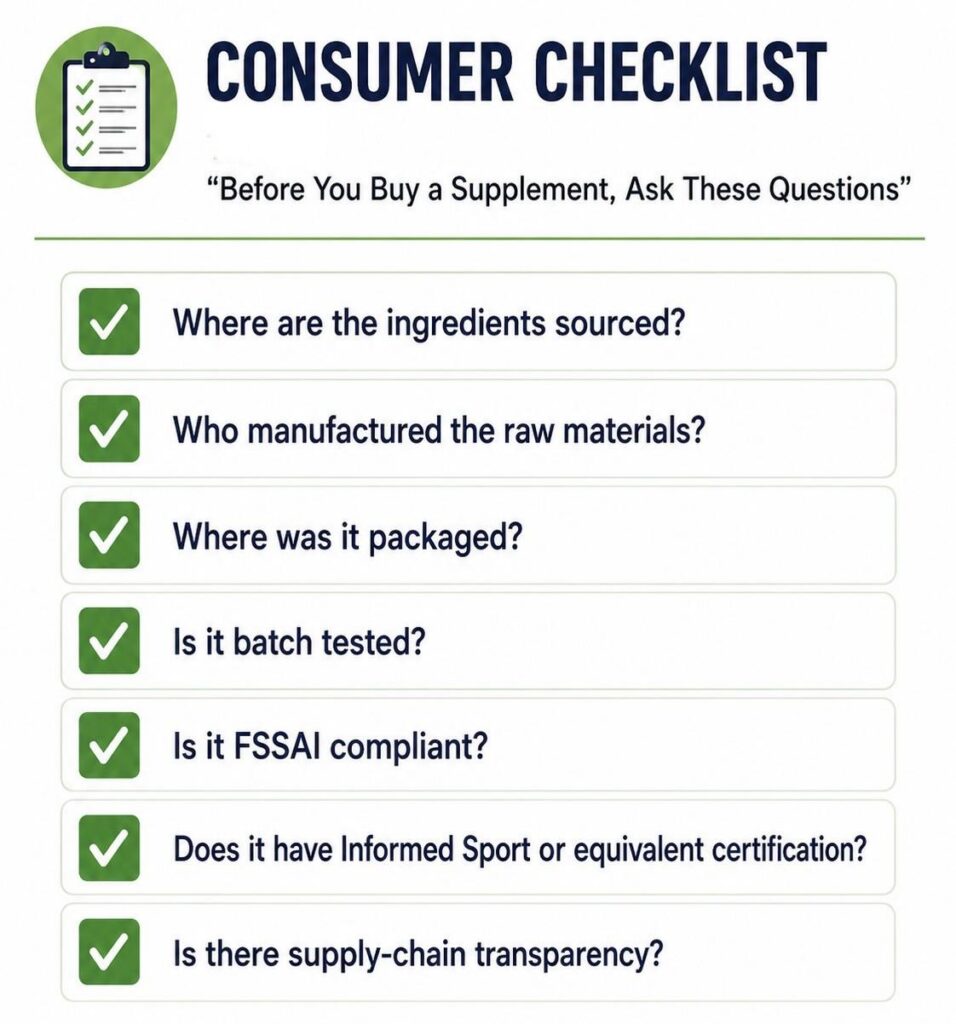
Before purchasing any sports nutrition product, consumers should consider:
- Country of origin for key raw materials
- Manufacturing location
- Packaging location
- Testing certifications
- Facility quality standards
- Regulatory compliance information
- Traceability documentation where available
The most trustworthy products are often those that provide clear and verifiable information rather than relying solely on marketing claims.
The Future of Trust in Sports Nutrition
India’s sports nutrition industry has made tremendous progress in quality, accessibility, and innovation.
However, as the industry matures, consumers are demanding something more valuable than marketing buzzwords.
They are demanding transparency.
The future of trust in sports nutrition will not be built on a single batch certificate or a country-of-origin claim.
It will be built on traceability, supplier accountability, manufacturing excellence, facility oversight, and honest communication.
Because informed consumers don’t just want supplements.
They want to know exactly where those supplements came from and how they were made.
FAQ’s
Q: Does “Made in India” mean all ingredients come from India?
A: Not necessarily. Many supplements are manufactured or packaged in India using ingredients sourced from international suppliers.
Q: Is batch testing enough to guarantee supplement quality?
A: Batch testing is an important quality-control measure, but it is only one part of a broader quality assurance system that may also include supplier verification, facility audits, and traceability programs.
Q: Why should athletes care about ingredient sourcing?
A: Ingredient sourcing affects traceability, quality control, and contamination risk, all of which are important considerations for athletes subject to anti-doping regulations.
Q: What should consumers check before buying supplements?
A: Look for ingredient origin information, manufacturing location, regulatory compliance, third-party certifications, facility standards, and independent testing where available.
Q: What certifications should athletes look for?
A: Depending on their needs, athletes may consider products associated with recognized testing and quality-assurance programs such as Informed Sport, Informed Manufacturer, or similar third-party verification systems.
FitCart Consumer Awareness Note
This article is intended solely for educational and informational purposes. Its purpose is to encourage transparency, consumer awareness, and informed decision-making within the sports nutrition industry.
Consumers, athletes, and fitness enthusiasts are encouraged to perform their own due diligence before purchasing any supplement product.
When evaluating a supplement, consider verifying:
The source country of key raw ingredients
The manufacturer of the raw materials
Where the product was blended, packaged, and labeled
Whether the product complies with applicable regulatory requirements
Whether independent batch testing has been conducted
Whether the manufacturing facility follows recognized quality-control standards
Whether the product carries certifications such as Informed Manufacturer, Informed Sport, LGC-associated testing programs, or other reputable third-party verification systems where applicable
Whether the product complies with applicable FSSAI labeling and manufacturing requirements in India
Transparency throughout the supply chain—from ingredient sourcing to final packaging—helps consumers make more informed decisions and supports higher standards across the industry.
Always consult qualified healthcare professionals before beginning any supplementation program, particularly if you are a competitive athlete or have existing medical conditions.
Follow us on X: https://x.com/fitcartofficial and Instagram: https://www.instagram.com/fitcartofficial/ for the latest updates, health insights, and exclusive content.
Follow Smart Nutrition India X: https://x.com/SmartNutrition1 and Instagram: https://www.instagram.com/smartnutritionindia/ for trusted sports nutrition, supplement education, wellness tips, and the latest news from the world of health and performance.
Fitcart believes in True Play and Clean Sport
#trustedbrandsbetterhealth