


KNOW YOUR NUTRITION — (KYN) — Collagen Educational Series by Fitcart.com
Fitcart Nutritional Guides
KNOW YOUR NUTRITION – COLLAGEN
Educational Series by Fitcart.com
After working closely with Indian athletes, teams, coaches, fitness enthusiasts, health experts, youth athletes and more over the duration of more than 18 years in the sports nutrition, fitness and health fields, We discovered there was a lack of knowledge backed by education with regard to understanding each nutritional component of food and sports nutrition.
The general awareness of nutrition and sports nutrition on how to consume? When to consume? What amount? and other necessities made us wonder: Why hasn’t anyone offered Indian consumers and athletes nutrition learning?
After collecting concepts, We determined to develop a series of nutritional guidelines addressing every component of nutrition and more specifically sports nutrition.
Fitcart’s Know Your Nutrition (KYN) Series offers readers an informed, science-backed resource to refresh their knowledge on a certain nutritional topic or component.
First, we want to emphasize the importance of batch-tested, lab-certified sports nutrition for both athletic performance and overall health. You can improve your athletic performance by taking a supplement that has a certificate of analysis from a reputable organization, such as LGC, Informed Sport or HASTA.
We promote True Play and Clean Sport along with WADA and we advise all athletes, fitness enthusiasts and anyone else to seek advice from a trained health and sports highly qualified professional before starting any program.
Always check the authenticity and efficacy of every one of your vitamins and supplements before consuming.
Fitcart.com we have a page dedicated to checking the batch number for your supplements to ensure this is authentic, this is called Check My Supplement https://www.fitcart.com/my-supp, and Trusted Health page for information on all the testing authorities https://www.fitcart.com/trusted-health.
Say ‘NO’ to Doping. True Play and Clean Sport.

We will cover a range of sports nutrition components –
- Creatine
- Glutamine
- Whey Protein
- Pre – Workouts
- BCAA’s
- EAA’s
- Plant Protein
- L- Carnitine
- ZMA
- Collagen
- Magnesium
- Co-Q 10
- Caffeine
- Hydration
Know Your Nutrition (KYN) – COLLAGEN
What is Collagen?
Collagen is a type of molecule. It is a fibrous, stiff and insoluble protein.
It is essential to many different structures including blood vessels, skin, tendons, cartilage, bones and connective tissue.
One of the main building blocks of the extracellular matrix, which is a web of molecules that holds the body’s tissues together are collagen.
Biochemistry, Collagen synthesis – https://www.ncbi.nlm.nih.gov/books/NBK507709/ (National Library of Medicine)
In humans, collagen is found in large quantities. Collagen makes up three-quarters of the dry weight of skin and one-third of the protein in the human body.
Why are Collagen levels in the body so important?
Healthy collagen levels support the following:
- Flexibility of the skin,
- Protection of the kidneys and other organs,
- A robust cardiovascular system,
- Joint health
What causes Collagen loss?
There are a number of factors that can cause low or no collagen production, including:
- Oxidative stress from the body’s metabolism.
- Dietary habits, consuming too many sugars and refined carbs.
- Smoking;
- Hormonal changes caused on by pregnancy, menopause and various other health-related conditions.
- The normal aging process.
- Sun exposure, since UV radiation can cause the skin’s collagen to break down.
- Low vitamin C levels due to health-related issues.
- Autoimmune diseases, rheumatoid arthritis, scleroderma.
- Genetic mutations which lead to health related conditions, Ehlers-Danlos syndrome and osteogenesis imperfecta.
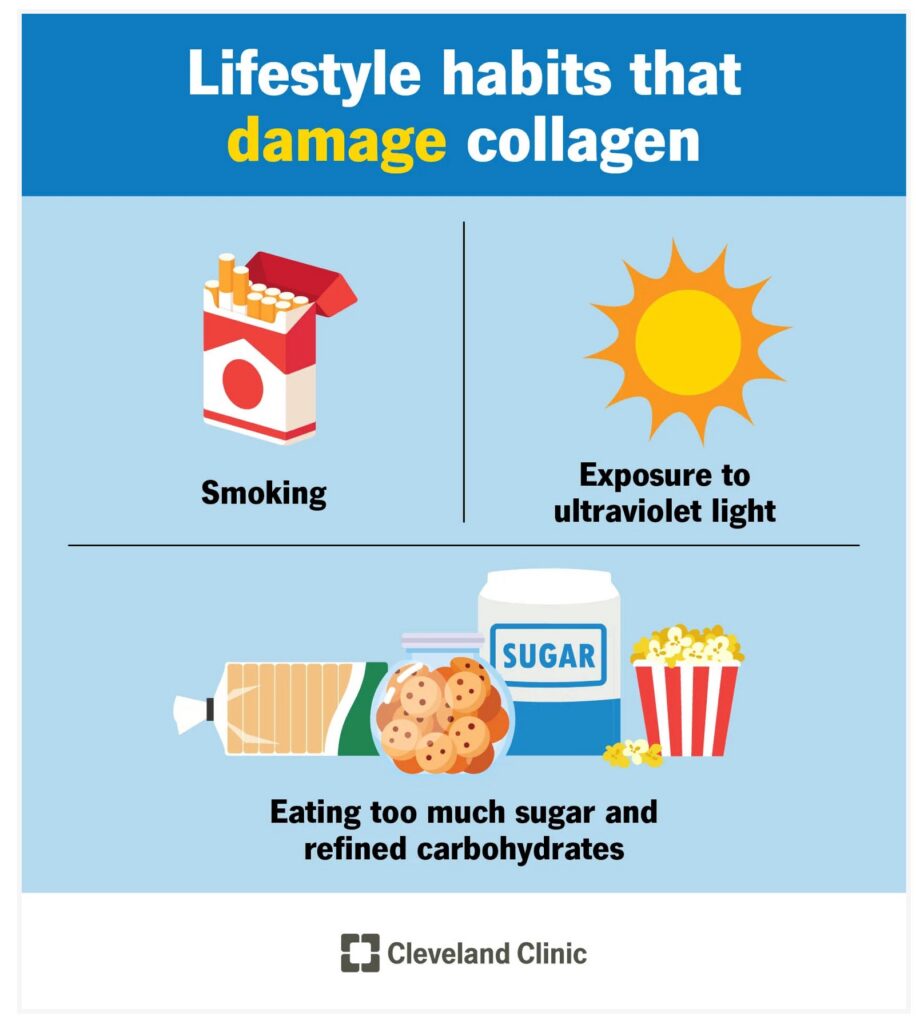
(Lifestyle habits that damage Collagen levels in the body, source Cleveland Clinic)
Which foods can I eat which contain Collagen?
Your body is unable to absorb collagen in its whole. The collagen proteins you eat are broken down by your body into amino acids. Thus, increasing the consumption of foods high in collagen is not going to increase your body’s collagen levels.
However, a balanced diet may consist of a variety of foods that include the natural elements needed to support the creation of collagen.
Foods high in Proline, Glycine, Copper, Zinc, Vitamin C :
Certain vitamins, minerals, and amino acids can be found in the following foods:
- Broccoli, Brussels sprouts, oranges, strawberries, bell peppers, and potatoes all contain vitamin C.
- Mushrooms, cabbage, asparagus, peanuts, wheat, seafood, egg whites are foods high in Proline.
- Glycine is found in red meats, turkey, chicken and pork skin, peanuts and granola.
- Liver, lobster, oysters, shiitake mushrooms, nuts, seeds, leafy greens, tofu, and dark chocolate are foods high in copper.
- Red meat, chicken, pork, beans, chickpeas, almonds, broccoli, green leafy vegetables, whole grains, and dairy products are good sources of zinc.
Collagen Supplementation – How Much? Benefits and Vegan Options?
(Also Read, The Nutrition Source, Harvard School of Public Health) https://www.hsph.harvard.edu/nutritionsource/collagen/
How Much Should I Take Into My Diet?
Adults can safely ingest 2.5 to 15 grams of collagen each day, according to research. To find out how much is in your supplement, read the label. A lot of people consume one to two tablespoons of collagen powder daily.
Heath Benefits of Collagen (Source WebMD) https://www.webmd.com/diet/collagen-health-benefits
Benefits of Collagen Supplementation
There are many benefits to collagen supplementation, these include:
- Gut Health
- Brain Health
- Weight Loss
- Hair and nails growth
- Heart health
- Joint health
- Boost muscle mass
- Prevent bone loss
- Improve skin health and quality
What about collagen for Vegans?
Since collagen is a protein that can only be found in animals it cannot be vegan or vegetarian.
There are vegan collagen boosters available on the market. Although they don’t include collagen protein, these collagen boosters are vegan. They only encourage the synthesis of collagen. It is not the same, and its advantages might not be the same either.
For supplementation you can only use collagen boosters as an addition you can also opt for a range of foods including fruits, vegetables, tempeh, legumes, and tofu in your diet that can help to naturally increase your production of collagen.
Fitcart believes in True Play and Clean Sport
#trustedbrandsbetterhealth
All our nutritional information is scientific and evidence-based, to be used as a dietary guide. Before starting any new diet or fitness regime, we recommend consultation with a certified healthcare professional.