



Sustainable dietary choices depend not only on carbon footprints per unit mass, but should consider an overall perspective including lowest “societal cost”, nutrient content and retail price, study reveals. Taking this broader perspective may change the optimal sustainable dietary choices.
Article by Yogurt Nutrition
Many people think of sustainable foods as those that simply have a small carbon footprint. But when it comes to advising them about their planet-friendly food choices, a much more complex picture is emerging, say researchers from The Netherlands. They’ve taken a deep dive into the sustainability profiles of foods, using semi skimmed milk and plant-based beverages as case studies – with unexpected results.
Their findings provide fresh insights that will empower consumers and healthcare professionals to make informed decisions in the pursuit of a healthier and more sustainable future.
The research also underscores the importance of adopting a holistic approach when evaluating the sustainability of dietary choices, incorporating nutritional content, environmental impact and economic costs associated with foods and drinks.
For example, it’s not just the food’s composition that matters: the availability and uptake of nutrients in the body and the potential synergistic effects of components in the food matrix may also play a crucial role.
Mounting concerns over climate change drive the pursuit of sustainable diets
As concerns mount over climate change, the search for more sustainable food systems is becoming more intense. One manifestation of this is the drive to switch away from animal-based proteins towards more plant-based proteins.
The improvement in sustainability tends to be measured by the greenhouse gas emissions (GHGs), and generally plant-based alternatives have smaller footprints than cow’s milk [2]. But it’s not as simple as measuring emissions in relation to weight of a food product, say the researchers. Because of the lower nutrient density of many dairy alternatives, the gap narrows when considering emission per amount of nutrients [3].
Environmental impacts of food products have many variables. For dairy milk, GHGs can vary according to the production chain, the geographical region, and milk production per cow [4]. Similarly, the carbon footprint of plant-based alternatives varies between regions, depending on their source, yield per hectare, energy used, and soil treatment.

Multiple components are needed to build a sustainability profile
With this in mind, the researchers used multiple criteria to build full sustainability profiles of semi-skimmed cow’s milk and several plant-based beverages in both fortified and non-fortified formulations – including oat, soy, rice, coconut, and almond drinks. For one serving of each product, they assessed the Nutrient Rich Food (NRF) score, protein digestibility, and essential amino acid content.
Next, they calculated the true price of each product, converting carbon footprints to euros using the European Union Emissions Trading System, and adding them to supermarket prices. The environmental costs were based on GHGs associated with production, land use, and water consumption. These environmental impacts were assessed throughout the entire life cycle of each beverage, from raw material extraction and production, to distribution and consumption.
“The comprehensive method used, which considers retail price, environmental costs, and nutrient content, demonstrates that, in terms of sustainability, choosing a serving of semi-skimmed milk remains the optimal choice. Following this, soy-based beverages represent the next best alternative.‘’ – de Jong P, et al., 2024
Cow’s milk and plant-based drinks each have advantages
The carbon footprint of plant-based beverages is lower per unit mass than that of semi-skimmed milk. However, the analysis showed that to achieve the same NRF score the consumer would need to drink more servings of unfortified plant-based beverages than semi-skimmed milk, resulting in larger carbon footprints. The exception was soy drink – but when emerging farm practices were taken into account, semi-skimmed milk and soy drinks showed similar carbon footprints for a given NRF score.
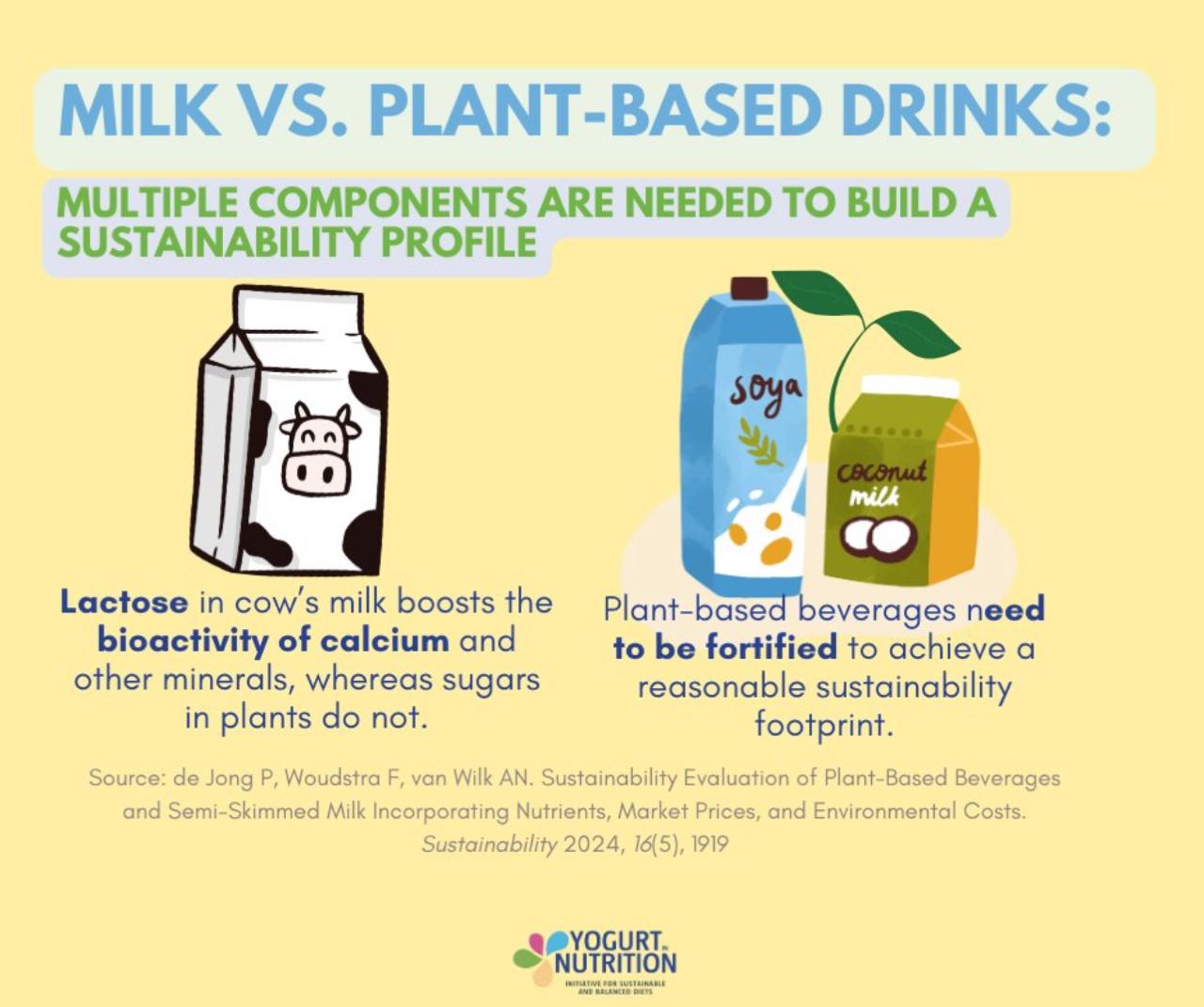
Among fortified plant-based beverages, the nutrient-based footprint of soy, oat, and almond beverages was smaller than that of semi-skimmed milk, while coconut and rice had larger footprints. These findings underscore the need for plant-based beverages to be fortified to achieve a reasonable sustainability footprint, the researchers say.
When combining the economic costs of environmental impact with the price consumers have to pay for these products, semi-skimmed milk emerged as the best choice.
A mix of plant- and animal-sourced foods for the future diets
The findings suggest that, although popular as an alternative to milk, plant-based beverages should not necessarily be seen as a replacement for cow’s milk. If people consume plant-based drinks without compensating with other food sources, they risk having insufficient nutrient intake [5-8].
Soy seems to have the highest potential to become a basis for sustainable plant-based drinks, in addition to cow’s milk.
Semi-skimmed milk belongs to the group of food products with the best value for money.
In reality, the growing world population implies that we need to find best use of available land and future diets are likely to contain a mix of plant-based and animal-based foods. It’s also important to remember that the bioactivity of nutrients is influenced by other components in the food matrix. For example, lactose in cow’s milk boosts the bioactivity of calcium and other minerals, whereas sugars in plants do not, the researchers say.
Sustainable dietary guidelines should not only recommend foods with lower carbon emissions per unit mass, but take time to consider the broader perspective including national values. The researchers call for more research to learn how the food matrix modulates nutrient bioavailability and effectiveness.
Fitcart believes in True Play and Clean Sport
#trustedbrandsbetterhealth