


Article by Dr. Rob Wildman.
Dr. Rob Wildman answers questions on protein use for body fuel and what happens during calorie imbalances exercise and performance basics. These Q&As can also be found in The Nutritionist: Food, Nutrition & Optimal Health and TheNutritionDr.com.
Is protein used for body energy?
When needed, as well as with excess intake, amino acids can be used for energy purposes. For a typical adult diet, about 20 to 40 grams of protein in the form of free amino acids is utilized each day as an energy resource. Furthermore, if the diet either has a higher level of protein, either total grams or as a percentage of calories, more protein derived amino acids would be used in this manner. In these situations, more of the amino acids being used for energy would be derived from the diet.
PROTEIN PLAYS MOSTLY STRUCTURAL AND FUNCTIONAL ROLES IN THE BODY WHILE MOST OF BODY FAT AND NEARLY ALL CARB IS PURPOSED AS FUEL
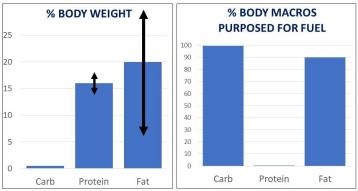
Blue bars based on typical values for generally healthy, lean adult. Directional arrows on the left indicate flexibility.
If diet energy is limited, such as during planned weight loss, more amino acids would be used for daily energy. In this case, body protein can provide more of the amino acids used for energy simultaneous to the breakdown of body fat. One strategy to help minimize to loss of body protein during caloric restriction is to plan for more of the diet calories to be derived from protein. Furthermore, resistance exercise will help minimize the loss of skeletal muscle protein.
What happens if we do not eat enough protein?
To create daily body protein balance, our diet needs to replace a quantity of protein equivalent to what is lost to 1) energy demands, 2) modified amino acids in proteins that can’t be recycled, 3) processes that produce amino acid-derived molecules such as neurotransmitters, nucleic acids, some hormones, niacin, etc., 4) metabolized by bacteria and lost in digestive waste. Since these processes are continuous as is protein production in trillions of cells throughout the body, the goal should be to provide ample nourishment of dietary protein for as much of the total day (24-hours) as possible.
If protein intake is limited below needs to create balance to offset what is lost, over time total body protein will be reduced. This would be visually obvious as skeletal muscle mass is reduced. If the deficiency continues, the level of various proteins in blood would decrease and our immune system could become compromised, leaving us more prone to infections.
What happens to body protein when we don’t eat enough calories over short periods (1-2 days)?
Situations can occur that increase the use of body protein for energy. Eating too few calories or fasting increases the reliance on body protein as an energy source. In these situations, the level of circulating glucagon and cortisol increase. Cortisol, the stress hormone, will promote the breakdown of our body proteins to amino acids. This is especially true in skeletal muscle. Meanwhile, both hormones promote the conversion of amino acids to glucose in our liver which is released to serve as fuel.
The amount of amino acids used to make glucose is related to the length and degree of caloric restriction and the intensity and duration of exercise. Simply stated as glycogen stores in the liver and muscle become depleted as in prolonged fasting and aerobic exercise the reliance upon amino acids to make glucose increases. Most amino acids derived from the breakdown of body protein can be used to make glucose.
Calorie Balance Model for Weight Gain vs Weight Loss
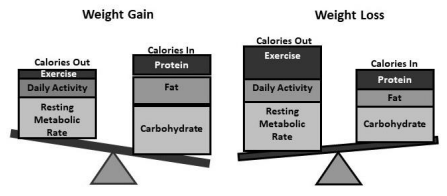
Weight Gain is caused by an energy imbalance, whereby the number of calories that our body burns is less than those coming into our body (food).
Weight Loss is caused by an energy imbalance, whereby the calories burned by the body (metabolism) exceeds the calories brought into the body in food.
Note: the mild resting metabolism and low level of daily activity and exercise in the weight gain imbalance and the increase in exercise and physical activity driving higher Calories Out in the weight loss.
What happens to body protein when we don’t eat enough calories over longer periods (e.g.>week)?
During a longer period of fasting (e.g. more than a week) the reliance on amino acids lessens as our brain adapts to utilize more ketone bodies. This is one way that our body attempts to slow the loss of protein, however the use of amino acids for energy is still greater than during more normal times. Seven amino acids can be utilized to make ketone bodies which is happening simultaneously with the conversion of amino acids to glucose.
If the loss of body protein continues for months a person can reach a critical level of body protein whereby normal function is compromised and illness can occur, and over more protracted periods death is possible. Even if the cause of death is due to an infection, the true cause is probably a failure to maintain an optimal immune defense because of poor protein status.
What happens to body protein when we exercise?
During more intense exercise, such as endurance training/competition and heavy, prolonged resistance or intermittent high intensity efforts, muscle protein breakdown is increased. Six amino acids, including the BCAAs, can be used for energy by the active muscle cells. Meanwhile, there is some amino acid release into the blood, most of which are alanine and glutamine. Alanine is one of the principle amino acids used to make glucose in the liver and the new glucose can help maintain blood glucose levels and fuel muscle. This process is driven by primarily by cortisol as well as epinephrine, both of which are elevated in circulation during exercise.
Cortisol promotes muscle protein breakdown during the exercise while epinephrine promotes the conversion of amino acids to glucose in the liver. Since cortisol is a stress related hormone, the degree to which this happen depends on how hard you are exercising and for how long. Thus, for shorter, less intense exercise sessions (e.g. walking, casual bicycling) this isn’t a consideration; however, for more serious competitive endurance athletes it is.
What happens to the nitrogen when amino acids are used for energy purposes?
The composition of elements in amino acids differs from carbohydrate and fat, as they contain nitrogen (N). This creates an additional consideration for the body when amino acids are used for energy or the make glucose or ketones depending on the metabolic state. (e.g. fasting, exercise, etc). An important step in using amino acids for any of these purposes is to remove the nitrogen-containing portion of the molecule. The removed nitrogen portion of amino acids will become ammonia (NH4+), which is potentially toxic to the brain. Thus, it must be removed from the body before it builds up in the blood.
The most prevalent way to rid the body of the nitrogen removed from amino acids is as urea. Urea is made by the liver and released into the blood, circulates to the kidneys and is subsequently lost from the body in urine. Each molecule of urea allows us to efficiently remove two nitrogen atoms from our body. The urea content of the urine is called Blood Urea Nitrogen (BUN) and is often used in clinical assessments.
How important is protein during weight loss?
Protein is advantageous to weight loss for a couple of reasons. First, when a meal derives more of its calories from protein, versus saturated fat and simpler carbohydrates, it supports greater satiety (fullness) as well as hunger reduction for the hours that follow. Furthermore, amino acids require special (energy requiring) processing if they are to be used for energy, plus they support optimal body protein manufacturing, which is energy costly as well.
All of this means that more calories are burned to use food protein for energy, as well as for protein to do its job in maintaining and building body protein. This may support greater weight loss over time, or at least create a potential for better outcome versus keeping the protein contribution lower during calorie restriction. Furthermore, eating more protein during weight loss may help a person maintain or slow the loss, of metabolically active lean body mass, including muscle mass, during the process. Muscle mass retention is more realistic when the caloric restriction is moderate combined with protein levels approximating at least double the RDA and combined with resistance exercise.
The International Protein Board (iPB) recommends at least 1.4-1.6g per kilogram of near future targeted body weight when calories are restricted. This will help preserve leaner body mass such as skeletal muscle.
Protein Recommendations of the International Protein Board (iPB) for Different Populations.
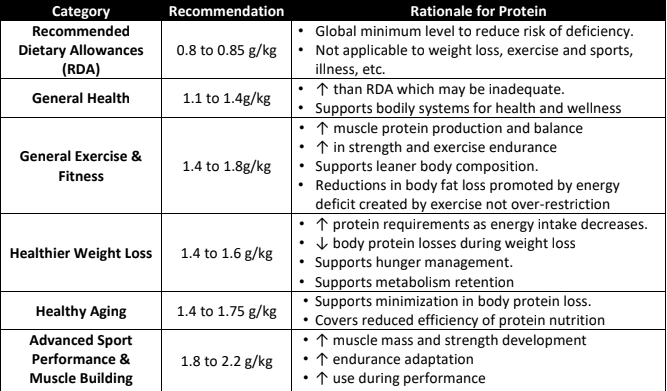
*g/kg = grams of protein per kilogram body weight
Derived from the International Protein Board (www.InternationalProteinBoard.org). Protein recommendations are not intended to exceed 35% of calories.
All our nutritional information is scientific and evidence-based, to be used as a dietary guide. Before starting any new diet or fitness regime, we recommend consultation with a certified healthcare professional.
Follow us on X: https://x.com/fitcartofficial and Instagram: https://www.instagram.com/fitcartofficial/ for the latest updates, health insights, and exclusive content.
Follow Smart Nutrition India X: https://x.com/SmartNutrition1 and Instagram: https://www.instagram.com/smartnutritionindia/ for trusted sports nutrition, supplement education, wellness tips, and the latest news from the world of health and performance.
Fitcart believes in True Play and Clean Sport
#trustedbrandsbetterhealth