


Fitcart Editorial Team Ritu Makhija.
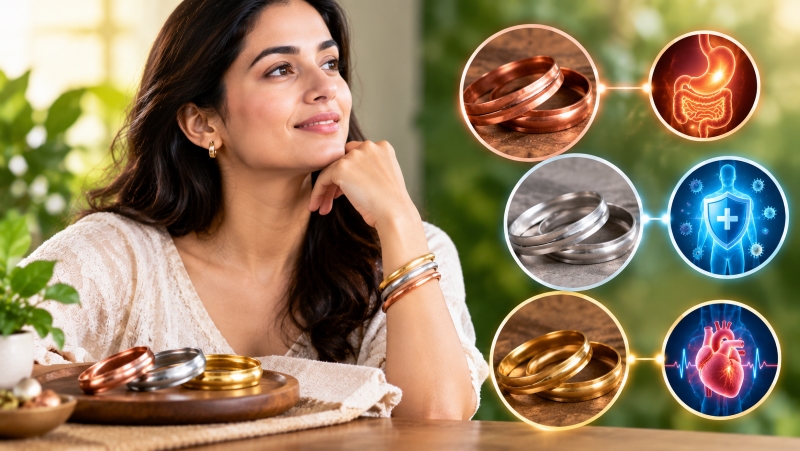
For centuries, people across different cultures have worn copper, silver and gold not only as jewellery, but also because these metals have been associated with health, healing, protection and wellbeing.
Copper bracelets have traditionally been associated with joint health. Silver has a long history in medicine because of its antimicrobial properties, while gold has been valued not only for its beauty but also for its use in traditional and medical applications.
But what does modern science actually tell us?
Can simply wearing a copper bracelet, silver chain or gold ring influence the body?
The answer is more nuanced than many health claims suggest.
Copper: An Essential Mineral With Interesting Biological Properties
Copper is an essential trace mineral. The body requires copper for several important biological functions, including energy production, connective-tissue formation, blood-vessel health, nervous-system function and immune function.
Copper is therefore genuinely important to human health.
But this does not automatically mean that wearing copper jewellery provides the body with meaningful amounts of copper.
Copper bracelets have been particularly popular among people interested in joint health and arthritis. However, controlled clinical research has not demonstrated a meaningful therapeutic effect from wearing copper bracelets.
A randomized, double-blind, placebo-controlled crossover study involving people with osteoarthritis found that copper bracelets did not produce meaningful improvements in pain, stiffness or physical function compared with control devices.
Similarly, a randomized controlled study involving people with rheumatoid arthritis found no significant differences in pain, inflammation, physical function, disease activity or medication use between copper bracelets and control devices.
So, does copper jewellery have health benefits?
Copper itself is unquestionably important nutritionally.
However, there is currently insufficient evidence to conclude that wearing copper jewellery provides systemic health benefits comparable to obtaining copper through food or medically indicated supplementation.
For nutritional copper, food remains the evidence-based route. Good sources include nuts and seeds, shellfish, whole grains, chickpeas, mushrooms, potatoes and other foods.
Silver: A Metal With Genuine Antimicrobial Properties
Silver is particularly interesting because its biological activity is much better established than many claims surrounding jewellery.
Silver ions can have antimicrobial effects against a broad range of microorganisms. This is one reason silver-containing materials have been used in wound-care products.
Modern silver dressings can be used in specific clinical circumstances, particularly where controlling microbial burden is important. Research has investigated their role in burns, infected wounds and other types of wound care.
More recent evidence also suggests that certain silver-containing dressings can reduce surgical-site infection risk, although the effectiveness depends on the specific product, formulation and clinical circumstances.
But there is an important distinction:
Silver used in a medically designed wound dressing is not the same thing as wearing a silver bracelet or chain.
The antimicrobial activity of a clinical dressing depends on factors such as silver ions, formulation, concentration, release characteristics and contact with the wound.
That doesn’t mean ordinary silver jewellery provides the same antimicrobial effect.
Research also indicates that intact skin is an effective barrier against silver absorption, meaning that simply wearing silver jewellery should not be assumed to deliver significant amounts of silver into the body.
Silver and skin
Silver jewellery can nevertheless be useful from a practical perspective because silver itself has antimicrobial properties. However, the real-world health significance of this property when wearing ordinary jewellery remains uncertain.
Jewellery hygiene still matters. Sweat, oils, cosmetics and microorganisms can accumulate on jewellery and the skin beneath it.
So cleaning jewellery and maintaining good skin hygiene are considerably more important than assuming the metal itself is providing medical protection.
Gold: More Than a Precious Metal?
Gold has occupied a fascinating position in traditional medicine and modern science.
Historically, gold has been used in various medical and therapeutic contexts. Gold compounds have also been investigated and used medically in specific circumstances.
But that should not be confused with the idea that wearing gold jewellery improves general health.
There is currently no strong evidence that wearing a gold necklace, bracelet or ring improves immunity, circulation, energy levels, ageing, hormonal balance or overall health.
Gold can also be relevant to dermatology.
Some people develop contact sensitivity associated with gold exposure or gold compounds. A 2024 systematic review and meta-analysis found gold contact allergy in a proportion of patients evaluated for dermatitis, although the researchers emphasized that positive patch tests do not always translate into clinically relevant reactions to everyday gold exposure.
Interestingly, emerging 2026 research examining pure metallic gold particles found no allergic reaction in the study group, suggesting that reactions detected with gold salts do not necessarily mean that pure metallic gold itself is an allergen.
This highlights an important point:
“Gold allergy” is more complicated than simply saying that someone is allergic to gold jewellery.
The purity of the metal, alloy composition, other metals present and individual sensitivity can all matter.
What About Traditional Beliefs?
Copper, silver and gold have been used in traditional health systems for centuries.
In Ayurveda and other traditional practices, metals have sometimes been associated with specific energetic, protective or therapeutic properties.
These traditions are culturally important and form part of a long history of human interaction with metals.
However, traditional use and modern clinical evidence are not the same thing.
A traditional practice may provide an interesting hypothesis for scientific research, but it should not automatically be considered a clinically proven treatment.
This distinction is particularly important when jewellery is promoted as being capable of treating arthritis, improving circulation, removing toxins, balancing hormones or preventing disease.
At present, many of these claims remain unproven or insufficiently supported by high-quality clinical evidence.
Could Wearing Metals Have Indirect Benefits?
Even when a piece of jewellery does not have a proven pharmacological effect, wearing it may have personal or psychological significance.
A particular bracelet, ring or necklace might be associated with:
- cultural identity
- family traditions
- spirituality
- personal rituals
- mindfulness
- confidence
- emotional connection
- a reminder to focus on wellbeing
These effects can be meaningful to an individual without requiring the metal itself to have a biological therapeutic effect.
For example, someone who wears a particular bracelet as a daily reminder to exercise, meditate or maintain healthy habits may experience a genuine behavioural benefit.
But that would be an indirect behavioural or psychological association, rather than evidence that the metal itself is treating a health condition.
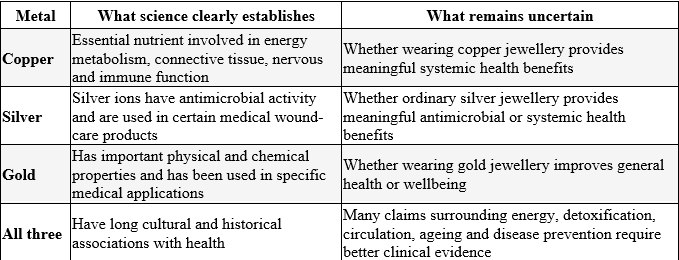
Copper, Silver and Gold: What Does the Evidence Actually Say?
The Fitcart Perspective: From Tradition to Evidence
At Fitcart, we believe that health and wellness should be approached with curiosity without losing scientific perspective.
Copper, silver, and gold are fascinating materials with genuine biological and medical properties.
Copper is an essential mineral. Silver has well-established antimicrobial activity in certain medical applications.
Gold has important applications in science, medicine and materials research.
But the biological properties of a metal do not automatically mean that wearing that metal as jewellery produces the same effect in the human body.
This is where evidence matters. When evaluating any health claim, it is useful to ask:
What is the mechanism?
Has it been demonstrated in humans?
Was the research randomized and controlled?
Was the metal actually responsible for the observed effect?
Was the metal used as jewellery, a supplement, a medical device or a specialized clinical formulation?
And perhaps most importantly:
Is the evidence strong enough to justify the health claim being made?
Jewellery Is Not a Substitute for Nutrition or Healthcare
Wearing a copper bracelet cannot replace obtaining adequate copper through a balanced diet.
Wearing silver jewellery cannot replace appropriate wound care or infection treatment.
Wearing gold cannot substitute for exercise, good nutrition, sleep or medical care.
For people interested in metals and wellbeing, the most evidence-based approach is to appreciate the fascinating science behind these elements while remaining cautious about claims that go beyond the research.
The Bottom Line
Copper, silver and gold have much more to offer science than simply their appearance.
Copper is an essential nutrient involved in numerous physiological processes. Silver has genuine antimicrobial properties that have found applications in modern wound care. Gold has fascinating chemical and biological characteristics and important specialized medical applications.
But wearing these metals as jewellery is not currently supported by strong evidence as a treatment for disease or as a way to significantly improve overall health.
The most sensible approach is therefore not to dismiss the centuries of interest in these metals, but to separate traditional belief, biological plausibility and proven clinical benefit.
That distinction is at the heart of evidence-based wellness.
Fitcart — Connecting consumers with trusted, evidence-informed health, nutrition and wellness choices.
Fitcart Health Disclaimer
This article is intended for general educational and informational purposes only and is not medical advice. Traditional uses and emerging scientific hypotheses should not be interpreted as proven medical benefits. Wearing copper, silver or gold jewellery should not be used to diagnose, prevent or treat a medical condition or as a substitute for appropriate nutrition or professional healthcare. Individuals with skin sensitivity, allergies or persistent skin reactions should discontinue use and seek advice from a qualified healthcare professional. Evidence relating to metals can vary substantially depending on the form, dose, route of exposure and intended application; evidence from medical devices or wound-care products should not automatically be extrapolated to ordinary jewellery.
Follow us on X: https://x.com/fitcartofficial and Instagram: https://www.instagram.com/fitcartofficial/ for the latest updates, health insights, and exclusive content.
Follow Smart Nutrition India X: https://x.com/SmartNutrition1 and Instagram: https://www.instagram.com/smartnutritionindia/ for trusted sports nutrition, supplement education, wellness tips, and the latest news from the world of health and performance.
Fitcart believes in True Play and Clean Sport
#trustedbrandsbetterhealth